


Only 10 states are seeing downward trends in new Covid-19 cases, and NYC now has a surge
Only 10 states are showing downward trends in new cases — Arizona, Florida, Georgia, Tennessee, Virginia, Connecticut, Vermont, New Hampshire, Delaware and Maryland — and 19 states are holding steady.
But in many states, “it’s not only that the number of infections keeps on going up. It’s also that the test positivity rates are trending in the wrong direction,” emergency medicine physician Dr. Leana Wen said Monday.
“We’re seeing more than a dozen states with a test positivity is over 10%. And there are two states — Idaho and South Dakota — where the test positivity is over 20%,” Wen said.
“That means that not only do we have increasing infections in these states, we also don’t have nearly enough testing.”
Cases ‘grow at an alarming rate’ in parts of NYC
For the first time since early June, New York state reported more than 1,000 new cases Saturday — prompting Gov. Andrew Cuomo to warn that this virus “remains a force to be reckoned with throughout the country.”

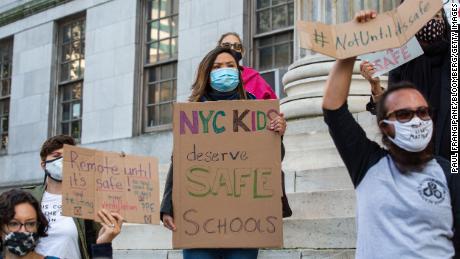
“It’s vital that New Yorkers continue to practice the basic behaviors that drive our ability to fight Covid-19 as we move into the fall and flu season,” Cuomo said. “Wearing masks, socially distancing and washing hands make a critical difference.”
In response, the department said it will deploy 11 mobile testing units this week to areas with high positivity rates and triple the capacity of “express” testing sites in some areas.
New York state boasted a test positivity rate of less than 1% for more than a month. But that streak has been broken, with the test positivity rate hovering around 1.02% in recent days.


“We cannot drop our guard,” Cuomo warned.
That’s especially true as public schools in New York City reopen to students this week. But officials could decide to close schools, limit gatherings and issue fines for not wearing masks.
Coronavirus and children
Children account for about 10% of coronavirus cases, but people should still pay attention to virus spread in that age group, Dr. Anthony Fauci said Monday.
“Children do get infected. And we’d better be careful about just dismissing infection in children,” Fauci told CNN’s Brian Stelter, adding “It is unclear the degree to which they transmit” the virus.
Some studies suggest they don’t do it as “efficiently” as adults, said Fauci, who is director of the National Institute of Allergy and Infectious Diseases and a member of the White House Coronavirus Task Force.
“But it’s an evolving situation,” and “you have got to keep an open mind when it comes to an issue like what the role of children is in transmission.”
The US Centers for Disease Control and Prevention published a report Monday that said Covid-19 among adolescents ages 12 to 17 was almost double the cases in children ages 5 to 11.
The report included data on 277,285 laboratory-confirmed cases among school-aged children in the United States from March 1 to September 19. Among those cases, 37% were in children ages 5 to 11 and 63% were in adolescents.
The data might underestimate the true incidence of disease among school-age children, as testing was often prioritized for people with symptoms, and those without may not have been tested, the researchers noted.
Authorities crack down on large gatherings


Now authorities are stepping up efforts to end gatherings where the virus can easily spread.
Sheriff’s deputies broke up a wedding of about 300 people Friday evening in Queens, New York City Mayor Bill de Blasio’s office said.
Both the owner and manager of the venue face multiple misdemeanor charges.
In Maryland, a man was sentenced to a year in prison Friday after holding two large parties in late March in violation of the state’s social distancing rules, which banned gatherings of more than 10 people, Gov. Larry Hogan’s office said.
The man started arguing after he was told to disband his first party of about 50 people, the state attorney’s office said. Five days later, he held a second party of more than 50 people that he refused to end, saying they had a right to congregate.
CNN’s Laura Ly, Sheena Jones, Anna Sturla, Dakin Andone, Chuck Johnston, Jacqueline Howard and Maggie Fox contributed to this report.