

Call for countries to phase out fossil fuel subsidies stays in latest COP26 draft deal
Alok Sharma urges nations to accept climate deal as COP26 goes into extra time and India hits out against new rules on fossil fuels
Alok Sharma urged other nations to ask if the draft agreement does enough, rather than what more they can getChina’s representative said though draft isn’t perfect, it only needs small tweaks Latest draft published Saturday 13 hours after summit in Glasgow was due to endIt is first time a climate change deal has mentioned coal and fossil fuel directly However draft must survive a plenary meeting between countries on SaturdayGreenpeace said it must ‘fight like hell’ to keep the provisions in the agreement
<!–
<!–
<!–<!–
<!–
(function (src, d, tag){
var s = d.createElement(tag), prev = d.getElementsByTagName(tag)[0];
s.src = src;
prev.parentNode.insertBefore(s, prev);
}(“https://www.dailymail.co.uk/static/gunther/1.17.0/async_bundle–.js”, document, “script”));
<!–
DM.loadCSS(“https://www.dailymail.co.uk/static/gunther/gunther-2159/video_bundle–.css”);
<!–
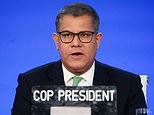
Britain’s COP26 president Alok Sharma urged other nations today to ask themselves not what more they could seek in United Nations climate talks but what is enough and back a series of texts as the summit’s agreement.
‘Please don’t ask yourself what more you can seek but ask instead what is enough. Is this package balanced? Does it provide enough for all of us?’ he told the summit after the so-called stocktaking plenary was delayed by last-minute wrangling over what one official described as ‘several issues’.
‘Most importantly please ask yourselves whether ultimately these texts deliver for all our people and our planet.’
He added that after the informal plenary, the meeting would reconvene later on.
It comes as calls on countries to accelerate the phase-out of ‘unabated coal’ and ‘inefficient fossil fuel subsidies’ have survived into the latest version of the Cop26 agreement.
Britain’s COP26 president Alok Sharma (pictured) urged other nations today to ask themselves not what more they could seek in United Nations climate talks but what is enough and back a series of texts as the summit’s agreement
It is the first time a climate change deal of its kind specifically mentions coal or fossil fuels.
The latest draft, published more than 13 hours after the UN climate summit in Glasgow was due to have finished, also demands countries ‘revisit and strengthen’ their 2030 emissions-cutting targets by the end of 2022.
This is seen as key to keeping the goal of limiting global warming to 1.5C, beyond which the worst impacts of extreme weather and rising seas will be felt – although the new draft does not specifically refer to the 1.5C goal.
The historic reference to coal and fossil fuel subsidies made it into the latest draft of the ‘cover decision’ despite expected pushback from some big producer and emitter nations.
It calls on countries to accelerate technology and policies to shift towards low-emission energy systems, by scaling up clean power generation and energy efficiency.
This includes speeding up the process of phasing out coal and inefficient fossil fuels.
The latest draft, published more than 13 hours after the UN climate summit in Glasgow was due to have finished, also demands countries ‘revisit and strengthen’ their 2030 emissions-cutting targets by the end of 2022 (Pictured: Boris Johnson during a fleeting visit to Cop26 on Wednesday)
And responding to the draft, China’s negotiator, Zhao Yingmin, told the COP26 summit on Saturday that while the proposed final declaration from the United Nations climate summit was not ideal, Beijing only wanted small edits.
‘We noted that there are still differences on some issues and currently this text is by no means perfect, but we have no intention to open the text again,’ he told a stocktaking plenary session that was delayed by last-minute wrangling.
But India’s environment and climate minister, Bhupender Yadav was less pleased and took aim at the draft deal, saying he disagreed with the language on fossil fuel subsidies and that the draft lacked balance.
In one of the strongest criticisms of the COP26 draft deal, Yadav said developing nations had the right to use the remainder of the so-called global ‘carbon budget’, or the amount of carbon dioxide the world can release before warming crosses the 1.5 degree Celsius threshold.
‘Mr President thank you for your efforts to build consensus,’ he told Britain’s COP26 president, Alok Sharma, at a so-called stocktaking plenary. ‘I am afraid, however, the consensus remained elusive.
‘In such a situation, how can anyone expect that developing countries can make promises about phasing out coal and fossil fuel subsidies when developing counties have still to deal with their development agendas and poverty eradication?’
The draft agreement also recognises the need for support towards a ‘just transition’, seen as important to protect those in countries who might be hit by job losses or higher costs from the shift to clean energy (Pictured: Protestor at final day of Glasgow summit)
The issue of subsidies for oil, gas and coal has become a major sticking point at the summit, where negotiators have already missed a Friday deadline to strike an agreement aimed at keeping alive a goal to limit global warming to 1.5C.
Greenpeace International executive director Jennifer Morgan said: ‘The key line about fossil fuels is still in the text.
‘It’s weak and compromised, but it’s a breakthrough, it’s a bridgehead and we have to fight like hell to keep it in there and have it strengthened.
‘Today’s plenary could witness a defining moment with a clutch of countries seeking to strike that line from the deal and dilute plans to force nations to come back next year with better emissions plans.’
The draft agreement also recognises the need for support towards a ‘just transition’, seen as important to protect those in countries who might be hit by job losses or higher costs from the shift to clean energy.
Examples of this include the deal struck by South Africa with the US, UK, France, Germany and the EU, announced at Cop26, to help the coal power-heavy country shift to a clean energy system.
The cover decision also includes efforts on loss and damage to people’s homes, livelihoods, land and infrastructure that vulnerable countries face from climate-related rising seas, storms, floods and droughts.
It includes measures to establish a ‘dialogue’ between countries and organisations to discuss the arrangements for the funding of activities to avert, minimise and address loss and damage – but does not involve rich countries paying compensation for climate harm they have caused.
It is the first time a climate change deal of its kind specifically mentions coal or fossil fuels – however the agreement is still to be debated at a plenary session on Saturday (Pictured: Placards outside Cop26 summit)
The texts are likely to survive in much of their current form until a formal plenary on Saturday afternoon, but they could still change when countries all meet together to debate them.
Key issues for debate are likely to be the references to coal, which affects exporters such as Australia, and fossil fuels, the 2022 revisiting of climate plans which emerging economies such as China could object to, and concerns by the US over loss and damage and adaptation finance.
There is also still debate over transparency on what countries are doing, and establishing carbon markets.
But countries will have to set out their concerns in public – in front of other nations and the watching world – at the plenary.
Tasneem Essop, executive director of the Climate Action Network, accused rich nations of betraying vulnerable countries by blocking proposals for the creation of a Glasgow loss and damage finance facility to support poorer nations hit by climate impacts.
Elsewhere, the draft Cop26 deal requests countries revisit the targets ‘as necessary to align with the Paris Agreement temperature goal by the end of 2022, taking into account different national circumstances’.
In the Paris Agreement in 2015, countries committed to limit temperature rises to ‘well below’ 2C and try to limit them to 1.5C to avoid the most dangerous impacts of storms, droughts, crop failures, floods and disease.
The latest draft deal wants countries to revisit their emissions goals by the end of 2022. This is seen as key to keeping the target of limiting global warming to 1.5C, beyond which the worst impacts of extreme weather and rising seas will be felt – although the new draft does not specifically refer to the 1.5C goal
Scientists have warned keeping temperature rises to 1.5C requires global emissions to be cut by 45 per cent by 2030, and to zero overall by mid-century.
But despite countries being required to update their action plans, known as nationally determined contributions, for emissions cuts up to 2030 in the run-up to Glasgow, the latest pledges leave the world well off track to meet the goal.
Therefore, countries are under pressure to come up with a deal in Glasgow that will see them rapidly increase their ambition for emission cuts in the 2020s to stop the 1.5C target slipping out of reach, as well provide the finance for developing countries to cope with the crisis.
The draft also urges developed countries to at least double their collective provision of climate finance to help developing nations adapt to climate change, from 2019 levels by 2025.