

Russia seizes Europe’s largest nuclear plant: Facility which provides 20% of Ukraine’s power falls
Russia seizes Europe’s largest nuclear plant: Facility which provides 20% of Ukraine’s power falls to enemy troops after being set on fire by shelling – as Zelensky accuses Putin of ‘nuclear terror’ and says he is trying to cause a repeat of Chernobyl
Europe’s largest nuclear power plant, at Zaporizhzhia in Ukraine, was attacked by Russian troops overnight Gun battle and shelling by Russian forces sparked fire at the complex, with firefighters blocked from going in Flames were eventually doused after several hours, before Russian forces moved in and captured the plant President Zelensky accused Putin of resorting to ‘nuclear terror’ and risking a catastrophe ‘six times worse than Chernobyl’, while Boris Johnson said his ‘reckless’ actions ‘threaten the security of the whole of Europe’
<!–
<!–
<!–<!–
<!–
(function (src, d, tag){
var s = d.createElement(tag), prev = d.getElementsByTagName(tag)[0];
s.src = src;
prev.parentNode.insertBefore(s, prev);
}(“https://www.dailymail.co.uk/static/gunther/1.17.0/async_bundle–.js”, document, “script”));
<!–
DM.loadCSS(“https://www.dailymail.co.uk/static/gunther/gunther-2159/video_bundle–.css”);
<!–
Russian troops have seized Europe’s largest nuclear power plant in Ukraine after a firefight that set part of the complex ablaze with President Volodymyr Zelensky accused Putin of resorting to ‘nuclear terror’ and risking a catastrophe ‘six times worse than Chernobyl’ that would affect the whole continent.
Russian troops attacked the Zaporizhzhia plant in the early hours of Friday, with CCTV capturing a fierce gun battle between Putin’s men and Ukrainian defenders that sparked a fire in a six-storey training building just outside the main complex. Moscow’s men then stopped firefighters getting to the building for several hours as fighting raged.
Eventually, emergency crews were allowed to go in and douse the flames before Russian troops moved in an occupied the site, which provides a fifth of Ukraine’s electricity. The UN’s nuclear monitoring agency said that, fortunately, none of the site’s six reactors had been directly damaged and radiation levels remained normal.
However, news that Russian soldiers had put the plant at risk by opening fire close by and shelling it sparked dire warnings and international condemnation – with the head of the International Nuclear Energy Agency saying he was ‘deeply concerned’. Prime Minister Boris Johnson, who spoke with Zelensky after the plant was attacked, called the attack ‘reckless’ and said Putin is now ‘threatening the security of the whole of Europe’.
Ukraine is home to three other active nuclear power plants, one of which is located 70 miles from the city of Mykolaiv which Russian forces have begun attacking after seizing nearby Kherson. The other two active sites are located in the west and are not currently under threat, though that situation could change as the Russian attack branches out. Ukraine also has five sites which are out of action, but could still pose a risk if hit by shells.
Nuclear experts told the BBC that attacks on Zaporizhzhia were ‘frightening’, and that damaging nuclear plants risks creating a disaster similar to what happened at Fukushima in 2011 after it was hit by a tsunami – where a loss of power results in uncontrolled heating and an eventual meltdown.
Claire Corkhill, professor of nuclear materials at Sheffield University, told the corporation that the reactors at Zaporizhzhia now appear to be shutting down to remove the danger – which may have been Russia’s intention in attacking the plant.
Russia’s war against Ukraine is now entering its ninth day and shows no sign of stopping any time soon after talks between the two sides yesterday broke up without agreement, before Vladimir Putin went on TV to declare that he would keep battling for ‘total victory’ whilst spouting propaganda that Russia’s forces are not deliberately targeting civilians and that the ‘special operation’ is proceeding on time with all of its major objectives completed to schedule.
Fighting is expected to ramp up around the cities of Mykolaiv and Odessa, in Ukraine’s south, in the coming days – with a mass amphibious assault on Odessa feared after dozens of Russian landing ships were pictured massing near Crimea.
The port city of Kherson fell to Russian soldiers yesterday with the city of Mariupol, on the other side of the Crimean peninsula, now under heavy bombardment as Moscow’s men try to bomb it into submission – with the aim being to cut off Ukrainian access to the Black Sea and deny the government access to lucrative trading routes.
Fighting is also continuing across the north and east, with Ukrainian special forces ambushing and destroying Russian tanks and armoured vehicles at Hostomel – to the west of the city – and Brovary – to the east – late yesterday and this morning. Ukraine also claimed its jets have targeted part of a 40-mile convoy currently stalled outside the city, amid fears it would encircle the capital and bombard it.
Meanwhile Chernihiv, to the north east of Kyiv, and Kharkiv, in Ukraine’s east, were braced for more heavy shelling today after days of increasingly indiscriminate attacks including with banned cluster munitions have left dozens of civilians dead.
President Putin is also stepping up actions on the home front, intended to head off internal dissent about the war as combat proves fiercer and harder than his generals anticipated, and western sanctions destroy large chunks of the economy.
Russia’s rubber-stamp parliament on Friday approved new laws that would see anyone spreading ‘fake news’ about the invasion jailed for up to 15 years. Putin had previously threatened and shut down radio and TV stations referring to the ‘war’ or ‘invasion’ of Ukraine – which Moscow prefers to call a ‘special military operation’.
Moscow also admitted to limiting news from outside sources getting into the country, with the BBC, Radio Free Europe/Radio Liberty, independent Russian site Meduza and Germany’s Deutsche Welle all restricted, while access to Facebook has been blocked.
Putin has also gone after peaceful protesters, with thousands arrested while marching in rallies around the country asking for the conflict to end.
President Zelensky accused Russia on Friday of unleashing ‘nuclear terror’ after his forces attacked the plant, claiming the Russian leader wanted to repeat the Chernobyl disaster – considered the worst nuclear disaster in history.
‘You know the word Chernobyl,’ he said in a video posted on Friday morning, calling on Russia to stop its attack on a nuclear power plant 350 miles south of Kyiv.
Fire-damaged buildings at the Zaporizhzhya nuclear complex are pictured on Friday morning after coming under attack by Russian forces overnight, leading to international condemnation
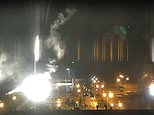
Sparks erupt from an administration building (bottom right) as a live steam video shot from a larger office block behind it films Russian tanks opening fire on the Zaporizhzhia nuclear power plant in the early hours of Friday morning
A projectile (the bright light, bottom left) lands in a car park at the Zaporizhzhia nuclear power plant, damaging cars in the area
Russian armoured vehicles and troops attacked the nuclear power plant in the early hours of Friday, shooting and shelling guards holed up in administrative buildings near the nuclear reactors – setting one of them on fire
Zaporizhzhia has six nuclear reactors, making it the largest of its kind in Europe, and accounts for about one quarter of Ukraine’s power generation. One report said the fire was about 150 meters away from one of the reactors
‘No country other than Russia has ever fired on nuclear power units.
‘This is the first time in our history. In the history of mankind.
‘The terrorist state now resorted to nuclear terror,’ he said in the video message.
Zelensky said: ‘Europe needs to wake up. The biggest nuclear power plant in Europe is on fire right now.
‘Russian tanks are shooting at the nuclear blocks. These are tanks equipped with thermal imagers, so they know what they are aiming at.’
Meanwhile, Moscow’s isolation deepened on Friday, with Airbnb becoming the latest company to pull out of the country – following Ikea, BP, Shell, HSBC, Apple and Nike.
‘Airbnb is suspending all operations in Russia and Belarus,’ tweeted the CEO, Brian Chesky.
Intel and Airbnb announced they were pausing business in Russia and Belarus on Thursday, joining a US tech freeze-out of Moscow over its invasion of Ukraine.
The United States and European allies have imposed tough sanctions on Russia over the attack, with major corporations across a range of industries following suit by freezing business in the country.
Apple has halted all product sales in Russia and limited the use of Apple Pay, while Facebook, YouTube and Microsoft have moved to curb the reach of Russian state-linked news outlets.
‘Intel condemns the invasion of Ukraine by Russia and we have suspended all shipments to customers in both Russia and Belarus,’ the chipmaker said in a statement.
‘Our thoughts are with everyone who has been impacted by this war.’
Airbnb’s co-founder and CEO Brian Chesky, who has added a Ukrainian flag to his Twitter profile, tweeted that the company ‘is suspending all operations in Russia and Belarus,’ without giving further details.
The vacation-rentals platform also announced on Monday that it would offer free short-term stays for up to 100,000 people fleeing fighting in Ukraine.
Since the beginning of the Russian offensive, one million refugees have left the Eastern European country, the United Nations said Thursday.
Airbnb’s offer echoes aid extended by the firm last August to people escaping Afghanistan after the Taliban took power.
The California-based company has also faced scrutiny over its presence in China in recent weeks.
Meanwhile NATO foreign ministers were meeting today to discuss their next steps over the war, with Canada’s top diplomat Melanie Joly saying that ‘all options’ – including a no-fly zone over Ukraine – should be discussed.
President Zelensky has been calling for a zone to be established over Ukraine to stop Russian jets from bombing cities, but establishing such a zone would require NATO aircraft and anti-aircraft batteries intervening directly in the fighting in what Moscow is almost-certain to view as a declaration of war.
Joly stressed that she is not in favour of a no-fly zone and said NATO’s top priority remains stopping the Ukraine war from spiralling into a world war, but added that ‘we want to make sure scenarios are being discussed’.
The Prime Minister of Lithuania, whose country would be on the frontlines if fighting broke out between Russia and NATO, said demands for a no-fly zone are ‘irresponsible.’
The shelling of the plant came as the Russian military pressed their attack on a crucial energy-producing Ukrainian city and gained ground in their bid to cut off the country from the sea.
As the invasion entered its second week, another round of talks between Russia and Ukraine yielded a tentative agreement to set up safe corridors to evacuate citizens and deliver humanitarian aid.
Leading nuclear authorities were worried – but not panicked – about the damage to the power station. The assault, however, led to phone calls between Ukrainian President Volodymyr Zelenskyy and U.S. President Joe Biden and other world leaders. The U.S. Department of Energy activated its nuclear incident response team as a precaution.
Earlier, nuclear plant spokesman Andriy Tuz told Ukrainian television that shells fell directly on the facility and set fire to one of its six reactors. That reactor is under renovation and not operating, he said.
The Zaporizhzhia regional military administration said that measurements taken at 7 a.m. Friday (0500 GMT) showed radiation levels in the region ‘remain unchanged and do not endanger the lives and health of the population.’
The mayor of Enerhodar, Dmytro Orlov, announced on his Telegram channel Friday morning that ‘the fire at the (nuclear plant) has indeed been extinguished.’ His office told The Associated Press that the information came from firefighters who were allowed onto the site overnight.
British Prime Minister Boris Johnson called for an emergency meeting of the U.N. Security Council in ‘coming hours’ to raise the issue of Russia’s attack on the nuclear power plant, according to a statement from his office.
Zelensky said Russia’s attack on the power plant amounted to ‘nuclear terror’ that threatened all of Europe
U.S. Energy Secretary Jennifer Granholm tweeted that the Zaporizhzhia plant’s reactors were protected by robust containment structures and were being safely shut down.
In an emotional speech in the middle of the night, Zelenskyy said he feared an explosion that would be ‘the end for everyone. The end for Europe. The evacuation of Europe.’
‘Only urgent action by Europe can stop the Russian troops,’ he said. ‘Do not allow the death of Europe from a catastrophe at a nuclear power station.’
But most experts saw nothing to indicate an impending disaster.
The International Atomic Energy Agency said the fire had not affected essential equipment and that Ukraine’s nuclear regulator reported no change in radiation levels. The American Nuclear Society concurred, saying that the latest radiation levels remained within natural background levels.
‘The real threat to Ukrainian lives continues to be the violent invasion and bombing of their country,’ the group said in a statement.
Orlov, the mayor of Enerhodar, said Russian shelling stopped a few hours before dawn, and residents of the city of more than 50,000 who had stayed in shelters overnight could return home. The city awoke with no heat, however, because the shelling damaged the city’s heating main, he said.
Prior to the shelling, the Ukrainian state atomic energy company reported that a Russian military column was heading toward the nuclear plant. Loud shots and rocket fire were heard late Thursday.
Later, a livestreamed security camera linked from the homepage of the Zaporizhzhia plant showed what appeared to be armored vehicles rolling into the facility’s parking lot and shining spotlights on the building where the camera was mounted.
Then there were what appeared to be muzzle flashes from vehicles, followed by nearly simultaneous explosions in surrounding buildings. Smoke rose into the frame and drifted away.
Vladimir Putin’s forces have brought their superior firepower to bear over the past few days, launching hundreds of missiles and artillery attacks on cities and other sites around the country and making significant gains in the south.
Ukraine claimed to have shot down a Russian jet the was attacking military facilities at Zatoka, close to the port city of Odessa
A destroyed Russian tank is seen on the road near Brovary, to the east of Kyiv, after being destroyed on Friday morning
Ukraine says two tanks and three infantry fighting vehicles were destroyed in an early-morning attack near Brovary, Kyiv
Burning apartment buildings are seen in Mariupol, which has now been under days of heavy shelling by Russian forces
Fire is seen in Mariupol at a residential area after shelling amid Russia’s invasion of Ukraine
Gutted shops are seen in the Black Sea port city of Odessa, which has been under heavy attack by the Russian military
Russia claims to be avoiding civilian areas, but pictures from Mariupol show shops, restaurants and apartments have been hit
School hit during the Russian air raids in Zhytomyr, a city around 80 miles to the west of Kyiv, which was struck this week
Parts of a maternity hospital were damaged in Russian strikes on Zhytomyr, which seemed to have missed a police station
Damage is seen in one of the rooms of a maternity hospital in Zhytomyr after Russian air strikes on the city
A view of damaged building after the shelling is said by Russian forces in Ukraine’s second-biggest city of Kharkiv
People walk past the remains of a missile at a bus terminal, as Russia’s invasion of Ukraine continues, in Kyiv
The Russians announced the capture of the southern city of Kherson, a vital Black Sea port of 280,000, and local Ukrainian officials confirmed the takeover of the government headquarters there, making it the first major city to fall since the invasion began a week ago.
A Russian airstrike on Thursday destroyed the power plant in Okhtyrka, leaving the city without heat or electricity, the head of the region said on Telegram. In the first days of the war, Russian troops attacked a military base in the city, located between Kharkiv and Kyiv, and officials said more than 70 Ukrainian soldiers were killed.
‘We are trying to figure out how to get people out of the city urgently because in a day the apartment buildings will turn into a cold stone trap without water, light or electricity,’ Dmytro Zhyvytskyy said.
Heavy fighting continued on the outskirts of another strategic port, Mariupol, on the Azov Sea. The battles have knocked out the city’s electricity, heat and water systems, as well as most phone service, officials said. Food deliveries to the city were also cut.
Associated Press video from the port city showed the assault lighting up the darkening sky above deserted streets and medical teams treating civilians, including a 16-year-old boy inside a clinic who could not be saved. The child was playing soccer when he was wounded in the shelling, according to his father, who cradled the boy’s head on the gurney and cried.
Severing Ukraine’s access to the Black and Azov seas would deal a crippling blow to its economy and allow Russia to build a land corridor to Crimea, seized by Moscow in 2014.
Overall, the outnumbered, outgunned Ukrainians have put up stiff resistance, staving off the swift victory that Russia appeared to have expected. But a senior U.S. defense official, speaking on condition of anonymity, said Russia’s seizure of Crimea gave it a logistical advantage in that part of the country, with shorter supply lines that smoothed the offensive there.
Ukrainian leaders called on the people to defend their homeland by cutting down trees, erecting barricades in the cities and attacking enemy columns from the rear. In recent days, authorities have issued weapons to civilians and taught them how to make Molotov cocktails.
‘Total resistance. … This is our Ukrainian trump card, and this is what we can do best in the world,’ Oleksiy Arestovich, an aide to Zelenskyy, said in a video message, recalling guerrilla actions in Nazi-occupied Ukraine during World War II.
The second round of talks between Ukrainian and Russian delegations was held in neighboring Belarus. But the two sides appeared far apart going into the meeting, and Putin warned Ukraine that it must quickly accept the Kremlin’s demand for its ‘demilitarization’ and declare itself neutral, renouncing its bid to join NATO.
Putin told French President Emmanuel Macron he was determined to press on with his attack ‘until the end,’ according to Macron’s office.
The two sides said that they tentatively agreed to allow cease-fires in areas designated safe corridors, and that they would seek to work out the necessary details quickly. A Zelenskyy adviser also said a third round of talks will be held early next week.
Despite a profusion of evidence of civilian casualties and destruction of property by the Russian military, Putin decried what he called an ‘anti-Russian disinformation campaign’ and insisted that Moscow uses ‘only precision weapons to exclusively destroy military infrastructure.’
Putin claimed that the Russian military had already offered safe corridors for civilians to flee, but he asserted without evidence that Ukrainian ‘neo-Nazis’ were preventing people from leaving and were using them as human shields.
The Pentagon set up a direct communication link to Russia’s Ministry of Defense earlier this week to avoid the possibility of a miscalculation sparking conflict between Moscow and Washington, according to a U.S. defense official who spoke on condition of anonymity because the link had not been announced.
Firefighters extinguish a blaze at a warehouse after shelling by Russian forces in the village of Chaiky in the Kyiv region
People stand next to a shell crater in front of a house damaged by recent shelling in the village of Hatne in the Kyiv region
Huge plums of black smoke and fire were seen coming from a makeshift barricade on the main route to the Zaporizhzhia site in eastern Ukraine, as an air raid siren wailed in the background
The footage, taken earlier today, showed armed men holding guns and wearing bulletproof vests as rounds of ammunition appeared to be fired by Russian troops
Footage posted on social media showed the blockade, reportedly a kilometre long and comprising scrap cars, garbage trucks and sandbags
Hundreds of Ukrainian civilians defied Russian troops on Wednesday in a bid to protect Europe’s largest nuclear plant Zaporizhzhia
On Wednesday Ukrainian civilians built makeshift roadblocks with bright orange lorries and piles of tyres on the main route to the Zaporizhzhia site.
Brandishing Ukrainian flags, the army of volunteers created a human barricade near the city of Enerhodar to stop advancing Russian troops.
Footage posted on social media showed the blockade, reportedly a kilometre long and comprising scrap cars, garbage trucks and sandbags.
Anton Gerashchenko, an adviser to Ukraine’s interior ministry, warned on Wednesday the Russians could create a ‘new Chernobyl’ if the plant was damaged.
‘Because of Vladimir Putin’s madness, Europe is again on the brink of a nuclear catastrophe,’ he wrote on Facebook.
‘The city where the largest nuclear power plant in Europe is located is preparing for a battle with the invaders. An accident can happen like at the Chernobyl nuclear power plant or the Fukushima nuclear power plant.
‘Russian generals – think again! Radiation does not know nationalities, does not spare anyone!’
Russia has written to the International Atomic Energy Agency saying its forces have taken control of the area around the plant.
The UN nuclear watchdog said Moscow claimed technicians at Zaporizhzhia were continuing their ‘work on providing nuclear safety and monitoring radiation in normal mode of operation’.
The letter on Wednesday added: ‘The radiation levels remain normal.’
IAEA chief Rafael Grossi warned on Wednesday that any ‘accident involving the nuclear facilities in Ukraine could have severe consequences for public health and the environment’.
He said it was ‘imperative to ensure that the brave people who operate, regulate, inspect and assess the nuclear facilities in Ukraine can continue to do their indispensable jobs safely, unimpeded and without undue pressure’.
Jan Vande Putte, co-author of the risk analysis, said: ‘So long as this war continues the military threat to Ukraine’s nuclear plants will remain.
‘This is one further reason, amongst so many, why Putin needs to immediately cease his war on Ukraine.’
The fight to protect Zaporizhzhia is symbolic of the everyday heroism shown by the Ukrainian people.
Vitali Klitschko, the mayor of Kyiv, told the BBC he had seen a line ‘hours long’ of civilians queuing up to get weapons.
‘Right now, people are proud,’ the former world champion boxer said.
His brother Wladimir, who was also a top fighter, said: ‘This is our home. Our parents are buried here, our children go to school here.
‘Why should we flee? What would you do if someone gets in to your house? You defend it.’