

Analysis: Trump’s team dodges virus blame while jobless benefit cuts loom
Giroir, who did allow that turnaround times for tests needed to improve, said states had not claimed all of the money allocated to build up test and tracing networks seen as critical to quelling the pandemic.
As part of its aggressive new strategy, the administration also sought Sunday to leverage a fourth phase pandemic stimulus plan to incentivize people to return to work, even as the virus chalks up daily records in new infections.
The move would cut the federal benefit for many workers but many Republicans argue that such payments act as a disincentive to return to work. House Speaker Nancy Pelosi said Sunday she would prefer to keep the benefit, which officially expires at the end of the week, the same. The discord on Capitol Hill, and between the GOP and the White House that has delayed the package, is raising fears laid-off workers could be left high and dry with only more meager state unemployment benefits for support.
Giroir hits out at testing complaints
“Let me assure you that we are not going to stop our efforts until testing is exactly where we want it to be, with rapid turnaround times,” Giroir told Tapper while boasting about 54 million tests conducted. That figure is less impressive over the five-month span of the crisis and given that health experts say several million tests a day may be needed to get it under control.
“We’re not going to have 300 million tests per day,” he said, even though no expert has suggested such a volume would be possible or needed. He also claimed that half the tests — those processed in large commercial labs, came back at an average of 4.27 days, a figure he pledged to improve this week.
But Giroir also warned that states had used only $50 million of $10.25 billion allocated to them to hire contact tracers. “There is money there for them to do it,” he insisted. “We are supplying the technical assistance. The money is there. The state plans have to meet requirements.”
Health and Human Services Secretary Alex Azar claimed that states had not used $11 billion in allocated financing for next-generation diagnostics.
“We’re meeting every need they’ve got for supplies, for testing,” Azar said on CBS’ “Face the Nation.” “But at the end of the day, our governors have to take that initiative and get their public health labs fully up and running even as we improve testing through, say, our commercial labs.”
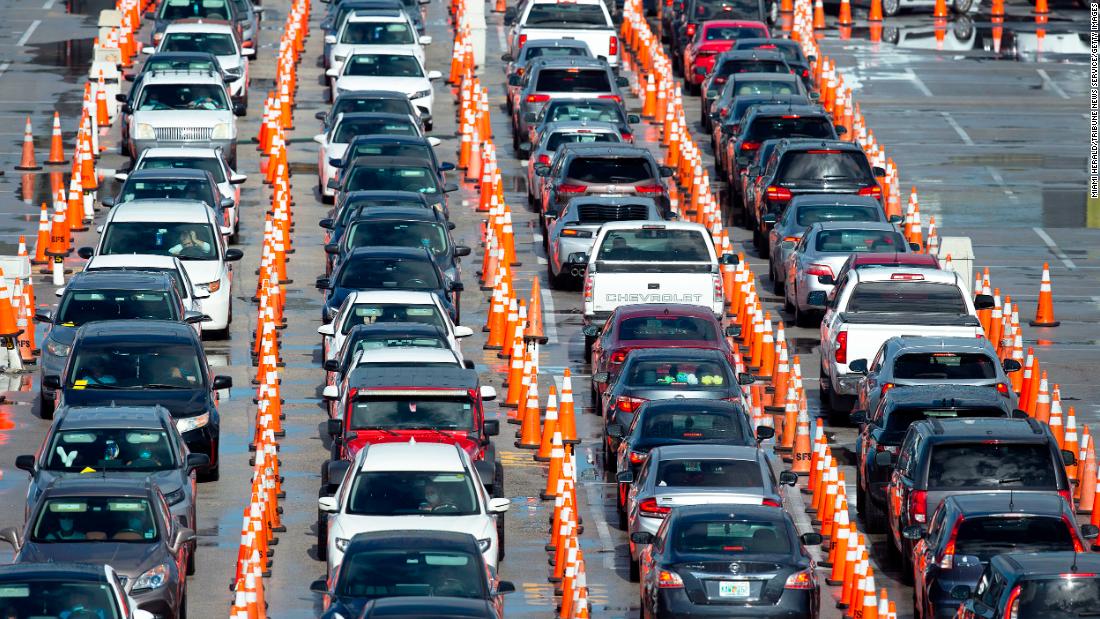
While the blame gets handed out in Washington, some physicians overwhelmed by a wave of sickness and death say they simply do not have the testing capability they need to beat back the pandemic.
“We’re living it here right now,” said Dr. Pritesh Gandhi, a primary care physician and pediatrician in Austin, Texas, one of the hottest of viral hotspots.
“We have test results that take 12, 13, to even 14 days to return,” Gandhi said on CNN on Saturday, warning that the lack of sufficient testing and a profit motive made it impossible to beef up diagnostics to halt the asymptomatic spread driving the pandemic.
“We can’t scale basic community testing particularly in communities of color, especially where essential workers are working … The government should step in,” Gandhi said.
A cut in benefits, but a $1,200 check
Kudlow said that the unemployment enhancement was meant to keep people at home during lockdowns but was now harming the hopes of economic recovery.
“We have had a flood of inquiries and phone calls and complaints that small stores and businesses and restaurants can’t hire people back.” Kudlow said.


But his comments, and an exceedingly rosy view of a crisis killing 1,000 Americans a day, raise the possibility that the administration is trying to force people to return before it is safe.
“There are more states that are reopening and doing very well. There are some key states, yes. California and Texas and Florida, right now that are having hot spot difficulties. But it’s nothing like it was last winter,” Kudlow said.
When Tapper pointed out that many workers didn’t find it safe to return to work because of the spike in the virus, Kudlow emulated his colleagues and put the blame on states for not doing enough.
“It’s a more optimistic picture than the one you are painting. And I think that we have made great strides. I mean, federal government doesn’t control this. We are leaders, hopefully, in encouraging people to be safe and secure and accept our guidelines. The states are in charge of this. Each state has a different story.”
Kudlow’s comment about guidelines is undermined by Trump’s disregard of state opening suggestions written by the US Centers for Disease Control and Prevention, the President’s push for all schools to reopen even as the situation worsens and his refusal until last week to endorse mask wearing.
Democratic New York Gov. Andrew Cuomo meanwhile blamed states that are now facing the same kind of coronavirus crisis endured by New Yorkers earlier this year for heeding conservative media commentary that supports Trump’s position on aggressive reopening of the economy.
“Florida listened to the New York Post, Texas listened to the Wall Street Journal, Arizona listened to the Wall Street Journal and the New York Post, that was wrong, that was wrong,” Cuomo told reporters.
“We have a phased modulated reopening, and that is right.”
CNN’s Phil Mattingly and Manu Raju contributed to this story.