

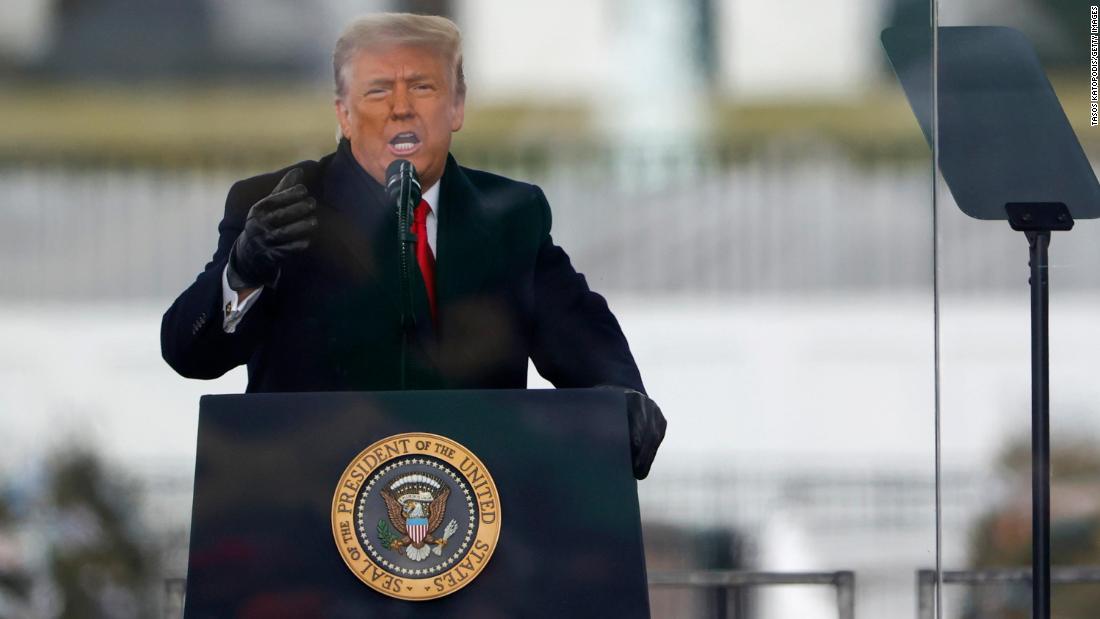
What is ‘incitement’ and what does it mean for Trump’s defense?
House impeachment managers have devoted most of their presentation this week to the results, airing graphic video footage and audio from the attack on the Capitol — which put members of the Senate, who will vote on the charges, personally at risk. Their argument is that Trump was responsible for what happened, even though he did not join the mob that marched from his January 6 rally near the White House to the US Capitol, where electoral votes were being tallied to seal Joe Biden’s victory.
We should note here that Cruz, in the days before the January 6 riot, was himself egging on election-skeptics to fight against the counting of electoral votes and promising them “we will win.” He also lodged the first of two Republican objections to the counting of the votes, challenging Arizona’s results — at around the same time the first wave of rioters reached the Capitol grounds. So Cruz has a personal interest in Trump’s words not being incitement.
But what is incitement, exactly?
The dictionary definition of “incite,” according to Merriam-Webster, is simple: “to move to action : stir up : spur on : urge on.” Trump clearly did that, when he directed his supporters to march toward Capitol Hill from a rally held under the “Stop the Steal” banner.
“…the term ‘to incite a riot’, or ‘to organize, promote, encourage, participate in, or carry on a riot”, includes, but is not limited to, urging or instigating other persons to riot, but shall not be deemed to mean the mere oral or written (1) advocacy of ideas or (2) expression of belief, not involving advocacy of any act or acts of violence or assertion of the rightness of, or the right to commit, any such act or acts.”
The history of ‘incitement’
Those words were written in the World War I era, when Congress and President Woodrow Wilson actively limited what Americans could say against the government and war effort.
This is a political case
But impeachment is not a criminal or a civil case, it’s a political one, and the impeachment managers are arguing “high Crimes and Misdemeanors,” which is different than a regular court case.
Did Trump encourage people who turned into a mob to march on the Capitol? Indisputably. Did he tell them to “fight?” Yes. Is that inciting a mob against democracy? We shall see, when it comes time for the Senate to vote.
Clearly, the idea of incitement brushes up against the First Amendment protection of free speech, and Trump’s defense has already focused on this constitutional protection.
That he’s seeking the protection of the Constitution after arguably inciting a mob to stop the counting of electoral votes — which would have short-circuited the Constitution — is not something they’ve addressed.