

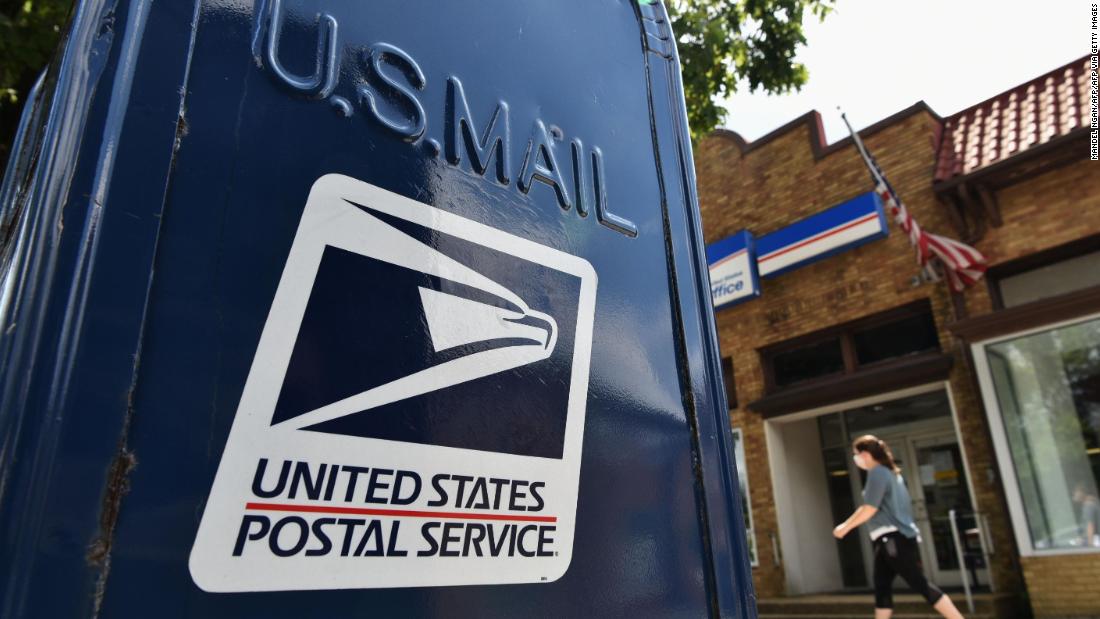
Analysis: The post office backed off, but the damage is already done
This will not be the end of the story.
There are still real questions about how long it will take ballots to reach voters and get back again.
The message people who want to vote by mail need to take away from all of this is simple: Vote early.
Congress is on the case. DeJoy will now appear Friday at a Senate hearing (where he’ll face a Republican majority) and next week at a Democratically run House committee. Democrats are continuing to push for an urgent $25 billion bailout for USPS. Republicans have sounded more open to $10 billion.
- That then-Trump campaign chairman Paul Manafort was working with a Russian intelligence officer, and sought to share internal campaign information with Konstantin Kilimnik. The committee says it obtained “some information suggesting Kilimnik may have been connected” to Russia’s 2016 hacking operation and concludes Manafort’s role on the campaign “represented a grave counterintelligence threat.”
- That Trump and senior campaign officials sought to obtain advance information on WikiLeaks’ email dumps through Roger Stone, and that Trump spoke to Stone about WikiLeaks, despite telling the special counsel in written answers he had “no recollections” that they had spoken about it.
- That information offered at the June 2016 Trump Tower meeting “was part of a broader influence operation” from the Russian government, though there’s no evidence Trump campaign members knew of it. Two of the Russians who met with Donald Trump Jr., Jared Kushner and Manafort had “significant connections” to the Russian government, including Russian intelligence, and Russian lawyer Natalia Veselnitskaya’s ties were “far more extensive and concerning than what had been publicly known.”
Confidence that votes for president will be accurately cast and counted has dropped significantly since 2016, according to a new CNN poll conducted by SSRS.
And as the coronavirus pandemic enters its sixth month of changing nearly every aspect of American life, the poll also finds a majority of voters prefer to cast their ballots before Election Day, far more than have ever done so in previous presidential elections.
A majority of Americans (55%) say they don’t think President Donald Trump will concede should he lose. A slightly larger majority said that in 2016 (61%), but Trump was not a sitting president then. There is near unanimity, though, that once all states have certified their votes for president, the loser should accept the results and concede (87% feel that way, up from 77% in October 2016).
Celebrating 100 years of the 19th Amendment
Voting matters. Trump has spent the last few weeks and months trying to make it harder for people to vote in November, but on Tuesday he celebrated the 19th Amendment, which gave all American women the right to vote in 1920, by pardoning Susan B. Anthony, the suffrage leader who was convicted of voting illegally in 1872.
Trump routinely pushes the ridiculous idea that election fraud will cost him his job in 2020 (it will be voters who do that). So there’s something a little funny about him pardoning a woman for violating federal election law, even if it was wrong.
Add to that the fact that Trump has been trolling progressive women by making overt pleas to “suburban housewives.”
The description of the judge repeatedly telling her to sit down is incredible. She was fined $100, but didn’t pay and the government never asked her to.
In it, 50% of registered voters said they’re leaning toward Biden over Trump, who had the support of 46% of registered voters. That edge for Biden is because of female voters, who prefer him (59%) over Trump (36%).
Conversely, men prefer Trump (56%) over Biden (40%). And now consider the fact that Republicans are actively trying to make sure fewer people vote.
So many voting amendments
There are not one or two but SEVEN constitutional amendments that deal directly with who gets to vote and how. And a lot of laws have been passed since then, too.
- The 12th Amendment, passed in 1803, set out more specific rules for electors in presidential elections.
- The 14th Amendment, adopted after the Civil War, said men 21 and older could vote unless they had joined in a rebellion or committed other crimes.
- The 15th Amendment, ratified in 1870, said men could vote, regardless of their race, though African Americans were still largely discriminated against using other methods until the Voting Rights Act of 1965.
- The 17th Amendment, ratified in 1913, said senators should be chosen by the people and not state legislatures. It didn’t specifically say which people.
- The 19th Amendment, ratified in 1920, said states couldn’t keep women from voting.
- The 23rd Amendment, ratified in 1961, said citizens of Washington, DC, got three electoral votes (but no voting representation in Congress).
- The 26th Amendment, ratified in 1971, lowered the voting age from 21 to 18, although some states let people who are 17 vote in primaries if they’ll be 18 on Election Day.
Basically it took almost 200 years to get from “the people” to a system that includes citizen male, female and Black voters 18 or older.
And things today aren’t perfect. Far from it. More Americans live in Puerto Rico than several states and DC. They don’t get to vote for president unless they move to a state.