

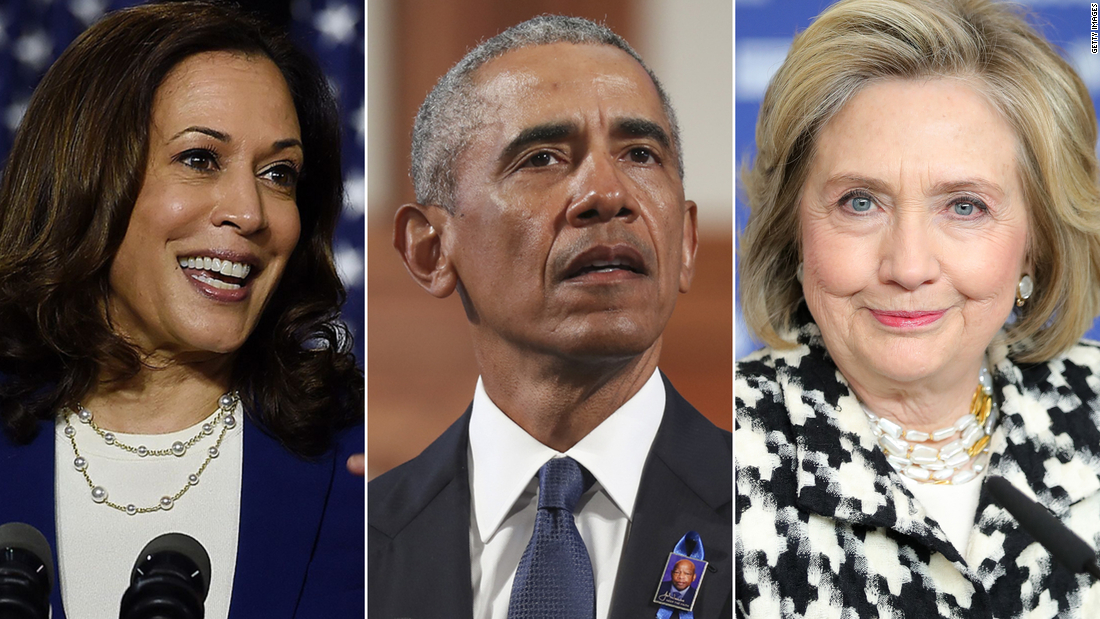
Opinion: Obama brings the blowtorch
As a conservative commentator, I spent years — at least eight of them — railing against both the policies and prose of President Barack Obama. It was my job, and there was plenty of material — some fair, some unfair, in retrospect.
But in contrast to the first term of President Donald Trump, it’s clear looking back that Obama felt the weight of being president, had reverence for the office, respect for the mantle that voters gave him and worked tirelessly to fight for his agenda.
It was a small point — Obama rightly went on to promote his former Vice President Joe Biden. But it was an important one, and one that only he could make. The job of president is hard to begin with. It’s impossible when the person in the White House has no real interest in doing it, no respect for it, no belief in it.
Some will criticize it as a cheap shot. I disagree — I think it was fair, effective and persuasive. We need a president who wants the job, not just for the power but for the responsibility that comes with it.
Van Jones: We knew what Kamala Harris meant by “stroller-eye view”

Van Jones
A lot of people may well have watched Kamala Harris on Wednesday night holding their daughters’ hands, and what they heard would have touched them and inspired them.
In the past few years, lots of people have begun to lose hope — especially Black and brown folks in struggling communities. They started to worry and wonder if maybe they would not make it through this moment.
Then on the third night of the Democratic National Convention, they saw a Black woman of poise, strength and warmth take the stage and offer medicine for broken hearts. The love that her family showed her in the introduction was intensely relatable and completely touching. When Harris told us about having a “stroller-eye view” of the civil rights movement, going along with her parents to protests, we knew what she meant. We knew she had been part of the fight her whole life. It meant the world to all of us who have been fighting our whole lives.
Harris praised the rising generation who today are taking to the streets, organizing rallies, and pushing for a better world. She honored the struggle of those young climate, gun control, immigration or Black Lives Matter activists. She may not always agree, but she made it clear she would always listen.
Women are texting me from all over the country ecstatic over Harris being picked as Joe Biden’s running mate and how she performed on Wednesday night. I am hearing stories of brown girls in middle school shouting “this is amazing!” and yelling, “being Indian is cool! Women rule!”
A lot of the talk about Wednesday’s convention night will focus on former President Barack Obama’s tough words lacerating Donald Trump. I appreciate him taking the hard shots. It freed up Harris to be herself. Normally, the vice presidential candidate gets up on stage and takes a blowtorch to the opposition. Instead, Harris created a campfire to bring people together. That is what America needs right now.
Jen Psaki: It’s time to permanently ditch the old convention format

Jen Psaki
Let’s not go back to the old way of doing conventions. The third night of the Democratic National Convention was far more powerful and more moving, featuring speeches from inspiring women in their living rooms and empty convention halls, and with a strong focus on issues that have remarkably become the core of the Democratic Party platform.
If the convention was in person, the primetime slots would have been filled with speakers back to back.
We would not know Estella, the little girl wearing a “Unicorns are real” t-shirt, who read a letter to President Donald Trump about her family, telling of her father’s military service and the deportation of her mother to Mexico.
The videos of children and family in cages at the border would have played during commercial breaks while people in the convention halls waited in line for bathrooms and drink refills.
And we would not know more about what a Biden presidency would do to combat gun violence, to fight climate change and to protect families like Estella’s. It isn’t just about balloons and fancy halls. It is also about people and about issues.
Conventions highlight the city and the community where they are hosted, and they are an opportunity for party insiders from across the country to get together every four years. But they are no longer the best way to tell the story of who a nominee is, who and what they will fight for, and what they will do as president.
Scott Jennings: Dems underscore their nervousness that Biden can close the deal


Scott Jennings
On night three of the Democratic National Convention, I made five observations.
First, Hillary Clinton and Barack Obama renewed Michelle Obama’s call for Democrats to vote as soon as possible. The exhortations from those three leaders underscore, I think, their nervousness about Joe Biden’s ability to close the deal in November.
The more votes Democrats can bank early, the better — especially if Biden stumbles during the upcoming presidential debates.
Second, Obama, unlike his predecessor George W. Bush, has not receded from the political arena. Though many in the Democratic Party view him as some sort of nonpartisan figure who floats above it all and is a reluctant combatant in this campaign, nothing could be further from the truth.
Third, the Democrats are smartly trying to solidify their single biggest advantage in this election — female voters. It was on full display tonight, as prominent Democratic female leaders spoke out loudly and proudly.
That’s a problem for Trump, since it will be hard for him to win unless he can persuade more women to join his coalition.
Fourth, the attempt to reach out to disaffected Republicans certainly ended with Wednesday’s roster of speakers, including Nancy Pelosi and Hillary Clinton. And putting Elizabeth Warren on television as Biden’s economic spokesperson is not going to persuade any center-right moderates to join his coalition.
Finally, I viewed Kamala Harris’ speech, which was too busy and largely fell flat, through the lens of 2024, as she’s clearly the Democratic frontrunner for the next presidential nomination, whether Biden wins this year or not. And that’s especially true since Biden has described himself as a transitional figure, which I interpret as meaning he’s unlikely to run for a second term.
It’s not the same on the GOP side. Current Vice President Mike Pence will be a strong contender in a post-Trump world. But he’s going to be part of a large group of conservatives posturing for the 2024 nomination — and these ambitious politicians won’t so readily step aside for him.
Elliot Williams: Diversity in presidential politics is becoming the norm

Elliot Williams
Nowhere was this diverse future of the Democratic Party more on display than with the image of Kamala Harris standing on stage to give her vice president acceptance speech Wednesday night.
In real terms, this all means not just that my own mixed Jamaican and Asian American children have a particular role model who represents who they are — or could become. It means that now, after 12 years of presidential tickets featuring combinations of women, people of color, and children of immigrants, a generation of American children — whether they like it or not — sees diversity in presidential politics as a norm.
And it means that South Asian and West Indian immigrants of my parents’ generation see in Harris the embodiment of why they came — that their struggle was worth it, that their fully American children can thrive and that truly anything is possible here.
Jill Filipovic: A night of hope, tempered by unease

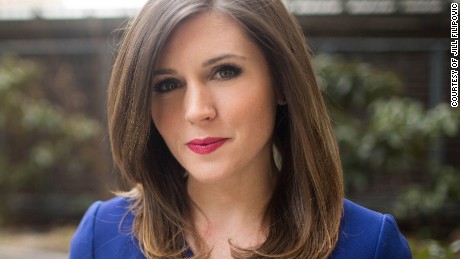
Jill Filipovic
Night three of the Democratic National Convention was about who makes the party, and America, what it is: Women who marched for the vote and for their rights. Black Americans who stood up, again and again, and demanded that we live up to our founding promises.
Young activists and devastated mothers who are fed up with gun deaths and refuse to let our country remain in bloody complacency. And, of course, Kamala Harris, who embodies so much of America’s progress, and so many of its unfulfilled promises.
It was a bittersweet night. When the montage of women finally gaining the right to vote a full century ago flashed across the screen, juxtaposed with women in pink hats marching on Washington, the message was supposed to be an inspiring and optimistic one about female grit, feminist rabble-rousing, and women claiming our time and getting stuff done.
When the convention opened with a segment on gun violence, including a recording of the moving speech Emma Gonzalez gave in the aftermath of the Parkland shooting that left 17 people dead, the message was one of youth power in the face of adult-made problems. Both were powerful and affecting.
There was Gabby Giffords, speaking through sheer force of will after being shot in the head in 2011 — and yet here we are, with so many more bodies piled up, no closer to reasonable gun laws.
The incomplete story is part of the message. But these tear-jerker segments were also reminders of how fragile progress is. The hopes that swell when we face a sea change sometimes crash as the tides change.
It’s been 100 years since women gained the legal right to vote and over 200 years since the first president took office, and yet we’ve never had a woman in the White House. That could change this year, as it could have changed four years ago.
Anyone with eyes and ears four years ago knew the disaster that would befall us if Donald Trump won the election, and he won anyway, riding on the fumes of white male rage at a Black president being succeeded by a female one. Now, we’ve seen so many of our worst-case scenarios play out and somehow get worse still, and yet this election could still go either way.
Recognition of past fights and optimism about winning future ones is absolutely the right message for Democrats to send. And throughout the night I felt my heart tugging and my eyes tearing up imagining a post-Trump country with a Biden-Harris team in charge.
But the thing with historical firsts is that they’re always preceded by long histories of people who didn’t get there — who were boxed out, forced out, refused entry. Harris’ nomination, and the convention fanfare that led up to it, has me feeling hopeful again.
This time around, that hope is tempered with unease, as I worry that our country will again fall short, as we have so many times before.
Julian Zelizer: The Party brought receipts on night three


Julian Zelizer
The third night of the Democratic National Convention demonstrated the party’s commitment to changing the character of national politics. Rather than relying on the symbolic appeals to diverse constituencies, Democrats showed they have made real progress in the halls of power.
The official nomination of Sen. Kamala Harris, the first Black and South Asian woman to be on a major political party’s presidential ticket, has grown out of the ways that Democrats as a party look more like a majority of the nation than their opponents.
She has been a tireless champion for middle class Americans, pushing for legislation to protect them from the devastation of debt and economic insecurity. Like Vermont Sen. Bernie Sanders’ historic runs, her presidential campaign helped move progressive ideas closer to the center of mainstream debate.
Hillary Clinton, former first lady, senator and secretary of state, is one of the most influential political figures of modern times. Like Eleanor Roosevelt, she helped to reinvent the role of first lady by playing a pivotal role in the push for key policies like health care.
As secretary of state, Clinton played a pivotal role in rebuilding America’s relationship with allies after the fallout from Bush’s disastrous war in Iraq.
During her two terms in the role, Pelosi has proven extraordinarily successful at holding together a diverse party coalition and moving through legislation. In 2006, she delivered a Democratic majority in the House. Her role in the passage of the 2009 economic stimulus package and the Affordable Care Act in 2009-2010 were crucial.
Parties talk about change all the time, especially during conventions, but most of the time it’s just talk. Too much of American politics still looks like Joe Biden and Donald Trump in 2020. But on Wednesday night, Democrats brought the receipts.
There is still a long way to go, but the milestone of being able to hear from Sen. Harris and these three senior stateswomen —as well as the first African American president—marks progress.
Karol Markowicz: Democrats took one last spin with the relics of their past


Karol Markowicz
Who is the future of the Democratic Party? The last night of the Democratic National Convention provides no answer.
Typically, the answer would be easy: the person who has the nomination of his or her party to run for president of the United States. But it has to be clear to anyone watching the Democratic National Convention, that Joe Biden is the placeholder for the future.
The answer could also be Sen. Kamala Harris, though she did not get enough support of her own in the Democratic presidential primary, dropping out two months before the first contest, making her “future of the party” ranking tenuous.
The real answer is that the future of the Democratic Party is the progressive wing, which has largely been marginalized during this convention in order to appeal to the Republican voters, such as the ones featured in the opening montage.
It’s clear to anyone paying attention that Rep. Alexandria Ocasio-Cortez, and the rest of “the Squad” are the future. They’re the loudest voices with the most demanding opinions. They are constantly forcing the party to bend toward them.
Biden might back away from these positions, and the progressives might forgive that, in the name of uniting the party to take down their biggest enemy, President Donald Trump. But they won’t for long. On Wednesday night, the Democrats chose to take one last spin with the relics of their past: Sec. Hillary Clinton, Speaker Nancy Pelosi, and former President Barack Obama, too. But change is coming and the future is here. It’s time the Democrats faced it.
Karol Markowicz is a weekly columnist at the New York Post. She has also contributed to USA Today, Time, Washington Examiner and others. Markowicz was born in the Soviet Union and grew up in Brooklyn, New York, where she still lives with her husband and three children.
Raul Reyes: A daughter of immigrants made history

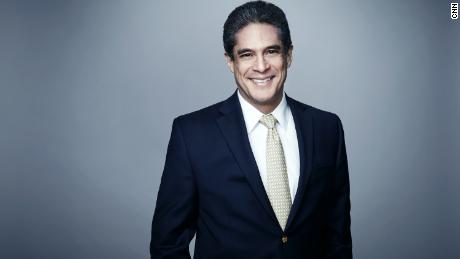
Raul A. Reyes
Hillary Clinton and Kamala Harris each faced challenges on the penultimate night of the 2020 Democratic National Convention. Clinton’s address needed to look both forward and backward, drawing upon her unique political experience as the last Democratic nominee.
Harris had to excite the party base while she introduced herself to the many potential voters who are perhaps only now closely tuning into the race. To their great credit, both women performed well, with their words reminding viewers of the power of possibilities.
She also reminded viewers that Biden and Harris could potentially win the majority vote and still lose the election. “Take it from me,” she said. With a straightforward message, Clinton effectively acknowledged the heartbreak and promise of this moment in time.
Harris likewise rose to the occasion, which was no small feat for one appearing after former President Barack Obama. Harris deserves praise for speaking so forcefully, and with such charisma, to a nearly empty auditorium.
But adoring crowds and applause were not necessary. It was powerful to hear the first woman of color to be on a major party’s presidential ticket declare, “And let’s be clear—there is no vaccine for racism. We’ve gotta do the work,” for George Floyd and other victims of police brutality.
Harris’ closing was especially strong, when she said that, someday, a new generation will ask about this contentious era. “They will ask us, what was it like?” she said. “And we will tell them. We will tell them, not just how we felt. We will tell them what we did.” Brilliant.
And in the midst of what so far looks like the most diverse presidential convention in history, it was refreshing to see so many Latinos, from New Mexico Gov. Michelle Lujan Grisham to a mixed-status immigrant family to singer/songwriter Prince Royce in Miami. Representation matters — and Latino voters are watching.
John Avlon: Barack Obama and Kamala Harris deliver a warning for “Us”

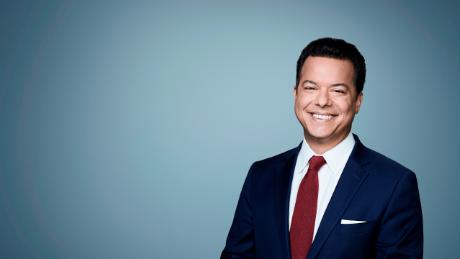
John Avlon
Presidential campaigns are about contrasts. Usually it’s a question of different policies and competing visions of America’s future. But the third night of the 2020 Democratic National Convention made it clear that the Democratic Party sees this election as a contrast of fundamental character — with the fate of our democracy at stake.
The former President’s speech was a balance of slashing attacks against his successor, combined with inspirational invocations of the civil rights movement, which served as an exemplar of America’s commitment to forming a more perfect union with each generation.
His also passed the baton to Kamala Harris, who described her childhood’s stroller-eye view of civil rights marches with her parents. Hers was a personal speech, an introduction to many Americans of the pioneering figure who could be our country’s first woman of color Vice-President.
As the daughter of Jamaican and Indian immigrants, Harris’ spirit shone through in a speech that had to defy the weight of a largely empty auditorium in Delaware.
Together, they set the stage for Biden’s big speech tomorrow night, while warning that our democracy rests in the hands of We The People — another way of saying: “Us.”
John Avlon is a senior political analyst at CNN
Abdul El-Sayed: Silver linings in an “un-conventional” cloud

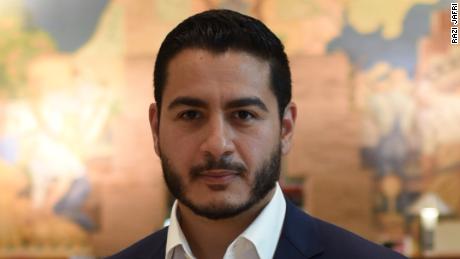
Abdul El-Sayed
The national mood isn’t banners, streamers, and big booming political speeches — it’s intimate and focused on fixing what’s broken. So what this convention lacks in raucous stage moments, it has delivered in personal portraits of Americans whose real problems demand answers.
In many ways, the new format has exceeded what a traditional format could have delivered — especially for a moment like this.
Those lived experiences are what we ought to stay fixated on — the family longing to be reunited with their deported mother because of President Trump’s brutal immigration policies; lives devastated by gun violence; and the young people organizing to save the Earth, literally.
These are the people our politics should serve — and perhaps this unconventional convention has reminded us of that.
Further, Covid-19 has taken away Vice President Joe Biden’s best political asset: his legendary personability. Without the mainstays of a traditional campaign that creates moments for interpersonal interactions with a candidate, Biden’s found himself stuck inside a box on Zoom.
Yet glimpses from people like the grandmother of an intern with whom he spoke for half an hour give us insight into that personability in a unique way.
Tuesday’s roll call also broke the convention mold. It took a perfunctory and banal procedure and turned it into a trip from sea-to-shining sea.
Though many of the stories shared throughout Wednesday night highlighted the need for strong public policy on immigration, gun violence, small business support, and health care, Democrats could be doing more during the convention to point up the chasm between their public policies and Donald Trump’s.
Notably, the only two speeches to focus directly on policy were Senator Bernie Sanders’s Monday address and Senator Elizabeth Warren’s excellent speech on universal childcare tonight.
Regardless, this will surely be a convention we remember — not just because we were all stuck at home to watch it — but because it reminded us who we are, and who we need to yet be.
Doug Heye: DNC night three ends with not one but two bangs

Douglas Heye
How you finish is usually more important than how you start — and Wednesday night at the Democratic National Conventionended with a bang. Two of them.
Her self-deprecating joke about losing to Trump fell flat. It’s hard to deliver humor in this kind of setting, but for Democrats, is losing to Donald Trump a laugh line?
On to the real show.
Former President Barack Obama was forceful and eloquent, simultaneously touching on Americans hopes and fears. He’s good at things like this, to put it mildly. As with his wife’s remarks the night before, speaking in an empty room added weight to hiswords that an arena filled with loud supporters in funny hats might have diminished.
Following Barack Obama is a tough task. Vice Presidential nominee Kamala Harris was not going to hit the heights of an Obama — few can.
That planning is clearly paying off: the party has leaned into the virtual and socially distanced requirements to produce a tightly-packaged, successful presentation.