

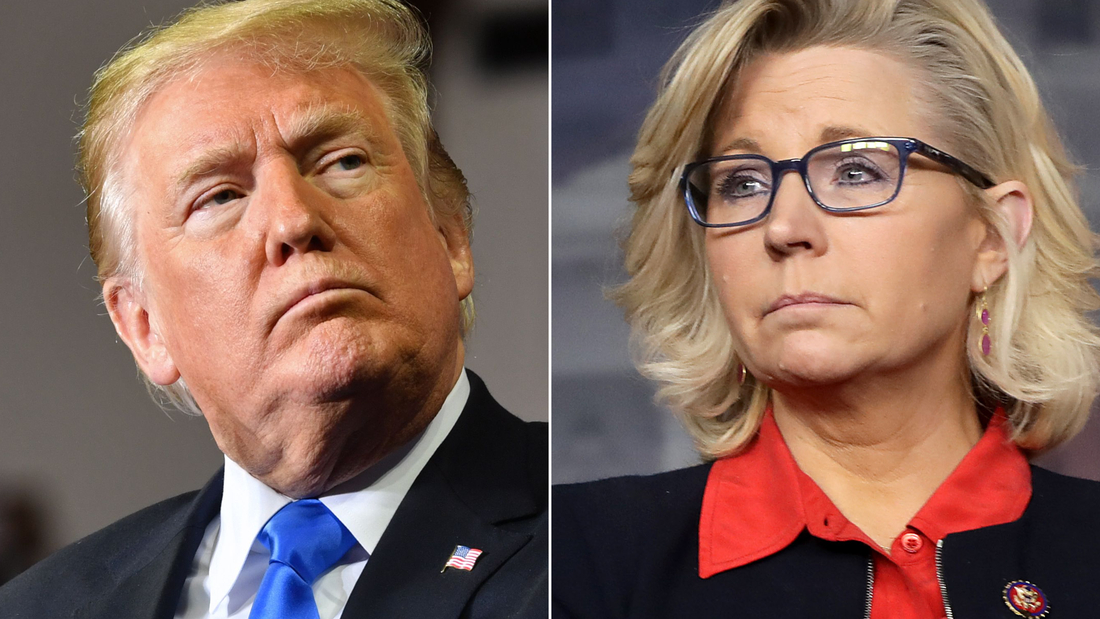
Analysis: The GOP of Cheney, Bush and Romney feels like ancient history
“The Fraudulent Presidential Election of 2020 will be, from this day forth, known as THE BIG LIE!” Trump declared in a statement Monday.
The layers are thick; he’s calling the election a lie because he can’t or won’t admit defeat, and in the process weaving the biggest lie around him like a security blanket.
Facts are hazardous things for certain Republicans at the moment. Wyoming Republican Rep. Liz Cheney, the most vocal truth-telling Republican, and so perhaps the most endangered, tweeted a new rebuke to the false narrative Monday.
“The 2020 presidential election was not stolen,” Cheney tweeted. “Anyone who claims it was is spreading THE BIG LIE, turning their back on the rule of law, and poisoning our democratic system.”
They write: Multiple Republican lawmakers and aides say that Cheney is on very shaky ground internally and whether she can hang on to her post in a secret-ballot election is highly uncertain.
When Cheney easily survived a bid to oust her in February, (House Minority Leader Kevin) McCarthy came to her defense and called on the House GOP Conference to keep her in the spot in a speech delivered behind closed doors.
This time, however, could be different. A House GOP source who has been in contact with McCarthy said the GOP leader has been “furious” at her for weeks amid her comments about Trump.
That’s the most recent Republican presidential nominee and the daughter of the former Republican vice president on the outs with the party’s base.
The ground is shifting under our feet. But the party has been moving in this direction for some time. Romney, although disgusted by Trump’s antidemocratic power grab, courted some of the same sentiments that Trump pushed. He won the 2012 Republican nomination in part by pledging to be severely conservative and making life so difficult for undocumented immigrants that they would want to leave the country, for instance.
Why can’t we just move on? What’s interesting is that even Republicans who voted to reject the Electoral College results, seem to want to move on from the Big Lie, even as Trump keeps pushing it.
She asked if he has regrets about joining the effort to throw out millions of American votes and the misinformation about the election that is still alive and well among Republican voters.
“I made a decision based upon the facts that I knew at that point in time,” he said, arguing states improperly changed their election laws during the pandemic. But anyway. He added: “It’s time for this country to heal. It’s time for a spirit of forgiveness to be happening. It’s time for this country to work together and focus on the goals that we can solve together.”
Unintended consequences. Voters in Florida, Arizona and Texas won’t be able to move on. Trump’s big lie has led to changes in the way they’ll vote. The Washington Post has an interesting look at early voting by mail, which historically benefited Republicans in Florida, and whether changes pushed through by the GOP-controlled state government could hurt Republican candidates more than Democrats.
What does the party stand for? Georgia GOP Rep. Marjorie Taylor Greene had sought to start an America First in Congress to push Anglos-Saxon political traditions. That effort appears to have been snuffed out, but there is clearly desire bubbling out of the party to embrace racial heritage.
That’s not a good look, according to George W. Bush, the former two-term Republican president who was asked about it by The Dispatch. (Reminder: His vice president was Liz Cheney’s dad, Dick.)
“If the Republican Party stands for exclusivity — you know, it used to be country clubs, now evidently it’s White Anglo-Saxon Protestantism — then it’s not going to win anything,” he said.
What is real and what is imagined? Bush was asked about Taylor Greene’s proposed caucus, but how far is the leap from Anglo-Saxon political ideals to the anger shown by Republican lawmakers at the 1619 Project, written to to uncover the paradox of American ideals of freedom being built upon the sin of slavery and now featured in some US school curriculum. 1619 is the year the first slaves were brought to North America.
Countering the 1619 project was President Trump’s 1776 Commission, which although it was ended by President Biden when he took office, submitted a 41-page refutation of the 1619 project on Monday.
Focus on the freedom rather than the slavery, in other words. From there, it’s much easier to simply write off racial injustice and severe inequality.
But Hemmer also draws a line between the fight over how to teach history and a larger gaslighting of the American public. She describes them as “part of the alternative reality constructed by conservative media.”
It’s arguably all part of the big lie, where facts are mangled to create a black and white reality.