

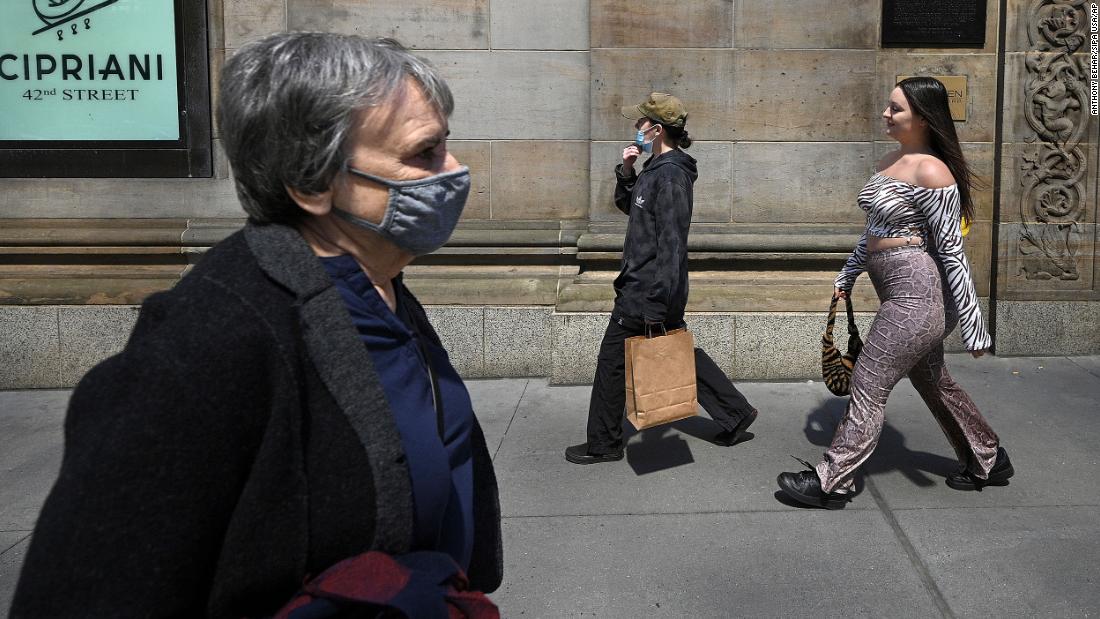
Some fully vaccinated Americans say they will keep wearing their masks outdoors, despite new guidelines
“I will probably still wear my mask and avoid shaking hands for a long while,” he says.
For Soto and many other pandemic-weary Americans, this is a tricky time. The vaccinated are emerging from 14 months of social isolation into a world where key questions remain about where and when to wear a mask.
Is that unmasked person near me vaccinated? If I don’t wear a mask, am I setting a bad example or making others uneasy?
Pandemic trauma has boosted fears about going out without a mask
Discrepancies between state and local rules are adding to the confusion.
In Texas, Soto can opt to go maskless. Gov. Greg Abbott lifted the state’s mask mandate in March, allowing businesses to reopen at full capacity. But even with his invigorated immune system, Soto plans to keep wearing a mask in public, with or without crowds.

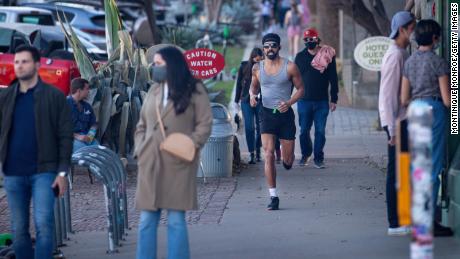
Pedestrians walk in Austin before Texas Gov. Greg Abbott ended the state’s mask mandate in March.
“I will admit that I am afraid of being judged by people who are less concerned than me. It makes me not want to wear the mask so I can avoid stares and judgment,” he told CNN. “But I will just have to push through that because my health and the health of my family is more important.”
Health experts say such concerns are the result of a year of pandemic trauma.
Even in a post-pandemic world, some people will experience fear, confusion and anxiety, says Dr. Hector Colon-Rivera, president of the American Psychiatric Association’s Hispanic caucus.
Some people are finding it hard to let go of their face masks, an item they’ve associated for months with saving lives, he told CNN. Those who’ve lost loved ones to coronavirus may have an especially difficult time.
“It’s like suffering from a form of PTSD or trauma that will make some people hyper-vigilant,” Colon-Rivera says.
Some Americans remain concerned about the variants
With all the fear and uncertainties, keeping a mask on for now just makes sense for some people.
Lexie Little, a master’s student at the University of Georgia, is fully vaccinated and eager to spend time with her family. But even though the self-described “people person” is looking forward to a time when she can see smiles again, she’ll continue wearing her mask when she’s around crowds and unvaccinated people for a while.
“I want to protect others around me from potentially contracting the virus,” she says. “Science continues to evolve surrounding the spread by those who have already been vaccinated, so I’m waiting for more clarification before doing away with the mask in daily life outside my bubble.”


A customer wearing a face mask interacts with a Delta employee at Hartsfield-Jackson International Airport in Atlanta.
“Variants continue to pose a threat as researchers examine their spread, but I have been encouraged by recent findings surrounding vaccine efficacy against the B.1.351 and B.1.1.7 variants,” she told CNN.
The variants may help explain why despite the apparent effectiveness of the vaccines, concerns over catching the virus are not going away.
Others will keep a mask on to protect children
Emily Rivera just got her Johnson & Johnson shot this week. The Centreville, Virginia, resident will continue following the CDC recommendations on mask-wearing indoors. But she also plans to keep wearing her mask in public long after the pandemic is declared over — partly to protect her four children.
“It’s such a habit and has definitely helped with the flu and cold season,” she told CNN. “I’m not sure I’ll believe we’re past the pandemic for a while anyhow.”
Rivera says she was not a fan of wearing masks at first and found them claustrophobic. But she’s gotten more used to them and believes they have made her family less sickly this year.
“And it’s definitely warmer on walks,” she says.

Ditching masks may feel strange to some people after a year of wearing them, one expert says.
Elle McKenna of Oakland, California, is fully vaccinated but plans to wear a mask in public indoor spaces and outdoor spaces with lots of people.
“The vaccines work very effectively, but not everyone is vaccinated, community transmission is still happening, and children cannot be vaccinated yet,” McKenna says.
“There is a need to set a good example for others, and to work together to minimize transmission as much as possible.”
Even after coronavirus is no longer a risk, McKenna plans to continue wearing a mask to protect against the flu and similar viruses that can be risky to people with weakened immune systems.
The pandemic has made some people more germophobic
Despite the lifting of mask mandates, many Americans may also be reluctant to go maskless because they’re at risk of other respiratory illnesses or just afraid of germs, one expert says.


The Austin Motel displays a message on its marquee encouraging people to wear masks.
“Changing routines can be most challenging,” he told CNN.
Public health authorities have documented a significant decline in flu cases since people began wearing masks in the pandemic, he says.
“The pandemic has certainly brought the value of good daily practices in personal hygiene, and their benefits … against (disease).”
So for now, many Americans will err on the side of caution.