

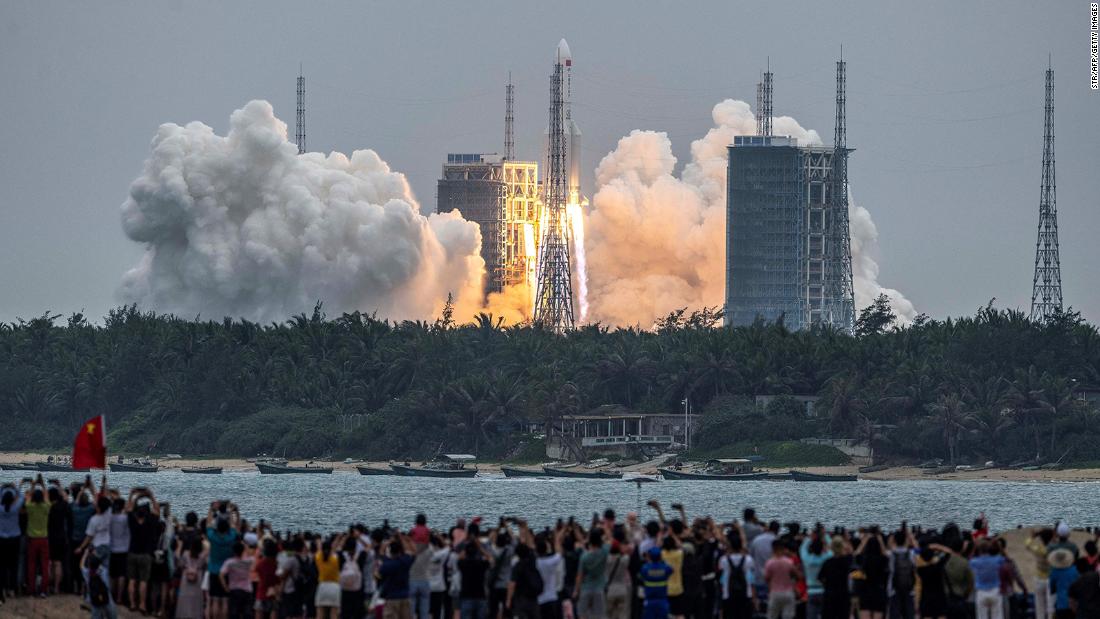
For a week, space agencies and experts tracked China’s Long March 5B’s trajectory, speculating where debris would fall upon the rocket’s uncontrolled reentry
In China, however, the country’s space administration stayed silent for days amid criticism that allowing such a large rocket stage to free fall towards Earth was irresponsible and posed a safety risk — albeit a small one — to many countries.
For many who have followed the rocket’s return, the news came as a big relief. In China, it was not only seen as a vindication of the rocket’s design, but also used by state media to argue that the intense global attention was merely a Western effort to discredit China’s space program and thwart its progress.
“These people are jealous of China’s rapid progress in space technology,” the paper said. “Some of (them) even try to use the noises they made to obstruct and interfere with China’s future intensive launches for the construction of its space station.”
While Beijing has long accused Western countries and media of holding China to a different standard, Chinese officials also routinely have a nationalist response to any criticism, branding it an ill-intended attempt to “smear China.”
Such fierce defensiveness is particularly evident when it comes to China’s space program, an important point of national pride for the Chinese public and a source of prestige for the ruling Communist Party.
The defensiveness to criticism from the West, especially the United States, is partially born out of what Beijing perceives as Washington’s hostility to block its progress beyond Earth’s atmosphere.
As a result, China is building its own space station, the Tiangong (meaning heavenly palace in Chinese). Last month, it successfully launched its first module with the Long March B5 — the rocket that drew the world’s scrutiny.
In blaming the West for their “smear campaign,” however, Chinese state media and space experts omitted to explain why the Long March B5 had caused anxiety among global scientists.
Rocket stages are often dropped before they reach orbit along trajectories that can be predicted before the launch. And when they are designed to reach orbit, they usually come with devices that allow more controlled reentries and aim for the ocean. Or they are left in so-called “graveyard” orbits that keep them in space for decades or centuries. The Chinese rocket, estimated to weigh over 20 tons, is the largest space object to return uncontrolled to Earth in nearly three decades — and a major deviation from the practice of other space agencies.
But amid deepening political mistrust of the US, and a lack of technological exchanges, meaningful scientific international exchanges with Beijing are being sidestepped in favor of fanning the flames of nationalist anger.
Around Asia
- Over a year into the pandemic, the southeast Asian country of Laos has recorded its first Covid-19 related death.
- A top international medical journal has blasted the Indian government for ignoring warnings of a second coronavirus wave, encouraging complacency and failing to be transparent on Covid-19 data.
- In the Afghanistan capital Kabul, the death toll from a bomb attack on a girls school has risen to 68, with more than 165 injured. The community of Shiites from the Hazara ethnic minority has previously been a target of terror attacks.
- Meanwhile on Everest, a “line of separation” will be set up at the summit to prevent the mingling of climbers from Covid-hit Nepal and those ascending from the Tibetan side.
The business of China: Alibaba leads busy week for earnings
The company is still expected to post an 11% increase in net income for the fiscal year ended March when it reports Thursday, according to analysts polled by Refinitiv — even after taking into account the $2.8 billion fine imposed this spring.
Alibaba has been a particularly notable target. The fine was reached after antitrust regulators concluded that the online shopping giant had been behaving like a monopoly, and was equivalent to 4% of Alibaba’s sales in China in 2019, according to state news agency Xinhua. Alibaba said when the fine was announced that it had accepted the penalty with “sincerity and will ensure our compliance with determination.”
The earnings calendar across Asia is heavy this week, with a few other tech firms scheduled to report. Chinese electric carmaker Xpeng is slated to release results on Thursday — the company has recently touted a strong uptick in revenue for 2020 as it sells more cars, though it still hasn’t reported a profit yet. The electric vehicle market in China is fierce, with Chinese and foreign companies alike battling for market share.
Taiwan-based electronics manufacturer Foxconn, meanwhile, will report results Friday. The company — which is the main assembler of Apple products such as the iPhone and iPad — recently warned it has taken a hit because of the Covid-19 pandemic, which briefly forced it to suspend production last year. Foxconn has also said it is closely monitoring the global chip shortage this year.
— By Laura He

Alibaba was hit with a record fine earlier this year for behaving like a monopoly.
Leopard on the loose
Residents living near the Hangzhou Safari Park, which did not inform the public for a week that the leopards had escaped, spotted the wild cats last week and alerted authorities, according to an announcement from the Fuyang District government.
Surveillance footage posted online showed one of the leopards walking near the upscale Jinyuan Villa area east of the park on Friday.


This partially sedated juvenile leopard was captured on May 8, having escaped a week earlier from a safari park in Hangzhou, China.
In a statement Saturday, the zoo said it was “sincerely sorry” for not alerting people sooner, adding: “We were worried that the announcement of the incident would cause panic.” The statement said administrators felt as the leopards were all juveniles, there was little risk, but added it was a mistake and “we sincerely accept the criticism” made by the public.
The Hangzhou Safari Park has been closed while local authorities investigate. The person in charge of the park was taken into police custody.
Photo of the day

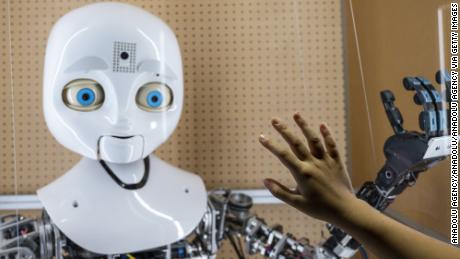
Making a connection: A visitor puts her hand against the glass in front of the “Nexi” robot display during an exhibition at the Hong Kong Science Museum on May 8, 2021. The “Robots” exhibition explores the 500-year story of humanoid robots and the artistic and scientific quest to understand what it means to be human.