

Six NHS trusts in England declare critical incidents amid Covid staffing crisis
Now Blackpool hospitals declare ‘critical incident’ amid spiralling staff absences: At least six NHS trusts in England raise alarm… as health chief claims there’s a ‘politicised attempt’ to downplay situation
Blackpool Teaching Hospitals became latest to signal it may be unable to deliver vital care in coming weeksMorecambe Bay and United Lincolnshire Hospitals also among trusts to warn of strain caused by absencesDeclaring a critical incident enables hospitals under pressure to get help from other nearby NHS trusts One in 10 NHS staff nationally are isolating with Covid and even higher absence rates at individual hospitals
<!–
<!–
<!–<!–
<!–
(function (src, d, tag){
var s = d.createElement(tag), prev = d.getElementsByTagName(tag)[0];
s.src = src;
prev.parentNode.insertBefore(s, prev);
}(“https://www.dailymail.co.uk/static/gunther/1.17.0/async_bundle–.js”, document, “script”));
<!–
DM.loadCSS(“https://www.dailymail.co.uk/static/gunther/gunther-2159/video_bundle–.css”);
<!–
At least half a dozen NHS trusts across England have declared ‘critical incidents’ amid a staff absence crisis and rising Covid hospital admissions caused by the rapid spread of Omicron.
Blackpool Teaching Hospitals became the latest trust to signal it may be unable to deliver vital care to patients in the coming weeks because so many medics are off isolating.
Trust bosses said the internal incident was declared due to ‘operational challenges across the organisation’, including Blackpool Victoria Hospital running at ‘full capacity’ and staff absence levels running at over 10 per cent.
Declaring an incident allows hospitals to get help from other nearby NHS trusts and means services can be reprioritised at speed, for example to focus on emergency care.
Morecambe Bay and United Lincolnshire Hospitals are also among the hospital trusts to have raised the alarm. NHS leaders say at least six trusts in total have declared incidents but some have not done so publicly.
One in 10 NHS staff nationally were off sick on New Year’s Eve, with Covid to blame for around half of the 110,000 absences — despite the quarantine period being cut from 10 to seven days.
Daily Covid cases have hovered above 100,000 for nearly two weeks straight amid fears the staffing crisis will only get worse, and there are growing calls for England to follow the US and France and cut self-isolation to five days.
Matthew Taylor, chief executive of the NHS Confederation, claimed there was a ‘politicised attempt’ to downplay the pressure the health service is facing.
Mr Taylor, a chief adviser to Tony Blair when he was Prime Minister, told Times Radio: ‘We’ve got to recognise that in the next few weeks… things are going to be very, very difficult.’
Boris Johnson yesterday ruled out imposing more restrictions ‘for now’, claiming that Omicron was ‘plainly milder’, but said he recognised that the NHS was under ‘considerable’ strain. The PM is under massive pressure from his backbench MPs who have slammed calls for more Covid restrictions to protect the NHS from a staffing crisis.
Daily Covid hospitalisations have doubled in the past fortnight to 1,915 but there is a growing acceptance that they will remain much lower than in previous peaks. Admission rates in Omicron-epicentre London also appear to have peaked already.
Doctors on the frontline have seen a rise in people testing positive after being admitted for a different reason, and say patients primarily sick with Covid are being discharged quicker compared to earlier waves. Fewer are needing to be hooked up to ventilators.
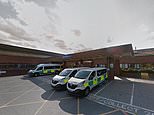
Morecambe Bay hospital (left) and United Lincolnshire Hospitals (right) are among the trusts that have signalled they may be unable to deliver vital care to patients in the coming weeks due to staffing crises caused by the rapid spread of Omicron
The above graph shows the proportion of Covid patients needing ventilators while Delta was dominant (November) and after Omicron took hold (late December). It shows the proportion has halved, in yet another sign the disease is milder
Natalie Hudson, Chief Operating Officer at Blackpool Teaching Hospitals NHS Foundation Trust (BTH), told the Blackpool Gazette that increased demand and staff absences were putting its hospitals under strain.
The trust is responsible for Blackpool Victoria Hospital and two smaller community sites, Clifton and Fleetwood hospitals.
Ms Hudson said: ‘Like hospitals across the country, we are currently seeing very high demand for our services and long waits to be seen in our emergency departments and across our urgent care pathways, continued challenges to discharge patients who no longer medically need to be in hospital but have nowhere to go or no care package in place, and very high levels of bed occupancy, all of which is exacerbated by rapidly rising rates of Covid-19 in our communities and rising rates of admission to hospital which is creating further pressures around discharge, as well as a significant impact on staff absence rates across the organisation.
‘Because of the pressures the trust is under, we have made the decision to declare an internal critical incident which means staff across the trust will be working together today to take actions immediately to attempt to alleviate the pressure we are under including stepping down some non-urgent activity in order to deliver all of the things we can and need to do to provide the very best care possible.
‘We will also be working across the Fylde Coast with our partners too, to ensure care packages and support are provided as quickly as possible to aid discharge, and encourage the public to help us respond to this period of high demand by doing everything they to protect their families and friends by ensuring they are fully vaccinated and following guidance around social distancing, wearing a mask, and washing their hands, and crucially seeking help from the most appropriate health services, only attending A&E for serious accidents and emergencies, and using NHS 111 first to seek advice about the most appropriate care for your needs.’
Chris Hopson, chief executive of NHS Providers, which represents trusts, told Sky News that approximately half a dozen hospitals across the country have declared critical incidents in the last five days.
He said: ‘It is a sensible, planned thing to do to ensure that trust can carry on providing the services that it needs to provide, particularly the critical and essential services.’
Despite this, Mr Hopson also stressed while there are some staff shortages within the NHS, they are localised.
There has been a suggestion that up to a quarter of staff could be off work with coronavirus if rates continue to spiral, but Mr Hopson does not believe this will be the case.
Maggie Throup, minister for vaccines and public health, told Sky News that the incidents were going to be ‘very short-term’.
‘I think the critical incidents are announced and then they can be very short-term ones and it’s saying to the other trusts around ‘can we have some extra help, can we have some mutual aid.’
‘Sometimes it’s just a matter of hours that the critical incident is in place for, other times it’s longer.
‘But it’s actually reaching out to the wider NHS to say we have got a problem in this particular area and it’s sometimes quite geographical as well and for different reasons, it can be staff shortages, it could be other reasons.’
Asked if the Government had a handle on the situation, she said: ‘It definitely does.
‘Obviously there’s meetings on a very, very – well, on a daily basis with the key people within NHS England and there’ll be an update later on that situation.’
Hospitals in Lincolnshire declared a staffing emergency over the weekend, illustrating the workforce crisis that prompted ministers to draw up plans to recruit 20,000 reservists to help ease winter pressures.
Bosses at United Lincolnshire Hospitals warned that so many doctors and nurses were now absent from shifts that patient care was ‘compromised’, especially for stroke and heart patients.
The trust, which runs four major hospitals in the county, saw 7.5 per cent of its 8,500 employees off sick on Boxing Day, according to the NHS’s latest workforce data which showed around 68,000 medics were absent nationwide.
But leaked documents revealed the nationwide crisis had dramatically worsened by New Year’s Eve. NHS bosses won’t update official staff absence numbers until later this week.
Morecambe Bay NHS Trust in Lancashire also declared the incident last night amid rising Covid hospital admissions and staff testing positive for coronavirus.
Speaking to BBC Radio 4’s Today programme this morning, Dr Sakthi Karunanithi, public health director for Lancashire County Council, said the county was at ‘the foothills’ of an Omicron wave.
He said: ‘Lancashire is beginning to experience what London did at the beginning of last month and, of course, London is better resourced and the infrastructures are well organised compared to other regions.
‘So we are bracing ourselves for a tsunami of Omicron cases in Lancashire.
‘We are clearly seeing a shift from 20s and 30s and 40-year-olds being affected by Omicron to a clear shift to a more 60-plus age group being affected, and that is what is causing us concern as well as the immediate concern being absence, staff absence, both in the NHS and education – schools are just going to re-open this week.
‘But this is all meaning that we are not able to concentrate on the non-Covid issues, that’s really needing to be addressed immediately as well.
‘So it’s a double challenge we face: not only fighting Covid but all the other pent-up demand and need due to non-Covid issues.’
There are now growing calls among scientists, politicians and business leaders for the self-isolation period to be cut to five days to prevent vital services being forced to shut.
But Mr Taylor, from the NHS Confederation, said the NHS did not want staff going back into hospitals with Covid and risk passing it on.
He told Times Radio that reducing the self-isolation period to five days should only be done if the science ‘said it was absolutely safe’.
On the outlook, he said: ‘We should feel some hope and confidence about the medium term, that we hope that we will gradually become more able to live with Covid as the Prime Minister has said, that when Omicron has gone through us that we make it to that stage and the NHS will recover.
‘On the other hand, we’ve got to recognise where we are now, we’ve got to recognise that in the next few weeks at least things are [going to be] very, very difficult.
‘I think that one thing that people in our service find difficult is that it does seem as though there’s a kind of almost politicised attempt to suggest that things aren’t as difficult as they are, that any suggestion that we should sustain the restrictions or whether it’s personal responsibility or policy.
‘And if you’re working in health service, you see the reality, and what you want politicians, what you want people, to be driven by is the data and what’s happening at the front line, and let’s not be in the business of… getting away from the reality of this.’
He said the judgment on restrictions ‘needs to be driven by the data and what’s in the best interests of the country’, adding: ‘It shouldn’t be driven by a kind of political virility symbolism, where the sooner we can be free, the better it is, regardless of the effects. Let’s carry on being driven by the data.’
He said the data would not become clearer until the end of this week or the start of next week.
Mr Taylor did admit that hospital admissions seem to have ‘perhaps plateaued in London or there may be a second peak after the new year now, but it’s rising across the rest of Britain’. Others have also warned that rates could still increase in London, with infections now rising in over-60s.
He said that even without Covid, the NHS is 100,000 staff short, ‘so we have a long-term failure in terms of workforce planning and resourcing’.
He added: ‘The problem with staff absence is that it is unpredictable and lumpy in the sense that you don’t know where somebody is going to get sick and, when somebody does get sick, it’s then more likely that other people in that team will get sick and hospitals and healthcare systems are complex, they’re inter-dependent, so … if you lose paramedics then the ambulance can’t go out, and if ambulances can’t go out then that means there’s more pressure on other services.
‘So, those interdependencies and the unpredictability of staff absence means NHS leaders having to work around the clock just thinking about how they can deploy their resources best to deal with the most urgent and pressing needs.
‘Even using all their imagination and creativity, it is becoming almost impossible, which is why we see hospitals declaring critical incidents.’