

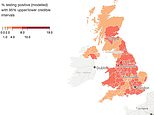
As many as one in five people in London’s worst-hit boroughs may have had Covid on New Year’s Eve
As many as one in FIVE people in London’s worst-hit boroughs may have had Covid on New Year’s Eve – but capital’s crisis WAS slowing, surveillance data reveals (so, how many people were infected in YOUR area?)
ONS analysis estimated 3.3million people were infected on any given day during the week in England A maximum of 18 per cent of people may have been infected in Tower Hamlets in the south of LondonInfections are falling in London, with around 7.8 per cent of people thought to have the coronavirus
<!–
<!–
<!–<!–
<!–
(function (src, d, tag){
var s = d.createElement(tag), prev = d.getElementsByTagName(tag)[0];
s.src = src;
prev.parentNode.insertBefore(s, prev);
}(“https://www.dailymail.co.uk/static/gunther/1.17.0/async_bundle–.js”, document, “script”));
<!–
DM.loadCSS(“https://www.dailymail.co.uk/static/gunther/gunther-2159/video_bundle–.css”);
<!–
Nearly one in five people in London‘s worst hit boroughs may have had Covid on New Year’s Eve, official surveillance data showed today — although infections were slowing in the Omicron hotspot.
Office for National Statistics (ONS) analysis estimated 3.3million people were infected on any given day during the week to December 31, up more than 60 per cent on the previous spell.
It means one in 15 people were thought to have the virus during the week, with the incidence even higher in London where one in 10 are estimated to have been infected.
And the numbers were higher still in some of the worst hit parts of the capital, with statisticians giving an upper estimate of 18 per cent of people being infected in Tower Hamlets in the south of the city.
But despite the huge wave of cases caused by the Omicron variant in London, early sign suggest infections are falling, with around 7.8 per cent of people thought to have the virus — down from 9.3 per cent the previous week.
Experts believe infections may have already peaked in the capital, which saw the supermutant variant become dominant first, in a positive sign for the rest of the country.
The ONS’ weekly infection survey is regarded as the most reliable indicator of the UK’s outbreak because it uses random sampling of around 100,000 people, rather than relying on people coming forward to be tested.
More up to date case data from the UK Health Security Agency (UKHSA) shows positive tests fell for the first time in XXX across the UK yesterday.
The Office for National Statistics (ONS) estimated a record 3.27million people in England were infected on any given day in the week to December 31, up more than 60 per cent on the previous week
despite the huge wave of cases caused by the Omicron variant in London, early sign suggest infections are falling, with around 7.8 per cent of people thought to have the virus on December 31 — down from 9.3 per cent the previous week. Graphs show: The average infection rate over the week in regions across England
The percentage of people testing positive for Covid continued to increase across all age groups in the week, the ONS said
The ONS data shows London no longer has the highest infection rate in the country, with the North West, Yorkshire and the Humber and North East overtaking the capital.
But several boroughs in the city still far exceed most of the rest of England on a more local level, with the City of London, Hackney and Islington having the second highest rate, with a maximum of 16.4 per cent infected.
It was followed by Nottingham (13.8 per cent), but five of the other top ten areas were based in London: Southwark (13.7 per cent), Hammersmith and Fulham, Lambeth (both 13.5 per cent), Greenwich (13.3 per cent) and Wandsworth (13.2 per cent).
The figures are the ONS statisticians’ upper estimates made for infection rates, meaning the true number with the virus may have in fact been lower.
And the data suggests infections were already falling in the capital, in line with several other data sources suggesting London’s Omicron wave has already peaked.
Infections are still increasing in other regions of the country, however, with the biggest jump seen in the North East, where the rate increased 11 per cent in a week.
After the North West (10.7 per cent), Yorkshire and the Humber had the highest rate with 7.9 per cent, followed by the North east (7.3 per cent) and London (7.2 per cent).
The percentage of people testing positive for Covid continued to increase across all age groups in the week, the ONS said.
Statisticians said: ‘For those in school Year 7 to school Year 11 and those aged between 25 and 49 years, the trend in the percentage testing positive was uncertain in the last few days of 2021.
‘This may mean that infections are no longer increasing among these age groups, but it is currently too early to suggest if this is a continuing change in trend.
‘Caution should be taken in over-interpreting any small movements in the latest trend.’
Infections were highest in young people aged from school year 12 to 24 years old (8.34 per cent) and those aged 25 to 34 (7.83 per cent) and primary school children (7.72 per cent).
People aged 70 and over had the lowest rate in the country (2.2 per cent) but they saw the highest rise in the country, nearly doubling in a week.
Experts feared cases would increase in the age group over the festive period because of higher levels of intergenerational mixing.