

Traditional old sayings and phrases are falling out of use
Pip pip – you’re ready for the Knackers Yard! Traditional old sayings and phrases are falling out of use as Britons confess they no longer use or even UNDERSTAND them
Terms at risk include ‘pearls before swine’ and ‘nailing your colours to the mast’Research came from a survey of 2,000 adults, aged between 18 and 50Perspectus Global, who commissioned poll, said it shows how language evolves
<!–
<!–
<!–<!–
<!–
(function (src, d, tag){
var s = d.createElement(tag), prev = d.getElementsByTagName(tag)[0];
s.src = src;
prev.parentNode.insertBefore(s, prev);
}(“https://www.dailymail.co.uk/static/gunther/1.17.0/async_bundle–.js”, document, “script”));
<!–
DM.loadCSS(“https://www.dailymail.co.uk/static/gunther/gunther-2159/video_bundle–.css”);
<!–
Some of the English language’s most traditional old sayings and phrases are falling out of use, with many Britons now no longer using or even understanding then, according to a survey.
The national research, carried out among 2,000 adults found the top 50 expressions most at risk of never being uttered again.
Top of the list came the term casting ‘pearls before swine’ – meaning you are wasting your time by offering something that is helpful or valuable to someone who does not appreciate it – with 78 per cent of people saying they never use it in conversation.
It originates from the sixth verse of the seventh chapter of the Gospel of Matthew in the New Testament of the bible, as translated by William Tyndale in 1526.
That verse reads: ‘Geve not that which is holy to dogges nether cast ye youre pearles before swyne lest they treade them vnder their fete and ye other tourne agayne and all to rent you.’
The phrase went on to be repeated by some of the most renowned British writers including Shakespeare and Dickens.
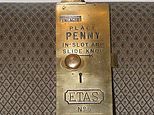
‘Spend a penny’, meaning to need to use the lavatory, refers to the use of coin operated locks on public toilets in the 19th century
‘Mad as a hatter’ is also on the list, and though popularised through the Mad Hatter character in Lewis Carroll’s Alice in Wonderland, the origin of the phrase pre-dates it
The study found the majority (71 per cent) of modern Brits have never used the saying, ‘nailing your colours to the mast’ to mean, declaring their beliefs openly, a phrase which dates back to the 17th century, when nautical battle colours – or flags – were lowered as a mark of submission.
It was also the custom in naval warfare to direct one’s cannon fire at the opponent’s ship’s mast, thus disabling it.
If all of a ship’s masts were broken the captain usually had no alternative but to surrender.
If the captain decided to fight on this was marked by hoisting the colours on the remnants of the ship’s rigging, that is, by ‘nailing his colours to the mast’.
Meanwhile, the research also found that saying goodbye with a cheery ‘pip pip’ might gain you bemused stares from 70 per cent of Brits under the age of fifty.
Its first known use was in 1907 and is thought to have originated by imitating the sound of a horn.
And you may ‘know your onions’ – meaning you are experienced or knowledgeable on a subject – however 68 per cent of Brits have never heard of the phrase, or use it in conversation.
In terms of its origin, some suggest it comes from British lexicographer and grammarian C T Onions, who worked on the Oxford English Dictionary in the 1960s.
However, it is also claimed that its birth came four decades earlier, being published for the first time in Harper’s Bazaar magazine in the United States in 1922.
It was one of a set of such phrases, all with the sense of knowing one’s stuff, or being highly knowledgeable in a particular field, that circulated in the 1920s.
Others were to know one’s oats, to know one’s oil, to know one’s apples, to know one’s eggs, and even to know one’s sweet potatoes.
‘A nod is as good as a wink’, meaning that you don’t need to be blatant with a signal if someone is willing to carry out a task, is no longer relevant for 66 per cent of Brits.
This saying dates back to the 16th century, with the longer version of phrase being: ‘A nod is as good as a wink to a blind horse.’
Even the classic proverb ‘a stitch in time saves nine’ is gobbledygook to 60 per cent of those who took part in the study.
Other classics include ‘spend a penny’, meaning to need to use the lavatory, which refers to the use of coin operated locks on public toilets which were first introduced outside the Royal Exchange in London in the 1850s.
However, its first recorded citation wasn’t until 1945, when it appeared in H. Lewis’s Strange Story.
‘Mad as a hatter’ is also on the list, and though popularised through the Mad Hatter character in Lewis Carroll’s Alice in Wonderland, the origin of the phrase pre-dates it.
Mercury was historically used in the making of hats and was known to have affected the nervous systems of hatters, causing them to tremble and appear insane.
The use of mercury compounds in 19th century hat making and the resulting effects are well-established, with mercury poisoning still known today as ‘Mad Hatter’s disease’.
A ‘curtain twitcher’ is a nosy person who watches his or her neighbours, typically from a curtained window
‘Knackers yard’ is also on the list – which dates back to the 19th century and refers to places where old and injured animals, usually horses – were killed
‘Knackers yard’ is also on the list – which dates back to the 19th century and refers to places where old and injured animals, usually horses, were killed.
‘Knackers’ was also once used to mean castanets, which then saw it become a slang term for testicles. This was used by James Joyce in his 1922 classic Ulysses, in which he wrote: Eh, Harry, give him a kick in the knackers.’
That meaning in turn led to verb to ‘knacker’, which originated in late 19th century as a synonym for castrate and not until about 1970 did it take on its current familiar meaning of exhaustion.
‘Curtain twitcher’, which is a nosy person who watches his or her neighbours, typically from a curtained window, is included as well.
The survey was based on a nationally representative sample of 2,000 adults, aged between 18 and 50.
But there is hope for some of these fascinating expressions, as 73 per cent of respondents believe it is a shame when phrases die out.
Ellie Glason from Perspectus Global who commissioned the poll said, ‘It’s interesting to see from our research, how language evolves and changes over the years.
‘It would seem that, many of the phrases which were once commonplace in Britain, are seldom used nowadays.’
Despite the fact many sayings and phrases might be dying out, four out of five Brits believe we have the richest and descriptive language in the world.