

Opinion: Voters’ power is being stripped away with the stroke of a pen
They warned redistricting alone could determine control of the US House for the next decade, and that Republicans, once again, had the upper hand. They feared another unhappy ending with maps — rather than voters — determining election results, a sequel to the influential GOP-directed effort of a decade ago: REDMAP II: The Wrath of Karl Rove!
But read the latest reviews and there’s been a plot twist, of sorts. “Democrats avert total redistricting doomsday,” pronounced Politico. “Surprising,” declared NBC News.
Indeed, by some online counts, it’s the Democrats that could come out ahead after redistricting, perhaps netting as many as three seats heading into the midterms. If this trend continues, some observers calculate, the national Congressional map could be as balanced as it has been at any time since the landmark US Supreme Court cases of the 1960s sparked the reapportionment revolution.
That would be quite an unexpected turn: Republicans had monopoly power to draw 187 congressional seats, while Democrats had complete control over just over 75. Many Democrats expected to battle not only historically stiff midterm winds, but also to run uphill on maps tilted toward the GOP.
Here’s the problem with that analysis: First, it’s premature. Only 31 states have finished drawing — and Republican lawmakers in Tennessee and New Hampshire have passed maps that erase Democratic seats. Tennessee Governor Bill Lee signed the proposal in his state, while New Hampshire’s proposal awaits its governor’s signature. GOP lawmakers in Florida and Missouri are still debating exactly how aggressive their gerrymanders should be.
Meanwhile, litigation could change the picture even in states that have enacted maps. Late last Friday, North Carolina’s state supreme court overturned a congressional map that many analysts believed would gift Republicans at least 10 of the state’s 14 seats. That pushed several Democratic seats that the GOP had moved red back into the blue column. Then late Monday, the US Supreme Court restored an Alabama congressional map that a lower court had ordered reworked to more accurately represent the state’s racial diversity. That shifted a seat from red to blue to red again, and ended Democratic hopes that it might also create additional Black opportunity districts in Louisiana and South Carolina. Pending cases from New York (drawn by Democrats) Ohio (by the GOP) could unravel similarly lopsided maps — and dramatically rework the calculus again.
Second, the punditry doesn’t align with the facts. A rigorous new study by three top scholars finds that while the US House map has a fairer partisan balance than it did a decade ago, it remains skewed in favor of Republicans.
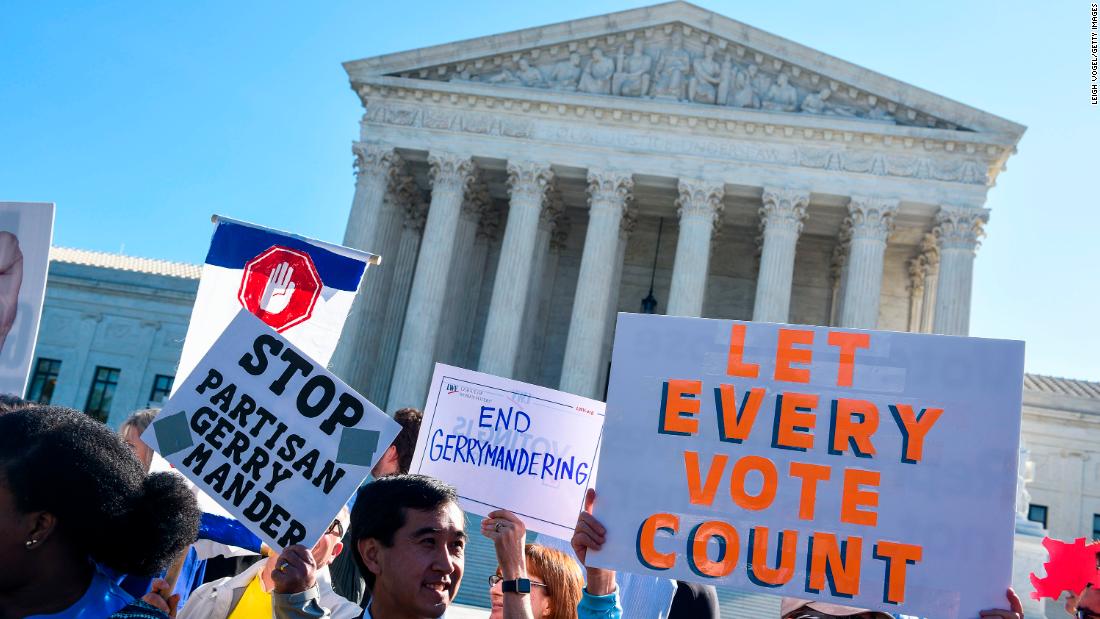
More importantly, looking at redistricting solely as a Red vs Blue horse race distorts what a partisan bloodbath this cycle has actually been. When the US Supreme Court halts the new map in Alabama, after all, what’s important is not that it costs Democrats a likely seat. It’s that it perpetuates the historical underrepresentation of Black voters. It’s voters — especially voters of color in Alabama, Texas and Georgia, but also red-state Democrats and blue-state Republicans — who end up short-changed and underrepresented. And when wildly uncompetitive districts turn low-turnout party primaries into the only race that matters, gerrymandering accelerates our already toxic polarization and pushes policy to extremes.
Gerrymandering, after all, isn’t just about nabbing seats from the other side. It’s about making your own seats safer — and less competitive for voters — after a decade of demographic and political change. Indeed, as this cycle concludes, the number of competitive congressional districts will dwindle to the lowest number in modern times. At the current pace, according to a New York Times estimate, there will be fewer than 40 competitive US House seats nationwide after redistricting, down from nearly 75 following last decade’s redistricting. With 435 seats in the House, that means about one in every 11 will be a contest without a predetermined winner. That’s not exactly “averting doomsday.”
Both parties have wiped competitive seats off the board. While Republicans overwhelmingly gerrymandered more Congressional districts and state legislatures 10 years ago, Democrats have been just as aggressive this cycle in states where they have complete control. The brazen gerrymander passed by New York Democrats last week not only locked in 22 blue seats in a 26-member delegation, but eliminated all four of the competitive districts where President Biden and Donald Trump finished within five points of each other in 2020.
Researchers have found the bulk of the decline in competitive seats can be attributed to a handful of GOP maps in states like Texas, Georgia and Indiana. Republicans, who had already maxed out their gains in many of the states under their control, have also tried to erase the remaining competitive seats in red states that provided Democrats with the path to the House majority in 2018. Democrats, after all, did not overcome GOP gerrymandering to win the House: According to a Brennan Center analysis, more than 70% of the seats that flipped were drawn by courts and commissions, and then they pulled an inside straight with purplish seats in some states.
Take Oklahoma, for example, where a Democrat, Kendra Horn, captured the competitive fifth district in 2018. Republicans dismantled that seat by cracking Oklahoma City and spreading those Democratic voters across three different districts, all of which favor the GOP by wide margins. (Trump won the district by 5 percentage points in 2020; under these lines he would have won by 19.) It’s a similar story in Utah, which Trump easily won in 2020 despite losing Salt Lake county, the largest in the state, home to nearly 40% of Utahns. Two different Democrats won a competitive district there during the last cycle, but that won’t happen again: The new map divides Salt Lake across four districts, attaching a small piece of urban blue to a giant swath of rural, conservative red.
Republicans look likely to zero out similar competitive seats won by Democrats in 2018 in Kansas and South Carolina, and shored themselves up in the suburbs of Omaha and Indianapolis. Tennessee’s new map slices blue Nashville into so many parts that veteran Democratic lawmaker Jim Cooper took one look at the new lines and retired. Republicans snagged a seat in New Hampshire by swapping 75 towns and more than 365,000 people into a new district.
If everything’s bigger in Texas, so are the redistricting shenanigans. There were 12 competitive Congressional elections here in 2020. Post-redistricting? Only one.
Texas provides a good example of how lawmakers entrench themselves at the expense of communities of color. Minority population growth — largely Latino and Asian — drove 95% of the population growth that earned Texas two additional seats in Congress. But Latinos and Blacks lose political power under the new maps — and those two new seats were drawn to elect White conservatives.
Just look at the way Texas lawmakers turned the 24th congressional district — the rapidly expanding suburbs of Dallas and Fort Worth — inside-out to keep a growing Latino district red. In 2020, this district went for Biden by 5 percentage points, and provided the state’s closest congressional battle; GOP incumbent Beth Van Duyne held off Candace Valenzuela’s bid to become the first Black Latina in Congress by 1.3 percentage points. The new 24th is a funhouse inversion of itself, made safely Republican by putting majority-minority cities like Valenzeula’s hometown of Carrollton through a paper shredder and scattering those largely Latino voters across five different congressional districts.
There was good news this cycle. New commissions in Michigan and Colorado did show that citizens can draw balanced, responsive maps. State supreme courts in Ohio, Virginia and North Carolina have defended constitutional protections against extreme maps that pick winners and losers.
And if — a big if — the two parties fight to a draw and neither side “wins” redistricting (and Republicans are still likely to emerge with an edge), that’s better news than expected at a time when our democracy can use it.
But better than expected isn’t good enough. A frozen, nationalized map provides voters with very little choice. It’s vulnerable to being hijacked by extremes in party primaries. And when seats can’t budge, it runs the very real risk of being non-responsive to the public will.
Perhaps this cycle’s gerrymandering horror show is less over the top, perhaps the villains are harder to identify. The ending is likely to be the same: The People’s House belongs to the mapmakers.