

Cop who watched as Derek Chauvin murdered George Floyd CRIES at civil rights trial
Cop who watched as Derek Chauvin murdered George Floyd CRIES at civil rights trial: Says he thought killer restraint appeared ‘reasonable’
Thomas Lane, 38, a former Minneapolis charged with violating George Floyd’s civil rights, testified at his federal trial on Monday Lane cried on the stand as he recalled seeing Floyd’s face in the ambulance after cops had kneeled on his neck to arrest him Initially, Lane thought Floyd was OK, and testified that he thought he saw Floyd’s chest rise and fall, initially believing the restraint to be ‘reasonable’ But when Lane saw him in the ambulance, he recalls that Floyd ‘didn’t look good’ Lane’s attorney, Earl Gray, rested his case Monday All three former Minneapolis officers are charged with depriving Floyd of his right to medical careChauvin was convicted in state court of murder and pleaded guilty in December to a federal civil rights charge Tou Thao and J. Alexander Kueng, presented their cases last weekThao said he was relying on the other three officers to care for Floyd’s medical needs while he controlled the crowd and trafficKueng, who like Lane was a rookie, said he deferred to Chauvin
<!–
<!–
<!–<!–
<!–
(function (src, d, tag){
var s = d.createElement(tag), prev = d.getElementsByTagName(tag)[0];
s.src = src;
prev.parentNode.insertBefore(s, prev);
}(“https://www.dailymail.co.uk/static/gunther/1.17.0/async_bundle–.js”, document, “script”));
<!–
DM.loadCSS(“https://www.dailymail.co.uk/static/gunther/gunther-2159/video_bundle–.css”);
<!–
An ex-Minneapolis cop who watched as Derek Chauvin murdered George Floyd sobbed as he recalled the deadly incident in court Monday – but said he believed Chauvin’s restraint to be ‘reasonable’ at the time.
Thomas Lane, 38, told his trial for violating Floyd’s civil rights that Chauvin had defended putting Floyd on his stomach because of the excited and delirious state he was in during his May 2020 arrest.
Lane told jurors that Chauvin said: ‘That’s why we got him on his stomach and that’s why the ambulance is coming.’
Explaining his initial take on the nine minute restraint that ultimately killed Floyd, Lane said: ‘It just seemed reasonable at the time.’
Lane also testified at his federal trial that he thought Floyd was doing OK while handcuffed, facedown on the street until paramedics arrived and turned the 46-year-old over.
‘He didn’t look good,’ Lane said, as he wiped away tears recalling seeing Floyd’s face.
Lane said he then got into the ambulance to help and was told to do life-saving chest compressions, he said.
‘I wasn’t sure if he was breathing or not,’ Lane said, as he paused a few times and sniffed.
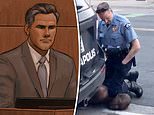
Former Minneapolis police Thomas Lane got choked up and teary eyed in court Monday as he recalled seeing George Floyd’s face after Chauvin knelt on his neck
Thomas Lane, 38, testified at his federal trial that he thought Floyd was doing OK while handcuffed, facedown on the street until paramedics arrived and turned the 46-year-old over
George Floyd was murdered by Chauvin during an arrest in Minneapolis in May 2020
Lane and three other officers had struggled to put Floyd into a squad car just moments earlier while responding to a complaint that he had used a counterfeit $20 bill at a corner store.
Lane said Floyd stopped resisting after about four minutes on the ground. He recalled asking if they should roll Floyd onto his side, and Chauvin said no.
As Lane was holding onto Floyd’s legs, he thought he saw Floyd’s chest rise and fall, Lane testified, and believed Floyd still had blood pressure based on the appearance of veins in his arm.
When the ambulance arrived, a paramedic checked for a pulse in Floyd’s neck. Since the paramedic did not act with urgency, Lane said he still believed Floyd was OK.
Minneapolis Police Officers Thomas Lane, left and J. Alexander Kueng, right, escorting George Floyd, center, to a police vehicle outside Cup Foods in Minneapolis, on May 25, 2020
Former police Officer Derek Chauvin kneels on the neck of George Floyd, a handcuffed man who was pleading that he could not breathe
Lane’s testimony concluded the defense’s case on Monday at the trial for himself, and two other officers, J. Alexander Kueng, Thomas Lane and Tou Thao.
All three are charged with violating George Floyd’s civil rights ignored their extensive training and did nothing to save his life as fellow Officer Derek Chauvin pinned his neck under his knee on May 25, 2020.
Derek Chauvin, 45, was sentenced in June last year to 22 and a half years in prison for murdering Floyd. He is awaiting a separate trial for violating Floyd’s civil rights.
Kueng and Thao are also charged with failing to intervene to stop Chauvin in the May 25, 2020, killing that triggered protests worldwide over police brutality and racism.
Kueng knelt on Floyd´s back and Thao kept bystanders back.
On cross-examination on Monday, Lane told prosecutor Samantha Trepel that he was trained that he had a duty to intervene and to provide medical care if needed.
Lane said when someone doesn’t have a pulse, CPR should be started as soon as possible ‘in ideal situations,’ but said that isn´t always possible in law enforcement.
Defense attorneys for three officers rested their cases Monday afternoon, paving the way for closing arguments.
Derek Chauvin, 45, was sentenced in June last year to 22 and a half years in prison for murdering Floyd. He is awaiting a separate trial for violating Floyd’s civil rights
J. Alexander Kueng is also charged with failing to intervene to stop Chauvin in the May 25, 2020, killing that triggered protests worldwide and a re-examination of racism and policing
Tou Thao is also charged with failing to intervene to stop Chauvin in the May 25, 2020, killing that triggered protests worldwide and a re-examination of racism and policing
Attorney Earl Gray questions Thomas Lane before U.S. District Judge Magnuson during his trial in the killing of George Floyd in federal court on Monday
Prosecutor Samantha Trepel questions Thomas Lane before U.S. District Judge Magnuson during his trial in the killing of George Floyd in federal court on Monday
Earlier, Lane testified that Floyd struggled with officers as they tried to put Floyd into a squad car while responding to a complaint that he had used a counterfeit $20 bill at a corner store. Lane said he called an ambulance because Floyd was bleeding.
Once officers had Floyd on the ground, Lane said, they considered using a hobble – a restraint device that would have required that Floyd be put on his side so that he could breathe more easily. The hobble has straps that bind the ankles together, and can also attach to someone’s waist.
Lane said Thao got the device, but then it was suggested that they not use it. Lane said Thao noted that if they used the device, they would have to call a supervisor to the scene. Also, the device would have to be removed for paramedics.
‘It seemed kind of excessive because we had an ambulance coming,’ Lane said.
Lane said he also suggested putting Floyd´s legs up, since he was kicking, but that ‘Officer Chauvin said, `No, we´re good.”
Lane said Floyd stopped resisting after about four minutes on the ground. He recalled asking if they should roll Floyd onto his side, and Chauvin said no.
Lane said he was worried about ‘excited delirium,’ a disputed condition that he said he understood to be kind of an ‘adrenaline overdose.’
Lane also said that at one point, he heard a bystander say Floyd wasn´t breathing, but Lane responded that he was. Asked why he said that, Lane testified, ‘I could see his chest rise and fall.’
He said even after he couldn’t find a pulse in Floyd’s ankle, he thought Floyd still had blood pressure because he could see that the veins in Floyd’s arm were raised.
When the ambulance arrived, a paramedic checked for a pulse in Floyd´s neck. Since the paramedic did not act with urgency, Lane said he still believed Floyd was OK.
Prosecutors have argued that the officers violated their training by not rolling Floyd onto his side or giving him CPR. Defense attorneys have attacked the department’s training as inadequate and have highlighted a culture that they said emphasized deference to senior officers like Chauvin.
Lane agreed with Trepel that he was trained to move someone from a prone position if possible. He also acknowledged that in statement to state investigators about six days after the killing, he said he felt like the situation ‘could have been handled differently.’
Kueng and Thao testified last week. Thao said he was relying on the other three officers to care for Floyd´s medical needs while he controlled the crowd and traffic. Kueng, who like Lane was a rookie, said he deferred to Chauvin.
Lane, who followed in the steps of his father, grandfather and great-grandfather when he became a Minneapolis police officer, testified that cadets were told to call officers ‘Sir or ‘Ma´am,’ and stand at attention when they came in the room.
Lane, who is white; Kueng, who is Black; and Thao, who is Hmong American, also face a separate state trial in June on charges alleging that they aided and abetted murder and manslaughter.
Chauvin, who is white, was convicted in state court of murder and pleaded guilty in December to a federal civil rights charge.
Bystanders, including Alyssa Funari, filming at left; Charles McMillan, center left in light colored shorts; Christopher Martin, center in gray, with hand on head; Donald Williams, center in shorts; Genevieve Hansen, filming, fourth from right; Darnella Frazier, filming, third from right, witness as then Minneapolis police officer Derek Chauvin pressed his knee on George Floyd’s neck for several minutes, killing Floyd on May 25, 2020
Defense attorneys in the federal trial for three officers charged with violating George Floyd’s civil rights have rested their cases, paving the way for closing arguments.
Thomas Lane’s attorney, Earl Gray, rested his case Monday. Lane’s co-defendants, Tou Thao and J. Alexander Kueng, presented their cases last week.
Lane testified that he thought Floyd was doing OK while handcuffed, facedown on the street with Officer Derek Chauvin’s knee pressed to his neck, until paramedics arrived and turned the 46-year-old Black man over.
Thao told the jury that he was relying on the other three officers to care for Floyd’s medical needs while he controlled the crowd and traffic. Kueng like Lane was a rookie and said he deferred to Chauvin.
All three are charged with depriving Floyd of his right to medical care. Kueng and Thao are also accused of failing to intervene to stop Chauvin in a killing that triggered protests worldwide and a re-examination of racism and policing.
Kueng knelt on Floyd’s back, Lane held his legs and Thao kept bystanders back.
During the monthlong trial, prosecutors have argued that the officers violated their training by not rolling Floyd onto his side or giving him CPR.
Defense attorneys have attacked the department’s training as inadequate and have highlighted a culture that they said emphasized deference to senior officers like Chauvin.