

Russia-Ukraine crisis to hit pockets of struggling British families
Gas prices surge by 13% after Germany slams brakes on approval of Nord Stream 2 pipeline – as experts warn UK household bills and food prices could soar during Ukraine crisis
There were hopes that supply of gas to Europe could be boosted with the Nord Stream 2 pipeline from RussiaBut Germany has halted process of certifying it as West started taking punitive measures against MoscowStock markets fall and oil prices rise to highest level for seven years after Russia ordered troops into Ukraine Brent crude reached $99.5 a barrel at one stage – highest since 2014 – due to fears over disruption to supplies Financial experts highlight Europe’s dependency on Russia for oil & gas as well as key ingredients like wheat
<!–
<!–
<!–<!–
<!–
(function (src, d, tag){
var s = d.createElement(tag), prev = d.getElementsByTagName(tag)[0];
s.src = src;
prev.parentNode.insertBefore(s, prev);
}(“https://www.dailymail.co.uk/static/gunther/1.17.0/async_bundle–.js”, document, “script”));
<!–
DM.loadCSS(“https://www.dailymail.co.uk/static/gunther/gunther-2159/video_bundle–.css”);
<!–
The Nord Stream 2 gas pipeline project was thrown into chaos today by the crisis in Russia – causing oil and gas prices to soar even further amid concerns this will hit UK consumers, along with higher inflation on food costs.
There had been hopes that supply of gas to Europe could be boosted with the Nord Stream 2 pipeline from Russia and therefore help bring down prices for consumers – but Germany has today taken steps to halt the process of certifying this project, as the West started taking punitive measures against Moscow over the Ukraine crisis.
The move saw European and UK gas prices surge today amid concerns of energy supplies across the continent being disrupted. Benchmark European gas prices jumped by 13 per cent, while the UK equivalent rose 8 per cent.
Nord Stream 2 was built to help Germany meet its energy needs, particularly as it switches off its last three nuclear power plants and phases out the use of coal – and it had resisted calls by the US and others to halt the project.
The undersea line directly links Russian gas to Europe via Germany and is complete but not yet operating. It has become a major target as Western governments try to exert leverage on Russia to deter further military moves.
It runs parallel to an earlier Nord Stream pipeline and would double its capacity each year. The project also means Gazprom can send gas to Europe’s pipeline system without using existing pipelines through Ukraine and Poland. The pipeline has been filled with gas but had been awaiting approval by Germany and the European Commission.
German Chancellor Olaf Scholz, speaking during a press conference with Irish Premier Micheal Martin today, said that he had asked the German officials to halt the review process for the major gas pipeline project.
‘The situation we find ourselves in today is a completely different one,’ Mr Scholz said, adding that this meant no certification process was now possible. ‘That sounds technical, but it is the necessary administrative step so there can be no certification of the pipeline and without this certification, Nord Stream 2 cannot begin operating.’
Meanwhile stock markets tumbled while oil prices rose to their highest level for seven years after Russia ordered troops into two breakaway regions of Ukraine, and it comes amid the backdrop of the UK’s cost of living crisis.
Brent crude surged to its highest level since September 2014, reaching $99.5 a barrel at one stage due to fears over disruption to supplies, with Moscow’s actions set to prompt new sanctions from governments on Russia.
Financial experts today highlighted Europe’s dependency on Russia for oil and gas as well as key food ingredients such as wheat, meaning that sanctions would ‘hit hard’ and supply shortages ‘could see prices shoot up further’.
The UK will unveil sanctions on Russian after President Vladimir Putin recognised two regions of eastern Ukraine as independent states and began moving in troops and tanks for ‘peacekeeping’ duties in Donetsk and Luhansk.
There are fears that Russia – the world’s second largest oil producer – may look to retaliate in response to sanctions by the West, in particular holding back oil and gas supplies and therefore reducing supply to the global market.
Shares tumbled amid the crisis today, with the FTSE 100 index falling more than 1.5 per cent at one stage after heavy overnight drops seen in Asia, before London’s top tier pared back declines to settle 0.5 per cent down.
The Hang Seng index in Hong Kong tumbled 2.7 per cent, sparking heavy falls across Europe when markets opened today – including Germany’s Dax dropping 0.7 per cent and the Cac 40 in France falling 0.5 per cent.
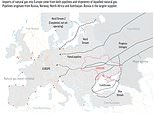
Financial experts have pointed out Europe’s dependency on Russia for natural gas, as shown in this Associated Press graphic
The price per therm in pence is shown for UK natural gas prices, which could be set to soar due to the situation in Ukraine
An above water tie-in is performed during the Nord Stream 2 pipeline construction in the Baltic Sea in September last year
The Nord Stream 2 gas line landfall facility in Lubmin, north-eastern Germany, is pictured in September 2020
Susannah Streeter, senior investment and markets analyst at Hargreaves Lansdown, told MailOnline today: ‘Already oil and gas prices are marching upwards as Russia put boots on the ground in Eastern Ukraine, and as fears of an escalation of the situation mount, it’s led to expectations of even higher prices to come.
‘Wars are by their very nature inflationary and this would particularly be the case with Ukraine, when considering Europe’s dependency on Russia for oil, gas and key ingredients like wheat, so sanctions would hit hard and shortages of supplies could see prices shoot up further.’
She added that there had been hopes that supply of gas to Europe could be boosted, helping bring down prices with the use of the Nord Stream gas pipeline – but these have now been dashed.
This is because Germany has halted its approval in response to the latest Russian action in Ukraine – with German Chancellor Olaf Scholz saying that the certification of the Nord Stream 2 project cannot go ahead.
Ms Streeter continued: ‘If a full blown conflict breaks out, there is also likely to be significant disruption to ship movements around the Black Sea. This could lead fuel higher food inflation given that Ukraine, Russia, Kazakhstan and Romania all ship grain from ports in the area.
‘Already petrol and diesel have hit fresh highs at the pumps causing yet more pain for consumers already caught in the grip of the cost of living crisis.
‘The extra pounds on bills are piling up for hard hit families, with the increase in fuel, energy and grocery bills set to hit lower income households harder as a higher proportion of their outgoings will be spent on travel costs. With budgets being squeezed further the likely knock on effect will be a hit to consumer confidence after any lockdown savings are worn away.’
Also today, National Farmers’ Union president Minette Batters said the eyes of the world were focused on tensions between Russia and Ukraine today.
Speaking at the NFU annual conference, Ms Batters added: ‘I would hope there are some in Government who are taking note that these two countries produce 30 per cent of global wheat exports.’
And Adrian Lowery, personal finance expert at investing platform Bestinvest, told MailOnline: ‘Evidently oil prices have risen in response to the worrying developments in the eastern republics Ukraine, with Brent Crude up more than 3 per cent at one point to a seven-year high of more than $99 a barrel.
‘It won’t take long for that to feed into higher petrol and diesel prices, which have already hit record levels at 149p and 152p respectively.
‘Global oil prices are now up 51 per cent in a year and that is still feeding through into the supply chain for many goods and services.
‘Even if out-and-out conflict in Ukraine doesn’t transpire, inflation looks like staying higher for longer – even if the Bank of England’s forecast peak of 7.25 per cent in April isn’t exceeded.’
He added that energy prices are ‘at the forefront of consumer inflation’ and while the UK is not directly affected by Germany’s mothballing of NordStream 2, there will probably be a knock-on effect on wholesale gas prices.
This therefore means any hoped-for moderation in domestic energy prices is less likely to materialise this year.
Mr Lowery continued: ‘Inflation is a threat to all British households. In the absence of wage increases that keep pace with it, inflation will reduce the standard of living. For those with savings it will erode the value of their cash deposits, and for those with investments it will eat into the returns that are made.
‘And crucially, with these geo-political tensions heightening the inflation outlook, the outlook for interest rates could ramp up.
‘If tensions in Ukraine spark a sell-off in global stock markets – which is by no means certain, as equities have shown resilience today – then the Bank of England and other central banks will be in a tricky situation, because they will find it very difficult to come to the rescue with lower rates or quantitative easing in such an inflationary environment. But rate rises could in a crisis situation be slowed or postponed.
‘As long as markets remain relatively undamaged, we can expect interest rates to rise further this year, and mortgage rates to increase with the base rate. Smaller banks might increase savings rates to attract customers but don’t expect any of the big High Street banks to offer any decent savings rates any time soon.’
On the subject of not importing Russian oil and gas, Prime Minister Boris Johnson said today that this would help with energy security.
He added: ‘In the UK we have been able to reduce our dependency on Russian gas very substantially. Only 3 per cent of our gas supplies now come from Russia.’
Mr Johnson said the response includes granting licences for UK gas reserves but also shifting to low-carbon energy, including nuclear power.
He added: ‘The faster this country can be more self-reliant on our own energy, the more prosperous we will be, but also, of course, the more sustainable our energy prices will be, and that will benefit the UK consumer.’
Meanwhile, Russ Mould, investment director at AJ Bell, said the latest sell-off on the stock markets today came as investors moved to dump shares in commodity producers, particularly those with exposure to Russia or Ukraine.
He said this would keep volatility high on stock markets across the globe.
Mr Mould said: ‘The threat of Russia invading Ukraine was clearly visible at the end of 2021, but most investors were more concerned about inflation and how fast interest rates might go up.
An output filtration facility of a gas treatment unit at the Slavyanskaya compressor station in Russia, operated by Gazprom, which is the starting point of the Nord Stream 2 offshore natural gas pipeline. The site is pictured in July last year
Tatneft’s Taneco oil refining and petrochemical complex in Nizhnekamsk in Tatarstan, Russia, pictured on February 11
The Sasco Angara container ship owned by Sakhalin Shipping leaves Zolotoy Rog bay in Vladivostok in Russia last November
‘Now the threat of war is very real, and investors will need to add it to their growing list of things to worry about. This could prompt another bout of panic and lead to heightened market volatility.’
Today, Mr Johnson said Britain is sanctioning three wealthy allies of Vladimir Putin and five Russian banks, as he announced a ‘first barrage’ of punitive measures in response to the ‘renewed invasion’ of Ukraine.
The Prime Minister warned today that Moscow sending troops into the Donbas region under the guise of being ‘peacekeepers’ appears to be the Kremlin ‘establishing the pretext for a full-scale offensive’, with nearly 200,000 troops amassed on Ukraine’s border.
Mr Johnson told the Commons that immediate sanctions are being deployed against three ‘very high net wealth individuals’ – Gennady Timchenko, Boris Rotenberg and Igor Rotenberg – whom he described as ‘cronies’ of the Russian president.
The sanctions, which include UK asset freezes, a travel ban and prohibition on British individuals and businesses dealing with them, were also tabled against Russian banks Rossiya, IS Bank, General Bank, Promsvyazbank and the Black Sea Bank.
‘This the first tranche, the first barrage, of what we are prepared to do, and we hold further sanctions at readiness to be deployed,’ Mr Johnson told MPs, before warning it is ‘inevitable’ he will return with a ‘much bigger package’.
The Prime Minister also applied pressure on European football governing body Uefa not to hold its Champions League final in St Petersburg in June, saying there should be ‘no chance of holding football tournaments in a Russia that invades sovereign countries’.
Mr Johnson added: ‘The House should be in no doubt that the deployment of these forces in sovereign Ukrainian territory amounts to a renewed invasion of that country.
‘And by denying Ukraine’s legitimacy as a state – and presenting its very existence as a mortal threat to Russia – Putin is establishing the pretext for a full-scale offensive.’
But he faced calls to go further on sanctions now from Sir Keir Starmer, as well as some Tory MPs.
The Labour leader said he understands the tactic of holding back sanctions to deter an invasion past the Donetsk and Luhansk regions in the east of Ukraine but said ‘a threshold has already been breached’.
He said a sovereign nation ‘has been invaded in a war of aggression’, and ‘if we do not respond with the full set of sanctions now, Putin will once again take away the message that the benefits of aggression outweigh the costs’.
Former Tory leader Sir Iain Duncan Smith suggested Russia should be hit ‘hard and hit them now’ to increase the pain of the current incursion.
Commons Defence Committee chairman Tobias Ellwood said ‘sanctions alone will not be enough’ and warned that ‘untargeted sanctions may play into Putin’s plan to pivot Russia ever-closer to China’.