

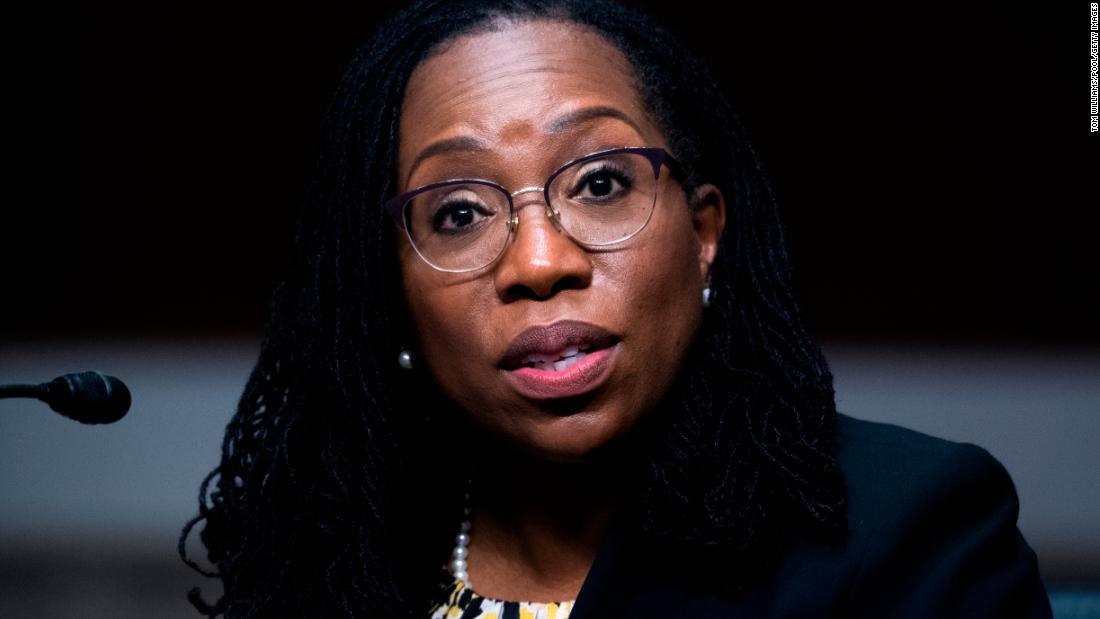
Opinion: What kind of justice will Ketanji Brown Jackson be?
Judge Ketanji Brown Jackson is an eminently qualified public servant with distinguished experience as a federal judge, and her historic nomination promises an end to the erasure of Black women from our most sacred legal institutions. She brings extensive litigation experience at every level of the federal court system, including distinguished service as a federal public defender. As a district court judge, she ruled on over 550 cases and is renowned for her careful, methodical approach to ensuring equal justice under the law on reproductive rights, disability rights and workers’ rights.
Frankly, this is a nomination that should unite the country. Diversity strengthens the integrity of the institution to the broader public and, in particular, the many Black women who face many of the harshest injustices of our system today. It’s critical for the US Supreme Court to understand the impact of its rulings in the real world, and it can’t do that until it reflects the country it governs. Jackson will move us closer to a more fair and just system for women, for Black Americans and for everyone on the side of equality before the law.
It is incumbent upon US senators to give her a fair and timely confirmation without obstruction, honoring their constitutional duty to advise and consent — and their moral duty to treat her with the respect and dignity she deserves.
Fatima Goss Graves is president and CEO of the National Women’s Law Center.
Elie Honig: A nominee Republicans will be hard-pressed to oppose
First things first: it’s about time. It’s long past time. For the first time in the history of the US Supreme Court, a Black woman has been nominated as a Justice.
Senate Republicans can act one of two ways in the wake of Jackson’s nomination. They can dig in and oppose it, but they don’t have much of substance to work with — and they’ll likely lose anyway, given the current Democratic Senate majority (which will presumably be coupled with the votes of three Republicans who supported her federal appellate judgeship).
Elie Honig is a CNN senior legal analyst and former federal and state prosecutor, and author of “Hatchet Man: How Bill Barr Broke the Prosecutor’s Code and Corrupted the Justice Department.”
Ed Whelan: Senate Republicans have an opportunity here
Biden selected Jackson for additional reasons, of course. Jackson has impressive credentials, and Biden likely feels confident that Jackson will implement the results-oriented, make-it-up-as-you-go-along “living constitutionalism” that progressives espouse.
The left is likely to make accusations of racism and sexism in response to any concerns expressed over Jackson’s vision of the judicial role. But if Senate Republicans assess Jackson on the basis of judicial philosophy, and don’t succumb to political pressure because of her race and sex, they will responsibly fulfill their constitutional duty to advise and consent.
The Democrats have control of the Senate, albeit slim control, so Jackson will almost certainly be confirmed. The process will probably be rather quiet. But Senate Republicans should use the opportunity to emphasize that judging is a craft that is distinct from policymaking. They can reinforce the message that the duty of a Supreme Court justice is to discern and apply the meaning that constitutional and statutory provisions bore when they were adopted, not to rewrite those provisions to advance an ideological agenda.
Ed Whelan holds the Antonin Scalia Chair in Constitutional Studies at the Ethics and Public Policy Center. A former law clerk to Justice Scalia, he is co-editor of “The Essential Scalia: On the Constitution, the Courts, and the Rule of Law” and of two other volumes of Scalia’s work.
Laura Coates: The power of seeing a former public defender nominated
As a prosecutor, I wielded a tremendous amount of power in the exercise of my discretion to pursue (or decline to pursue) charges and autonomy in the way I met my burden of proof. But like the power held by a co-equal branch of government, the power of prosecutors must be checked — not to disrupt the pursuit of justice but to further it. In a country where race and bias are far too frequently elevated above fairness, public defenders are the welcome foil to balance the system.
The relationship between public defenders and prosecutors may be necessarily adversarial, but it is always symbiotic. Prosecutors get all the credit (and blame) for ensuring accountability, as if they alone believe in it.
The public may mistakenly view those who represent the accused as soft on crime. Indeed, if past is prologue, I expect such an absurd talking point to emerge during Jackson’s confirmation hearings. But public defenders are not soft on crime — they are hard on injustice, which is precisely where we as a society must be. And precisely where a Supreme Court justice ought to be.
I sincerely hope Jackson is afforded the dignity she ensured for the presumed innocent: due process, fairness, equal protection from an abuse of power and a meaningful opportunity to be heard. After all, it’s the US Supreme Court.
Jeffrey Toobin: What kind of justice will Ketanji Brown Jackson be?
One thing that’s always said when there’s a US Supreme Court nomination is that presidents are often surprised by how their choices turn out. Presidents think the future justice will vote one way, and they wind up voting another way.
Don’t believe it. Especially in recent years, the art of picking Supreme Court justices has been refined to a science. All nine of the current justices largely vote in ways that would please the presidents who nominated them. That’s likely to be true if Judge Ketanji Brown Jackson is confirmed as well.
The myth of the surprised president dates principally from the presidency of Dwight Eisenhower, who nominated Earl Warren and William Brennan to the Supreme Court and found, to his dismay, that they were both powerful and outspoken liberals.
It’s true that President George H.W. Bush’s appointment of David Souter in 1990 ranks as a modest surprise, but his behavior as a moderate on the court was consistent with both his own earlier record as a judge and Bush’s overall approach to social issues. Also, 1990 was a long time ago.
In recent years, though, as the court has become the focus of fights on such issues as abortion, guns and affirmative action, ideology has become the main criteria for selections. Presidents (as well as their advisers and supporters) care a great deal about the possibility of ideological mistakes. So they don’t make them. President Joe Biden wanted a judicial liberal, and that’s what he will get with Jackson. She will not surprise him, or us.
Jeffrey Toobin is CNN’s chief legal analyst and the author of “The Nine” and “The Oath.”
A’shanti F. Gholar: An important step in addressing racial injustice
Judge Ketanji Brown Jackson’s nomination is an important step in addressing the injustices in the US judicial system, but it’s not the only step we need to take. America’s legal system has always looked different for Black women, who have historically been discriminated against. That will not change until we see more Black women jurists like Jackson in positions of legal power, and that begins with empowering Black women to be the leaders they deserve to be.
Jackson is the ideal role model in this regard. Her record is one that has championed equity and justice . She fought to defend the rights of incarcerated individuals, issued rulings that protected labor and women’s rights and upheld the integrity of our constitution when it was under attack by the Trump administration.
Along with her wealth of judicial expertise, she also brings with her experiences and identities that have never been enjoyed by another Supreme Court justice — and have been sorely missed in the highest court in America. I look forward to her swift approval process through the US Senate and hopefully to her being seated on a bench that doesn’t require her to bring her own folding chair.
Erwin Chemerinsky: Jackson may be the stabilizing force the Supreme Court needs
President Joe Biden simply could not have done better than his choice of Judge Ketanji Brown Jackson for the United States Supreme Court. In the world of law, credentials don’t get better than hers. A graduate of Harvard College and Harvard Law School, she clerked for judges in the federal district court and the federal court of appeals. She was also a clerk for Justice Stephen Breyer, who she is now poised to replace. Jackson has had extensive experience in a variety of settings and has served as a federal judge since 2013.
She also brings to the court experiences and perspectives the current justices lack. Most obviously, she is the first Black woman to be nominated to the Supreme Court. If confirmed, Jackson will also be the only justice on the current court to have worked as a public defender. She has significant experience as a trial judge, something only Justice Sonia Sotomayor has among those now on the high court.
As I think about what makes for a great justice, Jackson has it all: keen intelligence, enormous experience, unquestionable integrity, a terrific judicial temperament and a vision of justice. She should be confirmed swiftly by the Senate and start what will hopefully be a long career on the Supreme Court. Many will rightfully point out the fact that she won’t change the current ideological balance of the court by replacing Breyer. But if Jackson is still a justice in 2040 and 2050, she may be a stabilizing force on a very different court.
Erwin Chemerinsky is dean and Jesse H. Choper Distinguished Professor of Law at the University of California, Berkeley, School of Law. He is the author of “Presumed Guilty: How the Supreme Court Empowered the Police and Subverted Civil Rights.”
Jennifer Rodgers: The Supreme Court needs more diversity. Justice Jackson offers just that
Judge Ketanji Brown Jackson, President Joe Biden’s nominee to fill the retiring Justice Stephen Breyer’s seat on the Supreme Court, has it all. She is a highly accomplished lawyer and an experienced jurist with the sterling educational and clerkship credentials expected of someone about to ascend to the pinnacle of the legal profession. And, as a Black woman, Jackson will bring a historic perspective and important representation to the nation’s highest court.
Biden is right to prioritize elevating judges who bring different backgrounds and experiences to the courts, especially to the Supreme Court, where not a single justice has Jackson’s experience defending criminal cases. The Supreme Court needs more diversity, of all kinds; hopefully Jackson will be the first step in making that become a reality.
Jennifer Rodgers is a former federal prosecutor, adjunct professor of clinical law at NYU School of Law, lecturer-in-law at Columbia Law School and a CNN legal analyst.
Raul A. Reyes: A justice who sees the basic humanity of immigrants
In Judge Ketanji Brown Jackson, President Joe Biden has put forth a US Supreme Court nominee with impeccable credentials and a stellar legal background.
Jackson’s rulings on immigration are also important, as congressional inaction and legal challenges to immigration policy have given the Supreme Court an outsized role on this issue.
The Supreme Court holds immense power over our daily lives, on issues ranging from health care to the environment to reproductive and voting rights. At a time when many Americans have lost faith in institutions, Jackson will help restore trust and stability to the high court. Her historic nomination deserves bipartisan support.
Laphonza Butler: What Jackson proves about breaking the mold
President Joe Biden’s nomination of Judge Ketanji Brown Jackson as the first Black woman Supreme Court nominee in the court’s history is a tremendous moment for America. After a rigorous process, Jackson has proven that she has the experience and character to do this vital job.
As a Black woman, I am thrilled for what this means for me, my daughter and my community.
At EMILY’s List, we have seen far too many history-makers and ground-breakers have their accomplishments questioned and their qualifications undermined. But we know what Jackson’s example proves: to be the first and to break the mold, you bring qualifications, experience and character that is unrivaled.
I am proud to support her and look forward to the legacy she will hopefully create on the court.
Laphonza Butler is the president of EMILY’s List, the nation’s largest resource for women in politics. Butler grew up in Magnolia, Mississippi and served as a union leader and adviser to Vice President Kamala Harris’ presidential campaign.
Adam White: Jackson’s nomination gives senators an important incentive
Every US Supreme Court nomination presents an opportunity for Americans and our elected leaders to reflect on the court’s crucial, singular role in American government: to decide cases under the rule of law, according to the constitution and laws of our country.
Judge Ketanji Brown Jackson was recognized as the frontrunner for this seat because she is a respected judge on one of the nation’s most important courts. Her discussions with US senators, in visits and in the public hearing, will be an ideal forum for serious constitutional debate.
Judicial nominees are rightly reluctant to prejudge issues, especially when the nominee is a sitting judge. If Jackson follows this tradition, then senators will have all the more incentive to ask her about the bigger picture: her view of the court’s role in government and its responsibility to faithfully interpret the laws as written.
In an era when the Supreme Court is enduring partisan attacks on its legitimacy, and facing dangerous threats to pack the court for partisan purposes, it is crucial for senators — and all Americans — to know that the next justice is committed to preserving the rule of law and the court’s indispensable constitutional role.
Mini Timmaraju: A smart choice for upholding reproductive freedom
The anti-choice movement and its political allies spent decades working to install their ideologues on our nation’s highest court. The confirmations of Trump’s justices to the Supreme Court cemented a majority that is unmistakably hostile to abortion, and that won’t be easily undone. But confirming justices like Jackson is how we move closer to a future in which all of our families and communities thrive — a future in which there is equal justice for all of us.
With so much on the line, we can’t leave anything on the table in our fight to confirm Jackson to the court.
Mini Timmaraju is the President of NARAL Pro-Choice America, an organization that advocates for abortion access in USA.