

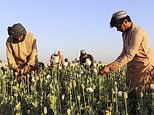
Taliban rulers of Afghanistan say anyone caught growing poppy crop will be subjected to Sharia law
Taliban BANS opium: Hardline rulers of Afghanistan say anyone caught growing poppy crop will be subjected to Sharia law
The Taliban has announced a ban on harvesting poppies used for making opiumThe group warned farmers their crops will be burned and they can face jail Poppies are a main source of income for millions of small farmers in Afghanistan
<!–
<!–
<!–<!–
<!–
(function (src, d, tag){
var s = d.createElement(tag), prev = d.getElementsByTagName(tag)[0];
s.src = src;
prev.parentNode.insertBefore(s, prev);
}(“https://www.dailymail.co.uk/static/gunther/1.17.0/async_bundle- -.js”, document, “script”));
<!–
DM.loadCSS(“https://www.dailymail.co.uk/static/gunther/gunther-2159/video_bundle- -.css”);
<!–
The Taliban announced a ban on opium today as they said anyone caught harvesting poppies today will be subjected to Sharia law.
The Taliban warned farmers in Afghanistan their crops will be burned and they can face jail if they proceed with the harvest.
However, Taliban sources said they were anticipating tough resistance from some elements within the group against the ban on poppy and that there had been a surge in the number of farmers cultivating poppy in recent months.
A farmer in Helmand who spoke on condition of anonymity said that in recent weeks prices of poppy had already more than doubled on rumours the Taliban would ban its cultivation. But he added that he needed to grow poppy to support his family.
‘Other crops are just not profitable,’ he said. The harvest and planting seasons vary across the country.
In the Taliban heartland of southern Kandahar the harvesting has begun but in the east of the country some farmers are just beginning to plant their crop.
In desperately poor Afghanistan the ban seems certain to further impoverish its poorest citizens at a time when the country is in an economic free fall.
The decree was announced by Taliban spokesman Zabihullah Mujahid at a news conference in the capital of Kabul.
Afghan farmers harvest poppy in Nad Ali district, Helmand province, Afghanistan (File image)
An Afghan farmer extracts raw opium from poppy buds at his farm on the outskirts of Kandahar, Afghanistan (File image)
The order also outlawed the manufacturing of narcotics and the transportation, trade, export and import of heroin, hashish and alcohol.
The ban is reminiscent of the previous Taliban rule in the late 1990s when the movement espousing a harsh interpretation of Islam outlawed poppy production.
At that time, the ban was implemented countrywide within two years, and according to the UN largely helped eradicate poppy production.
However, after the ouster of the Taliban in 2001, farmers in many parts of the country returned to poppy production.
Poppies are the main source of income for millions of small farmers and day labourers who can earn upwards of $300 (£228) a month harvesting them and extracting the opium.
Today, Afghanistan is the world’s largest producer of opium, despite billions of dollars spent by the international community during its 20 years in Afghanistan to eradicate the drug.
In 2021, before the Taliban takeover, Afghanistan produced more than 6,000 tons of opium, which the UN Office on Drugs and Crime said could potentially yield 320 tons of pure heroin.
Afghanistan produces more opium than all opium-producing countries combined and last year was the sixth straight year of record opium harvests.
During the years-long Taliban insurgency, the movement reportedly made millions of dollars taxing farmers and middle men to move their drugs outside Afghanistan.
Senior officials of the US-backed government also reportedly made millions on the flourishing drug trade.
Afghanistan’s ruling Taliban have announced a ban on poppy production, even as farmers across many parts of the country began harvesting the bright red flower that produces the lucrative opium which is used to make heroin (File image)
Washington spent more than $8billion (£6.1billion) trying to eradicate poppy production in Afghanistan during its nearly 20-year war, which ended with the Taliban takeover of the country in August.
Nearly 80 per cent of heroin produced from Afghan opium reaches Europe through Central Asia and Pakistan.
According to a UN report in 2021, income from opiates in Afghanistan was between $1.8billion and $2.7billion, more than 7 per cent of the country’s GDP.
The same report said ‘illicit drug supply chains outside Afghanistan’ make much more.
The Taliban’s ban comes as the country faces a humanitarian crisis that spurred the UN to ask for $4.4billion last month as 95 per cent of Afghans do not have enough to eat.
The ban, while hitting drug production houses hard, will likely devastate small farmers who rely on opium production to survive.
It’s difficult to know how the Taliban will be able to create substitute crops and financing for farmers, at a time when international development money has stopped.
Afghanistan’s poorest often use the promise of the next year’s poppy harvest to buy staples such as flour, sugar, cooking oil and heating oil.
When the Taliban last ruled, they employed village elders and mosque clerics to enforce the ban.
In villages that ignored the ban, the Taliban arrested the elders, clerics and offending farmers.