

Ship carrying diesel sinks near Galapagos Islands sparking fears of ecological disaster
Ship carrying thousands of gallons of diesel sinks near Galapagos Islands – sparking fears of ecological disaster
The ship sank yesterday near the island of Santa Cruz in Ecuador’s Galapagos Dispersant and containment barriers have been deployed to control the damageEcuador’s state-run oil company confirmed the ship Albatroz had gone downIt is currently unknown how much diesel was aboard the ship went it sank The Galapagos Islands are famous for their biodiversity, including giant tortoises
<!–
<!–
<!–<!–
<!–
(function (src, d, tag){
var s = d.createElement(tag), prev = d.getElementsByTagName(tag)[0];
s.src = src;
prev.parentNode.insertBefore(s, prev);
}(“https://www.dailymail.co.uk/static/gunther/1.17.0/async_bundle–.js”, document, “script”));
<!–
DM.loadCSS(“https://www.dailymail.co.uk/static/gunther/gunther-2159/video_bundle–.css”);
<!–
A ship carrying diesel sank off the coast of one of Ecuador’s Galapagos Islands on Saturday, with the extent of the ecological damage as yet unknown.
The ship, called Albatroz, went down near the island of Santa Cruz, according to the state-run oil company Petroecuador.
The company said a contingency plan had been activated, with containment booms set up around the site of the sinking.
Petroecuador did not say how much diesel was on board the ship or how much may have spilled.
All four of the crew members escaped the wreckage safely, Petroecuador added.
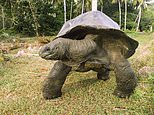
A ship carrying diesel sank off the coast of one of Ecuador’s Galapagos Islands on Saturday, near the island of Santa Cruz. Pictured: An endemic Galapagos giant tortoise
In a tweet posted by the Galapagos National Park’s official account, a ‘contingency plan’ was outlined including using dispersants and containment booms. Pictured: Dispersant is added into the waters by two men
A containment boom is set up around the site of the sinking to prevent diesel dispersing beyond the zone
Authorities said attempts would be made to bring the sunk boat back to the surface
Sting rays can be seen swimming in the Pacific near the Galapagos Islands, the site of a diesel-carrying shipwreck on Saturday
The damage caused by the sinking of the ship, called Albatroz, is as yet unknown, as well as the quantity of fuel on board at the time and the amount that may have spilled. Pictured: A Galapagos hammerhead shark
The ship sank close to Santa Cruz Island, one of the thirteen major islands that make up the Galapagos archipelago
On Twitter, the Galapagos National Park’s official account said a dispersing agent had been used to ‘limit possible negative impacts on the environment’.
According to the tweet, attempts were being made to drag Albatroz back up to the surface.
The UNESCO Natural World Heritage Site, renowned for its giant tortoises, is remarkable for being the only place on Earth that thousands of species call home.
An estimated 97 percent of Galapagos reptiles and 80 percent of the archipelago’s land birds cannot be found anywhere else.
The islands – located in the Pacific around 600 miles from Ecuador – inspired the British naturalist Charles Darwin, who visited aboard HMS Beagle aged 22, to pen the The Origin of Species, considered the founding document of evolutionary biology.
An estimated 97 percent of Galapagos reptiles cannot be found anywhere else on Earth
An estimated 80 percent of the archipelago’s land birds are endemic to the archipelago
The diesel ship’s sinking comes just months after Ecuadorian president Guillermo Lasso increased by nearly 40,000 squared miles the protected marine zone around the Galapagos Islands.
Extending the marine reserve around the archipelago was the first step in a plan agreed by Ecuador with Colombia, Costa Rica and Panama at last year’s COP26 in Glasgow to create a submarine corridor through which endangered sea creatures threatened by climate change could migrate safely.
In January, after signing a decree to create the protected marine zone, President Guillermo Lasso said: ‘We are declaring a Marine Reserve, measuring 60,000 kilometres squared, equivalent to an area three times greater than the size of Belize’ around the Galapagos Islands.