

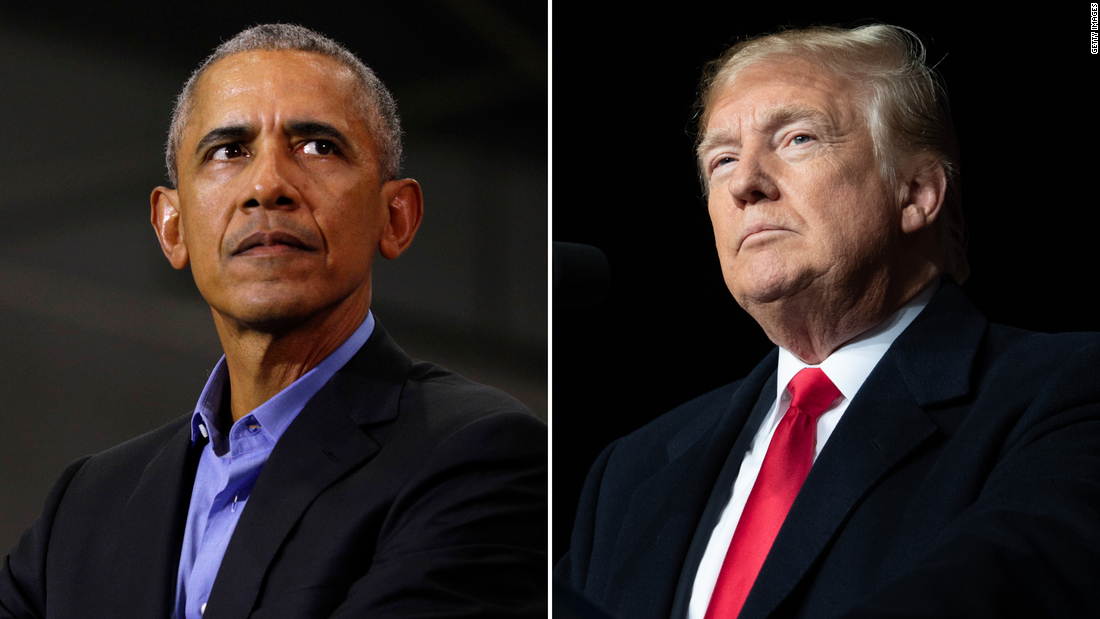
No modern former commanders in chief have been so present or outspoken about politics, or each other, after returning to private life
No modern former commanders in chief have been so present or outspoken about politics, or each other, after returning to private life. But the 44th and 45th Presidents just renewed their battle over the country’s political lifeblood — democracy — which has rarely faced a graver assault than from Trump’s election fraud lies.
And even though a new President, Joe Biden, is now in office, his immediate predecessors — who revile one another but will be forever linked in history — still embody the dominant forces tearing at the nation.
The former President warned the Republican Party that sought to neuter his presidency had taken a much darker turn as many of its key lawmakers now support Trump’s falsehoods about non-existent electoral fraud and whitewash his role in inciting an insurrection against Congress on January 6.
“We have to worry,” Obama said, “when one of our major political parties is willing to embrace a way of thinking about our democracy that would be unrecognizable and unacceptable even five years ago or a decade ago.”
That was some statement from a former President whose own administration was blocked at almost every turn by the GOP, and who once hoped in vain that the conservative “fever would break” with his reelection in 2012.
“I’m not the one trying to undermine American democracy. I’m the one that’s trying to save it,” Trump said, spinning a new and pernicious reality in which his millions of supporters can take refuge from the truth of the events of 2020.
Multiple courts, election officials in key states and official audits established that Trump lost fair and square to Biden last November, as the ex-President’s spurious suits alleging fraud fell apart. But Republican state legislators have nevertheless acted on his narrative of lies to pass a raft of electoral laws making it harder for Democrats, and especially Black Americans, to vote and to make it easier for partisan local officials to influence the outcome of future elections.
Biden to counter autocratic impulses at home and abroad
The intensifying struggle over democracy coincided with several other developments that underscore the primacy of this nation defining political theme in 2021. Moderate Democratic Sen. Joe Manchin of West Virginia said that he would oppose a sweeping bill his party hoped to pass to counter the GOP moves. His decision, in a 50-50 Senate where the GOP can block Biden’s agenda, makes it hard for his party to halt a drive many Democrats think is a bid to steal the 2024 election.
‘We occupy different worlds’
The style in which Trump and Obama are prolonging their long-distance tussle over America’s future encapsulated the vastly difference experience of their presidencies that played out over the last 12 years.
Obama, in a sit-down interview, was temperate and spoke in well-sculpted paragraphs. Trump delivered his new assault in a rambling 90-minute screed at a political event that previews a new round of summer swing state rallies.
Still, Obama has become far more outspoken about the toxicity that he sees as taking over the Republican Party than he was in while in power. The 44th President had originally planned to stay out of politics after his two terms in office ended, but he was so alarmed by Trump’s behavior that he decided to speak his mind. No modern president has ever made such strident warnings that the core of American democracy is under threat, as he did for instance during the Democratic convention last year.
While Republicans argue that the former Illinois senator was hyper-political himself and did not live up to his own calls for unity, events have proven the 44th President’s warnings as prescient. After all his successor denied his election loss, brought a mob to Washington that destroyed America’s tradition of peaceful transfers of power and Republicans nationwide have tried to remove the guardrails that confirmed Biden’s election as president.
“We occupy different worlds. And it becomes that much more difficult for us to hear each other, see each other,” Obama said on CNN’s “Anderson Cooper 360.”
He blamed the root causes of the country’s deep divisions on economic and racial “stratification” and the siloing of the media that means that millions of Americans only hear news that suits their politics.
“We occupy different worlds. And it becomes that much more difficult for us to hear each other, see each other,” Obama told Cooper.
It is clear that bitter experience and what would once have been seen as unthinkable political turmoil in modern America have scorched the worldview of the man who as a youthful Illinois Senate candidate wowed the nation with his career-making assurance that there is not a “liberal America and a conservative America” or a “Black America, a White America” but “there is the United States of America.”
‘It can happen here’
Trump has never subscribed to the ideal of unity Obama invoked at the 2004 Democratic National Convention in Boston. His political method weaponizes division, makes a virtue of chaos and distills grievance into power.
“Bad, bad things are happening to us, perhaps like never before,” the most recent ex-President said in North Carolina. He argued that radical leftists are destroying American freedom. “They want to silence you, they want to silence your voice,” Trump told his supporters.
By unveiling a Senate race endorsement for North Carolina Rep. Ted Budd — who voted not to certify Biden’s election win — Trump made clear the price for his support in a party he still dominates is full fealty to his election fraud lies — and that endorsement only came after his daughter-in-law, Lara Trump, decided against running. Trump last month ordered Senate Minority Leader Mitch McConnell of Kentucky and House Minority Leader Kevin McCarthy of California to kill a bill setting up a bipartisan, independent commission to probe the Capitol riot.
His former national security adviser Michael Flynn recently agreed that the US needed a coup like Myanmar, an impoverished nation long suppressed by a dystopian military dictatorship where pro-democracy advocates are imprisoned, and peaceful protestors are shot and tortured. He later tried to deny he said what he said, even though it was on tape.
In an appearance on David Axelrod’s “Axe Files” podcast, Cheney said on Saturday that Trump’s incitement of the Capitol insurrection was the “most dangerous thing, the most egregious violation of an oath of office of any president in our history.”
Perhaps the most remarkable aspect of the autocratic transformation of the Republican Party, which once styled itself as the guardian of global democracy, is that it profits from and advances a parallel attack by Washington’s former Cold War foe Russia.
As well as the election interference to benefit Trump, US intelligence agencies blame Russia for a flurry of cyberattacks on US government facilities and companies. A fresh spate of ransomware attacks on US infrastructure is also believed to originate in Russia.
The degradation of US democratic standards and the corruption of the political system looks familiar to one of Obama’s closest White House aides.
Ben Rhodes, a former deputy national security adviser, just published a new book “After the Fall” that examines the slide into autocracy in nations like Russia and Hungary. He noted that the latter’s leader, Viktor Orban, had orchestrated a right-wing populist backlash to the financial crisis, packed the courts with conservative justices and redrawn legislative districts and laws to benefit his voters. Orban also enriched cronies and weaponized a propagandistic media machine while wrapping the entire push in a nationalist bow.
“I’m thinking this sounds like a familiar playbook, it’s what I’ve lived at home,” Rhodes told CNN’s Bianna Golodryga on CNN International on Monday, referring to Trump’s 2016 campaign and presidency.
“On January 6, we learned it can happen here too.”