

Three Extinction Rebellion activists are CLEARED of obstructing railway
Now jury unanimously CLEARS three Extinction Rebellion activists of obstructing railway in rush hour stunt after claiming their ‘Christian faith and fears for their grandchildren’ justified their actions
Philip Kingston, 85, Reverend Sue Parfitt, 79, and Martin Newell, 54, are clearedTrio climbed on Docklands Light Railway train at Shadwell station in East LondonThey are members of Christian Climate Action within environmental group XRAll three denied obstructing an engine or carriage on railway in October 2019Nine days ago, four other protesters were cleared over Colston statue toppling
<!–
<!–
<!–<!–
<!–
(function (src, d, tag){
var s = d.createElement(tag), prev = d.getElementsByTagName(tag)[0];
s.src = src;
prev.parentNode.insertBefore(s, prev);
}(“https://www.dailymail.co.uk/static/gunther/1.17.0/async_bundle–.js”, document, “script”));
<!–
DM.loadCSS(“https://www.dailymail.co.uk/static/gunther/gunther-2159/video_bundle–.css”);
<!–
Three Extinction Rebellion activists were today unanimously cleared of obstructing the railway with a stunt on top of a Docklands Light Railway train – just nine days after four other protesters were cleared over the Edward Colston statue toppling.
Former university lecturer Philip Kingston, 85, Anglican priest Reverend Sue Parfitt, 79, and Father Martin Newell, 54, all climbed on top of the train during rush-hour.
The trio, who are members of Christian Climate Action within environmental group XR, caused chaos on October 17, 2019 at Shadwell station in East London.
Despite their stunt delaying rush-hour commuters for 77 minutes, the trio denied the charges and opted for a jury trial – the same strategy used by the ‘Colston Four’, which prompted a not guilty verdict that sparked outrage from Conservative MPs.
Reacting to today’s verdict, Conservative MP Brendan Clarke-Smith told MailOnline this afternoon: ‘The selfish actions and egos of these individuals prevented people from getting to work to provide for their families, children from attending school, wasted the time of our emergency services and put people’s lives at risk.
‘I don’t see that as being a particularly Christian thing to do. Whilst I would always defend the jury system, it clearly needs a review, and this outrageous decision has given the green light to people looking to commit all manner of appalling crimes in the name of religion to justify their political ideologies.’
Kingston, Parfitt and Newell were charged with obstructing an engine or carriage on the railway, but were cleared by a jury at Inner London Crown Court this morning.
If the DLR protesters had been found guilty at a magistrates’ court under section 36 of the Malicious Damage Act 1861, they would have faced up to six months in prison.
This would have increased to two years imprisonment’ if they were convicted at a court court. The trio would have also each faced an unlimited fine at either court.
Extinction Rebellion has said that the so-called ‘Shadwell 3’ case was one of a series of trials involving the group’s activists that is taking place this year in front of a jury.
The DLR train which was travelling from Lewisham to Bank was about 70 per cent full of passengers – and the court heard the protest caused 77 minutes of disruption.
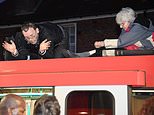
Father Martin Newell, 54, and Reverend Sue Parfitt, 79, used a ladder to climb on the DLR roof as part of an Extinction Rebellion demonstration at Shadwell station on October 17, 2019
Phillip Kingston, 85, superglued himself to the side of the carriage on October 17, 2019
(From left) Martin Newell, Sue Parfitt and Philip Kingston stand together on October 18, 2019
Kingston superglued his hand to the DLR train while Reverend Parfitt and Father Newell climbed on the roof and said prayers for the planet shortly before 7am.
The trio said they were strongly motivated by their Christian faith, while Kingston said the futures of his four grandchildren also prompted him to take part.
In what they said was an attempt to appeal to the public and the Government about the dangers of climate change and the financial institutions whose actions damage the planet, they targeted a train which was one stop away from Bank, in the City of London’s financial district.
Some 15 trains were delayed or cancelled but none were stuck in tunnels.
This was partly because, according to the activists, they had planned the demonstration to ensure there was no risk to public safety, by taking measures including targeting a station above ground and having ten more Extinction Rebellion activists on the platform to ensure violence did not break out.
Kingston, Parfitt and Newell all pleaded not guilty to the charge.
Reacting to the verdict, Mike Schwarz, solicitor at Hodge Jones and Allen, said: ‘There is mounting evidence from the courts and in particular from juries that the public is taking the climate crisis and the increasingly urgent need to focus on it far more seriously than government and business. This verdict is part of this escalating pattern.’
The verdict comes after four people were cleared of criminal damage over toppling the statue of slave trader Edward Colston in Bristol and throwing it in the harbour.
The bronze memorial to the 17th century figure was pulled down during a Black Lives Matter protest in Bristol on June 7, 2020, and those responsible were acquitted on January 5 following an 11-day trial at Bristol Crown Court.
And in April last year, six Extinction Rebellion protesters were cleared of causing criminal damage to Shell’s London headquarters despite the judge directing jurors they had no defence in law.
At Shadwell, Newell and Parfitt climbed a retractable ladder and sat on top of the carriage while Kingston superglued his hand to the side of the carriage in their protest against climate change.
Video clips from the scene showed angry commuters and passengers swearing at the Extinction Rebellion protestors while one yelled: ‘This is a f***ing electric train, you should be supporting this.’
Newell and Parfitt insisted they were motivated by faith and compelled to act in the way they did due to the climate emergency.
Parfitt said: ‘I feel deeply called by God to do all that I can to avert the catastrophe that is on its way to his whole creation.’
The duo, along with Kingston who attended trial via video-link from his home in Bristol due to his age, were cleared by the jury after around two hours of deliberation.
Parfitt and Newell had been accompanied at court by a number of supporters during the whole trial who could said the verdict was ‘amazing’ outside of the courtroom.
Judge Silas Reid had said that protest rights under the European Convention of Human Rights ‘gives them and us the freedom of belief, expression and the right to freedom of assembly.’
He explained however that ‘those rights are not without exception.
‘Are we sure that a conviction of the defendant for obstructing the railway is necessary in a democratic society in the interest of public safety, prevention of disorder or protection of rights and freedoms of others?’
Giving evidence Parfitt said: ‘Essentially because there is a climate emergency which is an existential threat to the human race and because this was the best way that I could think of, at that moment, at that time, to draw attention to it and get the government to take action.
Judge Silas Reid had said that protest rights under the European Convention of Human Rights ‘gives them and us the freedom of belief, expression and the right to freedom of assembly’
Extinction Rebellion tweeted the news, but the verdict upset many social media users (below)
‘We’ve tried everything else – that wasn’t working, and unfortunately disruption seems to be the best way to get people’s attention and the government’s attention.
‘The symbolic power of that action, of people seeing that – why would someone do that why would someone climb on top of a train, stop a train – people will think well, it must be really serious for people to do this.’
Newell told the court that inherent to his decision to take part in the protest was his Christian faith. He has been ordained as a priest for 25 years.
Jurors heard he had printed out copies of a prayer ‘Litany of the earth’ parts of which he had adapted from other prayers and parts he had written himself.
‘It’s a long prayer – I wrote most of it myself and a part of it is obviously about concern for the environment and concern for our part in what we are doing to the earth – God’s earth and asking God to forgive us for what we’ve done and ask God to change what we need to.’
Sitting on top of the train, the pair recited the prayer, alternating turns.
In the midst of the action, a fellow commuter climbed the ladder and threw the paper copies onto the platform.
Newell said: ‘The most important commandment for a Christian is to love God and to love our neighbour. Pope Francis says the earth is our neighbour.
‘All of us we depend on the earth for our life, so if the earth is suffering we suffer too.’
Parfitt, who is just weeks away from her 80th birthday told the jury: ‘I did it because I feel deeply called by God to do all that I can to avert the catastrophe that is on its way to his whole creation.
‘The older I get the more compelled I feel to do this.
‘In this particular case I believe that there is a compelling case for there to be acts of civil disobedience to try to wake up the government and society to the extreme emergency that we are in.
‘I’m sure that you must feel, members of the jury and others in the court, that this was an outrageous action to take.
‘And it was and I took it because of the outrageous inaction of the government and other governments in the world.
She asked the jury to acknowledge previous social movements, including the Suffragettes, since ‘all the great social movements that have brought about change in society have needed to include an element of civil disobedience.’
Parfitt had travelled from Bristol to London to attend previous Extinction Rebellion protests during October 2019.
‘I got a message through Christian Climate Action to say that there was a proposal to do an action towards the end of the protests that would involve civil disobedience and would I be interested.
‘I was invited to a meeting 2 days before, on October 15th, it was at that meeting I learned it was going to be to do with train transport in some way so that sounded okay to me.
‘I knew nothing about anything really – I’m never involved in planning things – I see myself as rather a small cog in the wheel.
‘I was completely satisfied [with regards to safety] in the sense that I knew the people who were taking charge of this.’
The group of between 10 and 12 people travelled by DLR to West Ferry station and then to Shadwell.
‘We were on the train for either one or two st
Officers had assisted Parfitt down the ladder using ropes and safety equipment but she insisted that had there been a medical emergency she would have been able to get down the ladder herself.
Parfitt added: ‘I have to say and I can look at you members of the jury and I can see that you’re much younger than me and it may be that you have children, I don’t have children myself and therefore I don’t have grandchildren.
‘What I do I’m doing for other people’s children. I’m sorry to be so blunt about it but those grandchildren have no future whatsoever unless we can slow this down.’
The verdict comes after four people (pictured on January 5) were cleared of criminal damage over toppling the statue of Edward Colston in Bristol and throwing it in the harbour
The bronze memorial to Edward Colston was pulled down during a Black Lives Matter protest in Bristol on June 7, 2020, and those responsible were acquitted on January 5
In April last year, six Extinction Rebellion protesters were cleared of causing criminal damage to Shell’s London headquarters despite the judge directing jurors they had no defence in law
Yesterday, Kingston told Inner London Crown Court that his grandchildren are ‘the greatest concern’ in his life and that his Catholic faith also influenced his decision to take part in the demonstration.
‘I have four grandchildren and they are the greatest concern in my life because my understanding of the temperature that the earth is heading towards is going to be mighty difficult for them and their generation,’ he said.
‘I have a very strong belief that this man Jesus shows me the way of life, which is giving all our use for others… I appreciate this principle that the order of my life is to, as far as I can, to put others first.
‘The poorest people in the world who have done the least to cause these high temperatures are the ones who are suffering the most from extremes of weather.
‘They don’t have the resources that we have (in the UK) to in some way cope reasonably with what is happening to us.’
Kingston, from south Wales and now living in Patchway, south Gloucestershire, told the court he worked as a lecturer at Bristol University for 27 years, and he had been employed as a probation officer before this.
He said he hoped to appeal to the public and the Government about ‘climate breakdown’ through the protest, adding that some passengers did ‘engage’ with his views on the day.
‘I hope to achieve the attention of fellow citizens and also of the Government, who I believe are responding quite inadequately to the huge dangers we are facing in regard to the climate and I wanted to draw attention to that,’ he said.
Kingston said the ‘safety of passengers was the primary consideration’ of the group’s planning ahead of the stunt, and he was as certain ‘as humanly possible’ that no-one would be put at risk.
When asked whether, if the safety of passengers had been in question, he would still have proceeded with the stunt, he said: ‘No, not at all.’
He added that initially passengers reacted angrily, but after he spoke with those nearby, ‘the anger subsided and they were beginning to engage’.
Edmund Blackman, prosecuting, earlier told jurors: ‘It is the prosecution case that these three defendants each played a part in obstructing the DLR that morning in a planned operation designed to bring the service of one of the lines to a halt by stopping the train.
‘The timing of that obstruction was not a coincidence. They were at Shadwell station shortly before 7am so at the beginning of the rush hour.
‘The action of these three defendants had a purpose, they weren’t just doing it for the fun of it. Their actions come under the broad umbrella of Extinction Rebellion.
‘Whilst that was the motivation behind the defendants’ behaviour and their actions it’s the prosecution case that these defendants went beyond what is permitted or allowed in society in that protest. They went too far.’
Jurors saw footage from a body worn camera showing members of the public yelling statements including ‘I don’t give a f*** what it is, get the f*** off the train,’ and ‘This is a f***ing electric train, you should be supporting this.
Defence lawyer Owen Greenall said that since Shadwell station is one stop away from Bank the protesters were ‘targeting the infrastructure that supports the financial institutions of the city’.
He argued that the protest was carried out ‘in a safe manner’ with the defendants taking measures such as targeting an open-top station so that no trains would be stuck in tunnels, and having several more people from Extinction Rebellion on the platform to ensure violence did not break out.
Mr Greenall added that disruption to passengers was ‘relatively short-lived’ with trains running again by 8am.
He summarised: ‘The issue about which they were protesting was and is so important and urgent that the degree of their disruption to users of the railway was justified.’
Last month six XR activists were cleared by a jury of halting the DLR by mounting a protest at Canary Wharf station on April 25, 2019.
Five of them, including Kingston, climbed on top of the train with banners that read ‘Business As Usual=Death’ and ‘Don’t Jail the Canaries’; a reference to fellow protesters who were facing prosecution at the time. The sixth, Dr Diana Warner, glued herself to a train window.
Last March Parfitt glued herself to a desk at Westminster Magistrates’ Court and live-streamed proceedings on Facebook after she was convicted of breaching a section 14 order during an XR protest in September 2020.
She was cleared of bringing traffic to a standstill during an XR protest on October 7, 2019 after charges against the reverend and two other environmentalists were withdrawn.