

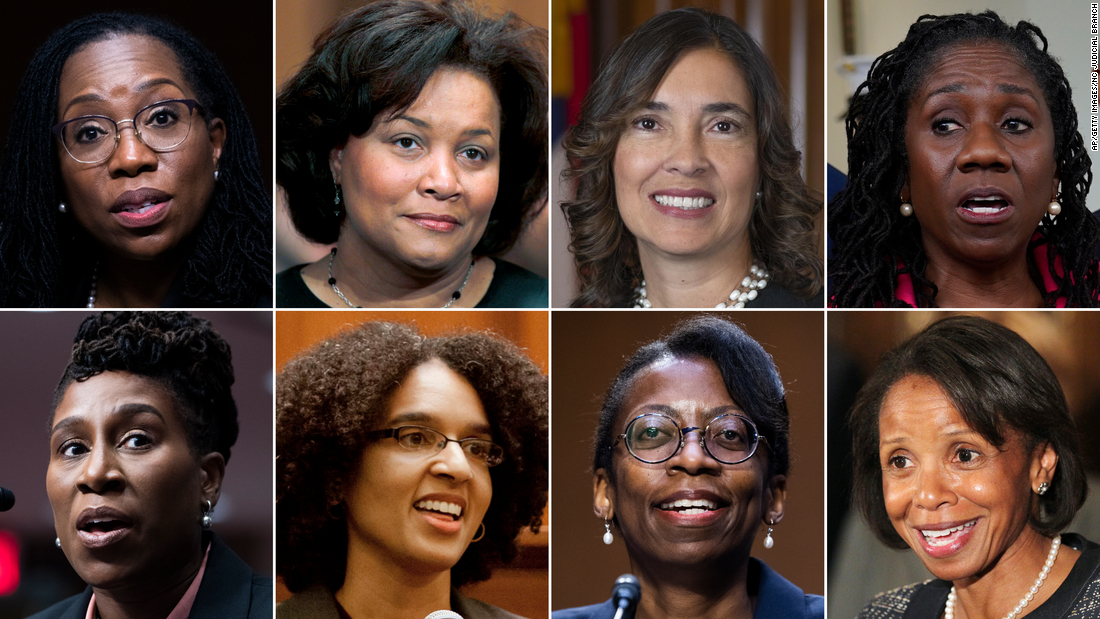
Whoever Biden selects is virtually certain to face resistance from almost all Republicans
The first ‘great dissenters’
“It’s a generational appointment,” says Fatima Goss Graves, president and CEO of the National Women’s Law Center. “It may be true that because of the current composition of the court that the [Democratic-appointed] justices find themselves too often in dissent. But we’ve also seen that the dissents of today can become the guiding principles of tomorrow.”
The tradition of justices known primarily for their dissents stretches back to John Marshall Harlan, who was appointed in 1877 by Republican President Rutherford B. Hayes. As author Peter Canellos observed in his 2021 biography, “The Great Dissenter,” “Before Harlan, dissenting opinions in Supreme Court cases were few and far between—strange and often unnoticed footnotes. Harlan turned the act of dissenting into something more significant: an appeal to the next generation of jurists. He spent thousands of hours holed up under gas lamps creating doctrines that would find their true light in the electric future.”
Serving for more than three decades on the deeply conservative court of the late 19th and early 20th centuries, Harlan voted against a succession of rulings limiting government’s ability to regulate business or impose an income tax. But he’s best remembered as the sole dissenter on the landmark 1896 Plessy v. Ferguson ruling, which authorized “separate but equal” racial segregation. Harlan’s ringing denunciation of the decision, Canellos says, became “the bible” for civil rights lawyers like Thurgood Marshall, later a Supreme Court justice himself, through the 20th century, and ultimately was vindicated in the court’s 1954 Brown v. Board of Education decision invalidating segregation in the schools. “I think [Harlan] believed his dissents would be appreciated over time,” Canellos says. “I think he would envision the conversation we are having right now.”
Harlan’s mantle was next seized through the early 20th century by Justices Oliver Wendell Holmes Jr. and Louis Brandeis, who issued a procession of powerful dissents to another conservative majority court. Many of those were on cases in which the majority voted to strike down public regulation of business, but Holmes and Brandeis are remembered even more for their dissents asserting an expansive right to free speech. Brandeis’ dissents in particular anticipated a succession of landmark rulings under Chief Justice Earl Warren validating free speech rights during the 1960s — and have led legal historians to call Brandeis “the acknowledged master of the judicial dissent,” as one put it.
Thurgood Marshall himself became a powerful dissenter, particularly on capital punishment and civil rights cases, after the liberal Warren court he had joined in 1967 tipped to become a conservative majority only a few years later. “His passionate vision came through in his dissents and was so important, obviously not in changing the results, but in educating the American public about the high stakes involved in Supreme Court decisions,” says Nan Aron, the recently retired founder and president of the Alliance for Justice, a leading liberal judicial advocacy group. “Decades of law students, decades of students studying civics, have read his dissents.”
Deploying to a war zone
Not everyone in liberal legal circles believes Biden must tilt his choice toward someone in this dissenting tradition. Erwin Chemerinsky, dean of the University of California at Berkeley Law School, told me in an email that Biden needs to take a very long view in the selection. “Of course … the new justice is likely to be in the bottom of a lopsided minority for the next decade or even two,” he wrote. “But Biden should be picking the Justice the Democrats will want there in 2040 and 2050. It should be a strong progressive who will articulate a progressive vision, even if in dissent. Ideally, too, it will be someone who might put together coalitions for progressive results.”
“If there was a 5-4 court, Biden might want someone who is more moderate and who might negotiate with the chief [Roberts], but with this 6-3 court I don’t think there is much of an opportunity for reaching out,” says Paul Butler, a law professor at Georgetown University Law Center. “Most of the conservative justices are hard-core right-wing ideologues, and people like [Clarence] Thomas and [Samuel] Alito have been waiting for this moment and this court for decades. So on issues like affirmative action and abortion they are not in a negotiating mood or posture.”
Two other characteristics of the six-member GOP-appointed majority may influence Biden’s thinking. One is its relative youth: Absent health issues, this same conservative bloc could dominate the court well into the 2030s, given that its oldest members (Thomas at 73 and Alito at 71) may serve for at least another decade. The other is its ambition and aggressiveness: Particularly in its handling of the Texas and Mississippi abortion cases, this majority has clearly signaled its willingness to tilt the law sharply to the right, even if that means overturning long-standing precedent. The GOP-appointed majority has shown that it will be “very aggressive on fundamental issues, not bound by precedent, and not bound by convention or practice,” says Deborah Archer, a professor at New York University Law School and president of the American Civil Liberties Union.
Taken together, all of this has produced a consensus in liberal-leaning legal circles that Biden will be deploying his nominee into the legal equivalent of a war zone. And that consensus has coalesced into a dominant preference for him to pick a warrior — not in her personal relations with the other justices, but in her approach to the job.
“Understandably, the President is seeking bipartisan support for his candidate, and certainly I would assume this is a very strategic decision on his part to set out a criteria of someone who, among other things, is a consensus builder,” says Aron, who now teaches law at Georgetown. “But I think perhaps at this moment in time, it’s simply wishful thinking that anyone can persuade the three Trump justices and others to move.”
Henderson agrees. “One reason Sonia Sotomayor stands out … is her willingness to speak truthfully and forcefully as to what she sees is happening, and I think Justice Breyer’s replacement needs to be someone in that mold,” he told me.
Assessing the short listers
For many of the analysts and advocates within Democratic legal circles, viewing Biden’s potential nominees on this spectrum from bridge-builder to truth-teller offers a revealing lens through which to assess his options.
Both on and off the record, a surprising number of those I spoke with cited the same name as the potential nominee who could prove the most dynamic dissenter and “truth-teller”: Sherrilyn Ifill, president and director-counsel of the NAACP Legal Defense Fund.
“From their records, Sherrilyn Ifill would be the best at writing passionate, erudite dissents that get talked about because people can understand them,” says Butler. “She’s got the skills in terms of messaging, a keen lawyerly grasp of the issues and she’s very charismatic.” The prospect of Ifill joining Sotomayor to dissent from the court’s conservative drift, he says, “would make the court more exciting for progressives … even if there are not enough votes to change the law in the short term.”
Whoever Biden selects is virtually certain to face resistance from almost all Republicans. Carrie Severino, president of the conservative Judicial Crisis Network, told me conservatives will mobilize against any Biden selection they view as too liberal, regardless of how they balance conciliation and confrontation in their approach to the court. “At the end of the day the most important thing is how that person approaches the law, not what their personal style is,” she says. “The Democrat short listers are ones who are going to be uniform in the way they are going to vote on the court.”
The White House has signaled to allies that Biden’s decision will not be influenced by public signals from some Senate Republicans that they might be more receptive to Childs in particular than others. Yet many liberal legal analysts believe that Biden’s desire to win at least some Senate Republican support will discourage him from making any selection, like Ifill, seen as especially provocative to the GOP, or even to the most conservative Senate Democrats. (At 59, Ifill is also older than the other major alternatives.)
In a tenure that could last decades, whoever Biden picks isn’t likely to ever play only one role or even to remain static in how she balances the “bridge-building” and “truth-telling” roles.
“I actually think that the nominee’s approach will be her own, and that is OK,” says Goss Graves. “She will not model herself after Breyer or Sotomayor or any other justice. Her approach and perspective will be one that is important and possibly new.”
Yet one thing is guaranteed: With a staunchly conservative majority likely to retain control of the court for years, whoever Biden selects will need to take a long view of her potential influence on American life. The best compass for Biden’s choice may be the words of Benjamin Cardozo, a celebrated New York state judge who later served in the minority of a conservative-dominated Supreme Court during the 1930s. “The voice of the majority may be that of force triumphant, content with the plaudits of the hour,” he once declared. “The dissenter speaks to the future, and his voice is pitched to a key that will carry through the years.”