

London on RED alert for Storm Eunice: Now Met Office issues most extreme weather warning for capital
Panic in ‘red alert’ London as police tape off parks and tell dog walkers to go home now as 100mph ‘sting jet’ Storm Eustice barrels across Britain leaving 14,000 homes without power in Cornwall and cancelling scores of flights and trains
Two red warnings issued for southern England for 7am-12pm in South West and 10am-3pm in South East Met Office warns of ‘flying debris resulting in danger to life’, ‘roofs blown off’ and power lines down Hundreds of schools close, all trains in Wales suspended and rail passengers in England told not to travelBritish Airways cancels dozens of flights and major attractions including London Eye and Legoland close
<!–
<!–
<!–<!–
<!–
(function (src, d, tag){
var s = d.createElement(tag), prev = d.getElementsByTagName(tag)[0];
s.src = src;
prev.parentNode.insertBefore(s, prev);
}(“https://www.dailymail.co.uk/static/gunther/1.17.0/async_bundle–.js”, document, “script”));
<!–
DM.loadCSS(“https://www.dailymail.co.uk/static/gunther/gunther-2159/video_bundle–.css”);
<!–
Millions of Britons were urged to stay at home today amid major travel chaos after the Met Office issued a rare ‘red warning’ for 100mph winds over southern England including London as Storm Eunice swept into Britain.
The warnings run from 7am until 12pm in the South West and 10am until 3pm in the South East with forecasters concerned over ‘flying debris resulting in danger to life’ as well as ‘roofs blown off and power lines brought down’.
Hundreds of schools were closed, all trains in Wales were suspended and rail passengers across England were told not to travel amid mass cancellations as the Army was on standby for what could be the worst storm in 32 years.
British Airways cancelled more than 80 flights at London Heathrow and City airports, motorists were warned only to make essential journeys and major attractions closed including the London Eye, Kew Gardens and Legoland.
Some 14,000 homes in Cornwall were left without power, while parks across London were closed and taped off – and police were seen ordering a dog walker to leave Primrose Hill in North London immediately. The man involved, film producer David Broder, 57, told MailOnline: ‘I saw two police vehicles and then was approached by a police officer who came running towards me shouting, ‘Get out the park now’, which I thought, ‘he’s a bit over excited’.
‘The police officer then informed me that the park is now closed and I have to leave. I thought I’ll get into the park, obviously 10am is the time (the red warning begins), my dog walker’s cancelled today, so I thought I’ll just do a quick half an hour as I do most days anyway.’ When asked whether he saw anyone else being told to leave, he said: ‘Yes. This was ridiculous, as I just wanted to take my dog out for half an hour or so before the storm sets in.’
All outpatient appointments were cancelled at Royal Cornwall Hospital today ‘to keep people safe’. In addition, Universities, National Trust sites and other tourist venues including Kensington Palace also shut today, and London Mayor Sadiq Khan said: ‘Please stay at home, do not take risks and do not travel unless absolutely essential.’
Transport for London urged people to avoid non-essential travel, while the Environment Agency told Britons to avoid travelling to the coast for dramatic photographs – saying it was ‘probably the most stupid thing you can do’.
The Government’s Cobra civil contingencies committee will meet this afternoon to discuss the response to the storm for the second time in two days, with the meeting again chaired by Cabinet Office minister Michael Ellis.
Network Rail urged customers to avoid travelling, with many services either cancelled or delayed, and trains running at 50mph due to the increased risk of having to brake for debris on the track. Major roads including the A66 cross-Pennine route and the M8 between Edinburgh and Glasgow were partially closed due to high winds.
The Met Office issued the first red warning for the South West at 11am yesterday, 20 hours in advance, before issuing the second for the South East at 4am today – just six hours before the ‘extremely strong winds’ begin.
The South West warning covers coastline of Devon, Cornwall and Somerset as well as South Wales due to the combination of high tides, strong winds and storm surge – while the second is over most of South East England.
One dramatic video showed pilots battling to land in extreme crosswinds at Birmingham Airport this morning, with a Vueling plane from Paris violently rocking from side to side as it approached the runway in 60mph winds.
Top wind speeds could hit 100mph with the strongest gusts expected in exposed coastal areas, while a lesser amber warning for gusts up to 80mph covers the whole of England until 9pm tonight having started at 5am.
The Met Office added that the phenomenon known as a sting jet – a small area of highly intense wind inside a storm – could form later today. It would be the first instance of such an event since the Great Storm of 1987, when wind speeds peaked at 115mph at Shoreham-by-Sea in West Sussex, while also hitting 94mph in Central London.
Forecasters today urged Britons to work from home in the worst affected areas – with the centre of the storm expected to be up the Bristol Channel and around the narrowing of the River Severn in Gloucestershire.
Prime Minister Boris Johnson tweeted today: ‘The Met Office has issued a red weather warning for much of the UK. We should all follow the advice and take precautions to keep safe. I thank responders for all their efforts.’
The top wind gusts by 9.30am today were 92mph on the Isle of Wight, 87mph at Swansea, 79mph on the Isles of Scilly and 75mph at Capel Curig in North Wales. Meanwhile in a string of weather-related developments:
Most schools across the worst hit regions in the South West and Wales announced they will shut today;Major UK attractions including Windsor Castle, London Zoo and Chessington World of Adventures closed;Windsor Great Park, Richmond, Bushy and Greenwich Parks in London all said they would shut to the public;Network Rail warned disruption was ‘inevitable’ with airports advising people to check flights with airlines;People were urged not to take dangerous ‘storm selfies’ with huge waves expected along the south coast;The Environment Agency issued 10 severe flood warnings, 31 normal flood warnings and 102 flood alerts;In some areas, refuse collections were cancelled and residents warned to ‘tie down’ bins in the back garden;Pet owners were warned to take extra precautions to keep their animals safe during the storm.
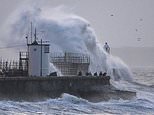
Waves crash against the harbour wall at Porthcawl in South Wales this morning as Storm Eunice sweeps into Britain
Waves hit Porthleven on the Cornish coast this morning as Storm Eunice makes landfall in the South West
Huge waves strike the seafront at Caswell Bay in Swansea, South Wales, this morning, which is in the red warning area
A fallen tree on a road in Wadebridge in Cornwall this morning as strong winds hit the South West due to strong winds
Waves crash over the sea wall at the harbour in Lyme Regis in Dorset this morning as Storm Eunice hits the south coast
Primrose Hill in North London is cordoned off this morning as parks across London were closed due to the high winds
A police officer orders a dog walker to leave Primrose Hill in North London immediately this morning as the site was closed
A flight lands in high winds at Bristol Airport this morning as millions of people were told to stay at home
Motorists drive through the sleet and snow along the M8 motorway near Bathgate in West Lothian this morning
A commuter struggles with her umbrella as she crosses London Bridge during wet and windy weather this morning
An early morning DFDS ferry arriving from Calais into Dover battles with the rough seas in the English Channel this morning
A man heads towards the sea at Caswell Bay in Swansea, South Wales, today where winds hit over 60mph this morning
Large waves strike the coast of North Devon at Ilfracombe this morning as Storm Eunice sweeps into Britain
Roofers have trouble staying on top of a building as the high winds from Storm Eunice hit Annan in Scotland this morning
Waves hits Porthleven on the Cornish coast as Storm Eunice makes landfall this morning
Waves crash against the sea wall at Porthcawl in South Wales today as Storm Eunice strikes Britain
A young person covers herself as large waves and strong winds hit during Storm Eunice at Porthleven in Cornwall today
People should ‘take precautions’ during Storm Eunice, the Government has said, adding that the Army is on ‘high readiness standby’ to help.
Home Office minister Damian Hinds told Sky News: ‘We are strongly encouraging people to take precautions and make sure they stay safe.’
He added: ‘Over the longer term a lot of learning has been done from Storm Arwen, particularly on dealing with welfare issues, staying in touch with people, staying in touch with customers for the (power) networks.
‘But in the immediate term there are troops on high readiness standby, the Environment Agency on the ground, the networks themselves have to be very much active, and they are.
‘Weather is unpredictable and it is really important that we all continue… to take those precautions and try to keep everyone safe.’
Asked if people could get ‘cut off’ by the storm, Mr Hinds said that was ‘absolutely a risk’, and the red weather warning indicated a ‘risk to life and limb’.
Mr Hinds also told Times Radio: ‘Please take precautions, please stay safe. The weather is by nature unpredictable. We have only just had Storm Dudley and now Storm Eunice. It is unusual to have a red weather warning. It is very unusual to have two. I just encourage people to take the precautions they can.’
Meanwhile Transport for London (TfL) urged people to avoid non-essential travel in the capital.
A spokesman said: ‘Due to the Met Office’s red warning over Storm Eunice, customers are advised to only travel if essential, and those who need to should check before they travel using our website and the TfL Go app.
‘We are doing all we can to ensure we are prepared for any impact with extra staff ready to respond quickly to any incidents, but some services will be affected by the extreme weather. We are also urging Londoners to please take care if they travel around the city.’
London Mayor Sadiq Khan echoed TfL’s advice to avoid non-essential travel in the capital. He said: ‘I urge all Londoners to stay at home, do not take risks, and do not travel unless it is absolutely essential.
‘City Hall is in close contact with key agencies across the capital and our city is as prepared as possible for any potential impacts of Storm Eunice. However, it is vital that Londoners listen to the official advice today and stay at home until the storm has passed.’
The Coastguard also urged people to stay at home.
In a Twitter post, it said: ‘Storm Eunice is forecast to be at its most dangerous this morning, especially in the South West, with a danger to life in some areas. Please stay home if you can and avoid exposed coastal areas.’
Devon and Cornwall Police tweeted that the A38 in Liskeard has been closed in both directions while emergency services respond to an incident where a tree has fallen on to a lorry and power lines have been damaged. The road is expected to be closed for at least a couple of hours. Drivers are urged to use alternative routes.
In Dorset, the Sandbanks ferry between Poole and Studland has been cancelled. A spokesman said: ‘We have had to suspend service immediately due to the drastically worsening conditions. We do not know when we will be able to resume service.’
Forecasters warned that the strength of the winds over Britain could be worsened by a rare weather feature called a ‘sting jet’
Strong waves hit the coast of South Wales at Swansea this morning as Storm Eunice sweeps into Britain
Large waves strike at Newquay in Cornwall this morning as Storm Eunice sweeps into Britain
A group of people lean into the wind at Caswell Bay in Swansea, South Wales, this morning where winds are extremely strong
Strong waves hit Wembury in Devon this morning as Storm Eunice strikes Britain after a series of red warnings were issued
People watch the waves hitting the coast of Somerset at Clevedon this morning as Storm Eunice strikes Britain
Waves hit Porthleven on the Cornish coast this morning as Storm Eunice makes landfall in the South West
Waves batter the promenade wall and the lighthouse at Porthcawl in South Wales this morning as Storm Eunice strikes
Photographers take pictures as large waves and strong winds hit during Storm Eunice at Porthleven in Cornwall today
Waves crash against the harbour wall at Porthcawl in South Wales this morning as Storm Eunice sweeps into Britain
P&O Ferries has suspended all sailings between Dover and Calais. The operator said: ‘All services between Dover and Calais are suspended until further notice.
‘We expect this to be the case for most of the day and we will provide further information when possible. We strongly advise our customers not to travel to the Port of Dover today.’
Dyfed-Powys Police said the B4308 between Furnace and Farriers has been closed due to falling trees. ‘If possible, please avoid the area and take an alternative route,’ a force spokesman said.
The M48 Severn Bridge is closed in both directions due to Storm Eunice but the M4 Prince of Wales Bridge remains open in both directions. ‘Wind speeds on the approaches and across the M4 Prince of Wales Bridge remain within our operating limits,’ a spokesman added.
National Highways said the Britannia Bridge, which connects the island of Anglesey with mainland Wales, is closed.
AA president Edmund King said: ‘We are still urging people to only travel when absolutely essential and most people are following our advice. Fifty trees have blown down in Surrey in the last two days even before this red warning has kicked in, fallen trees and falling debris are likely to bring a danger to life.’
He said the workload for AA patrol teams had increased in the last two days.
British Airways said the rate of aircraft permitted to land at Heathrow Airport ‘is being reduced due to gale force winds’.
The airline said in a statement: ‘Like other airlines, we’re expecting extreme weather conditions at airports across the UK as a result of Storm Eunice, which will cause significant disruption. Safety is our number one priority, and we’re cancelling a number of flights.
‘We’re doing everything we can to minimise disruption for our customers, including putting on larger aircraft where possible and providing a range of flexible rebooking options.
‘We’d like to thank customers for their patience and advise them to check the latest flight information on our website before heading to the airport.’
Heathrow Airport wrote on Twitter: ‘High winds and poor weather may cause last-minute delays, but we will do everything in our power to minimise any disruption that results.’
At Heathrow on Friday, at least 65 flights – both departures and arrivals – were cancelled and a further 114 were delayed by more than 15 minutes, according to aviation data provider FlightStats by Cirium.
At Gatwick there were 15 cancellations and 67 delayed flights.
EasyJet said it has cancelled a ‘small number of flights’ from UK airports on Friday.
It said in a statement: ‘Due to strong winds impacting parts of the UK today, like other airlines we are experiencing some disruption to our flying programme and have been required to cancel a small number of flights to and from the UK.
‘We are doing all possible to minimise the impact of the weather disruption for our customers and have notified those on cancelled flights in advance, with the option of transferring to an alternative flight free of charge or receiving a refund, as well as providing hotel accommodation and meals for customers who require them.
A snow covered landscape in Consett, County Durham, this morning as Storm Eunice sweeps across the UK
The Stirling village of Killearn has woken up to heavy snow this morning as Storm Eunice sweeps into Britain
A commuter makes his way to work in the snow in Consett, County Durham this morning as Storm Eunice arrives
Fresh snowfall in Barden Moor, North Yorkshire, as Storm Eunice sweeps across the UK today after hitting the south coast
A motorist struggles to deal with the difficult driving conditions in Consett, County Durham, this morning
Highland Cows in the snow near Carstairs in South Lanarkshire this morning as Scotland is placed under weather warnings
A person walking in fresh snowfall in Colburn, North Yorkshire, this morning as Storm Eunice sweeps across the UK
Storm Eunice arrives in Paisley in Scotland today as commuters make their way to work in the heavy snow
The A66 road is closed from Scotch Corner to Penrith, cutting off a main route between Country Durham and Cumbria
A local butcher carries his shop sign across a snowy pavement in Tow Law, County Durham, this morning
A snow covered landscape in Consett, County Durham, this morning as Storm Eunice sweeps across the UK
The A66 road is closed from Scotch Corner to Penrith, cutting off a main route between Country Durham and Cumbria
A pedestrian makes their way along a snowy pavement at Eastfield in North Lanarkshire this morning as Storm Eunice hits
Snow falls in Scotland against a backdrop of Edinburgh Castle as Storm Eunice sweeps across the UK this morning
Drivers make their way along a snowy pavement at Eastfield in North Lanarkshire this morning as Storm Eunice hits
Storm Eunice arrives in Paisley in Scotland as commuters make their way through the heavy snow on the way to work
A cyclist rides along a road in falling snow near Edinburgh Castle as Storm Eunice sweeps across the UK this morning
Storm Eunice arrives in Paisley in Scotland as commuters make their way through the heavy snow on the way to work
‘We continue to advise all customers due to fly with us today to check the status of their flights on our Flight Tracker page for real-time information, and to allow extra time to travel to the airport due to the impact of the weather on local public transport services.
‘While this is outside of our control, we would like to apologise to customers for the inconvenience caused by the weather. The safety and wellbeing of our customers and crew is always easyJet’s highest priority.’
It comes as millions of people were today told to stay indoors, cancel travel plans and stay away from the coast as Storm Eunice sweeps across the country from the early hours.
Families have been warned to expect falling trees, flying debris, severe flooding, roofs blown off and downed power lines.
There are also fears of blocked roads and rail routes, disruption to flights and the threat of 40ft waves on Britain’s shores.
Forecasters are especially worried because the storm is hitting during the morning rush hour – and in heavily populated areas.
Last night, much of the country began closing down in anticipation of its arrival. Some rail and bus networks announced they would shut completely.
Several popular attractions will be closed, as will many parks because of the risk of falling trees.
Meanwhile ministers held a meeting of the Government’s crisis Cobra committee yesterday amid fears Eunice could be the worst storm to hit Britain since the Burns’ Day storm in 1990 which killed almost 50 people, or the Great Storm of 1987, which felled countless trees and claimed 18 lives in England.
Home Office minister Damian Hinds told ITV’s Good Morning Britain today: ‘Cobra have been convened about making sure the readiness is in place for this storm. Obviously it comes right on the back of Storm Dudley.
‘We have had to learn a lot of lessons from previous events like Storm Arwen and others.
‘There are troops as you know at readiness if needed, if military assistance is called for, the Environment Agency are of course on the ground, the network operators themselves are also in readiness.’
Storm Eunice comes just hours after Storm Dudley brought down power lines, leaving more than 20,000 properties in the North of England blacked out.
Boris Johnson yesterday confirmed the Army was on standby to help Britain cope with the impact of Storm Eunice, with the Government ready to offer ‘all the support we can’.
The Met Office urged workers to cancel commutes and to work from home in the worst affected areas.
Forecaster Becky Mitchell said: ‘With the wind gusts we are forecasting at the moment, we’ve only seen a handful of storms in the past 30 years that have brought similar gusts.
‘It’s got the potential to be up there as quite a notable storm. Winds are likely to be 60 to 70mph inland across the south of the UK. It’s quite unusual, we don’t see gusts that high over such a wide area in the south. The Burns’ Day storm brought similar gusts.’
Dr Ambrogio Volonte of the University of Reading said the storm has the same structure as the 1987 one which could result in a ‘sting jet’ – winds of 100mph or more which descend rapidly to the ground leaving devastation in their wake.
The conditions will also coincide with high tide sparking massive waves which prompted warnings to stay clear of coastal paths.
Roy Stokes, the Environment Agency spokesperson for the Midlands, said Storm Eunice is a ‘really, really serious situation’ and some people may have to leave their homes.
Speaking on Sky News, he said: ‘What I would stress as well is that, folks, listen to the advice from the emergency services.
‘This is a really, really serious situation and I know that people don’t always want to leave their homes but in this case it might be the best advice, so listen to what you’re being told on the ground.
‘Keep an eye on things and we’ll just watch this come through now and hopefully it won’t be as bad as we’re all expecting but we always prepare for the worst and hope for the best.’
He added: ‘People talk about the perfect storms, so the high spring tides combined with this storm that’s moving in now, it’s just the worst possible thing really for the (Severn) Estuary so the worst case scenario is that some of those flood defences that have protected people over the years could be over topped.’
He also urged weather watchers to resist the temptation to travel to the coast for photographs of Storm Eunice, describing it as ‘probably the most stupid thing you can do’.
He told BBC Breakfast: ‘The worst possible thing you could do is go anywhere near these (coastal areas).
‘I know people like to go and get photos and pictures, it’s quite a dramatic scene but they’re far safer to watch it on the screen.’
Rob Stewart, leader of City and County of Swansea Council, has warned that Storm Eunice poses a ‘really dangerous situation’ as schools in the area close for 36,000 pupils.
Speaking to Sky News, Mr Stewart said the decision to have pupils attend lessons remotely and for civic buildings like libraries and community centres to close was made on Thursday as the area prepared for the extreme weather conditions.
He said: ‘I mean it is, unfortunately, a combination that we are dealing with of heavy rain over the last few days which has swelled the rivers, we’ve got high tides at the moment and, of course, this very, very rare red-rated storm so we’re as prepared as we can be but it is looking very dangerous for the next few hours.’
He added: ‘We’ve given safety messages and, again, I would repeat those. If people are choosing to venture out today, stay away from our coastal lines, stay away from our rivers, do not put yourself in danger, stay at home if you can and work from home if you can so, you know, this is a really dangerous situation.’
Network Rail executive Jake Kelly, the group director for system operator, told BBC Radio 4’s Today programme this morning: ‘We very, very strongly advise passengers not to travel. It’s going to be a very difficult day.
‘Fundamentally it’s right to expect lots of trees will be blown down and there’ll be other damage. There will be a lot of disruption. We are going to run a service for those who absolutely need to travel but it’ll be disrupted.
‘In a small number of places there are no trains at all – The South West coast and parts of Wales. Elsewhere we are expecting to run a disrupted service. Two pieces of advice, be prepared for very significant delays and second check your train is running at all.’
A motorist struggles to deal with the difficult driving conditions in Consett, County Durham, this morning
A motorist clears his car of snow amid difficult driving conditions in Consett, County Durham, this morning
A snowplough clears a road in Tow Law, County Durham, this morning as Storm Eunice sweeps across the UK
Snow falls in Burnopfield in County Durham this morning, covering roads, paths and vehicles as Storm Eunice arrives
A snowplough clears a road in Tow Law, County Durham, this morning as Storm Eunice sweeps across the UK
Snow falls in Burnopfield in County Durham this morning, covering roads, paths and vehicles as Storm Eunice arrives
A snow plough clears the roads in Consett, County Durham this morning, as Storm Eunice arrives in the UK
Motorists navigate difficult driving conditions in Consett, County Durham this morning as Storm Eunice hits
A person clears snow in Tow Law, County Durham, as Storm Eunice sweeps across the UK this morning
Snow falls in Burnopfield in County Durham this morning, covering roads, paths and vehicles as Storm Eunice arrives
A lorry drives through falling snow in Tow Law, County Durham, today as Storm Eunice sweeps across the UK
A person clears snow in Tow Law, County Durham, this morning as Storm Eunice sweeps across the UK
Heavy snow fall in Tow Law, County Durham, this morning as severe weather conditions sweep into Britain
Ferry operators cancelled several sailings due to operate across the Irish Sea today. Four services between Rosslare in south-east Ireland and Pembroke, South Wales, were cancelled by Irish Ferries.
Stena Line cancelled several sailings on routes between Belfast and Cairnryan in Dumfries and Galloway in Scotland, and Dublin and Holyhead in North Wales.
Met Office chief meteorologist Paul Gundersen said: ‘After the impacts from Storm Dudley for many on Wednesday, Storm Eunice will bring damaging gusts in what could be one of the most impactful storms to affect southern and central parts of the UK for a few years.’
‘The red warning areas indicate a significant danger to life as extremely strong winds provide the potential for damage to structures and flying debris.’
There was also a yellow wind warning until 6pm tonight in northern England and southern Scotland, while a separate yellow warning for snow covers Scotland, Northern Ireland and northern England until the same time.
The Met Office also took the unusual step of issuing a 12-hour severe weather alert with National Highways for strong winds covering the whole of the country’s strategic road network from 6am today until 6pm tonight.
National Highways said high-sided vehicles and other ‘vulnerable’ vehicles such as caravans and motorbikes could be blown over so should avoid bridges and viaducts.
National Highways head of road safety Jeremy Phillips urged those travelling to ‘plan your trip and take extra care, allowing more time for your journey’.
He said: ‘In high winds, there’s a particular risk to lorries, caravans and motorbikes so we’d advise drivers of these vehicles to slow down.
‘Drivers of other vehicles should be aware of sudden gusts of wind which can affect handling and braking, and give high-sided vehicles, caravans, and motorbikes plenty of space. In the event of persistent high winds we may need to close bridges to traffic for a period, so please be alert for warnings of closures and follow signed diversion routes,’ he added.
The Environment Agency issued 11 severe flood warnings along the River Severn near Gloucestershire, South Wales and Somerset, meaning there is a danger to life. It also issued 31 normal flood warnings and 102 flood alerts across England.
Environment Agency flood duty manager Katharine Smith said: ‘Strong winds could bring coastal flooding to parts of the west, south-west and south coast of England, as well as the tidal River Severn, in the early hours of Friday morning.
‘This is due to Storm Eunice resulting in high waves and potential storm surge coinciding with the start of a period of spring tides.’
Those travelling between England and Wales overnight faced difficulties with the closing of the Severn Bridge, while the alternative Prince of Wales bridge was expected to be closed about 6am.
National Highways announced the Orwell Bridge in Suffolk was closed in both directions with the Dartford Crossing joining it in shutting about 5am.
People have been warned to ‘tie down’ objects in their gardens and be wary of fierce winds which could cause trees to topple over and tiles to fly off buildings.
A number of attractions including the London Eye, Legoland and Warwick Castle are temporarily closing.
A Network Rail spokesman said disruption is ‘inevitable’ and Welsh services will be suspended for the whole day.
Flooding in Birmingham city centre today as Storm Eunice results in a series of weather warnings being issued across Britain
Flooding in Birmingham city centre today as Storm Eunice results in a series of weather warnings being issued across Britain
Flooding in Birmingham city centre today as Storm Eunice results in a series of weather warnings being issued across Britain
Flooding in Birmingham city centre today as Storm Eunice results in a series of weather warnings being issued across Britain
And London North East Railway urged customers with tickets for Friday to travel on Saturday instead or get a refund due to expected disruption and damage.
East Midlands Railway said trains to and from London St Pancras ‘may be withdrawn at short notice’, National Rail said there would be no trains between Nottingham and Skegness until about 8am, and Northern said it was advising customers ‘NOT TO TRAVEL across the Northern network’.
Transport for Greater Manchester has asked customers to ‘please consider whether your journey is essential today and take care if you are out and about’.
The operator said Storm Eunice was ‘likely to cause significant disruption due to extremely strong winds today’ across the region from 5am until 9pm.
And a council leader has said his area is ‘braced for impact’ as Storm Eunice touches down in the South West.
The deputy leader of North Somerset Council, Mike Bell, said most schools in the area were closed and public transport had already been disrupted by the extreme weather.
The Liberal Democrat councillor for Weston-Super-Mare Central told BBC Breakfast: ‘We’ve got teams on standby to tackle fallen trees, blocked roads, flooding, and any issues.’
Mr Bell added: ‘Yesterday obviously as soon as the red alert was issued we issued advice to our schools to close, so most of our schools are closed today.
‘We’ve closed off the sea front, we’ve got very good sea defences here in Weston-Super-Mare and in other parts of the North Somerset coast so we’ve closed off those sea fronts.
‘We know that travel and transport is already disrupted and suspended for most of the morning and I think the message is very firmly: stay at home if you possibly can, baton down the hatches and wait for Eunice to pass over.’
In Scotland, motorists are facing difficult driving conditions and schools are shut in some areas as Storm Eunice sweeps in bringing heavy snow.
A Met Office weather warning for snow is in place between 3am and 6pm today, while a wind warning encompasses the south-west Scottish borders, including most of Dumfries and Galloway.
Snow is forecast throughout the day for most of mainland Scotland south of Inverness and Fort William, and was disrupting travel this morning.
The M8 was closed eastbound at junction five due to the heavy snow and Traffic Scotland tweeted that there were reports of vehicles getting stuck on the A68 near Soutra.
A notice board in Penzance train station shows cancellations during Storm Eunice, in Penzance, Cornwall, this morning
A sign at London’s Paddington station shows cancelled trains after Storm Eunice hit the south coast this morning
Passengers arrive at London’s Waterloo Station ahead of the high winds expected from Storm Eunice this morning
Quiet walkways at London Waterloo station this morning as passengers are urged not to travel by rail today
Bear Scotland North West Trunk Roads reported heavy snow across the north-west network, including the A83 Rest And Be Thankful, A82 Glencoe, A85 Glen Ogle, and A889 Catlodge. In Aberdeenshire more than 30 schools were closed due to the forecast heavy snow.
Ferry passengers also faced disruption today due to adverse weather. Caledonian MacBrayne said that some services were liable to disruption or cancellation at short notice due to the conditions.
Storm Eunice follows strong winds from Storm Dudley that caused significant disruption to rail and ferry services, with trees blown on to train tracks and overhead power lines.
Scotland’s Deputy First Minister John Swinney said he chaired a meeting of the Scottish Government’s resilience team and that Storm Eunice ‘will bring risk of snow and strong winds across most of Scotland on Friday and danger of coastal flooding in south-west Scotland’.
He added: ‘Please follow all advice and only travel if safe to so do.’
With more than 20cm of snow predicted on higher ground and 5cm elsewhere, Scottish Mountain Rescue warned there was a risk of ‘dangerous conditions’ including the possibility of avalanches.
The organisation’s vice chairman Kev Mitchell said: ‘The weekend forecast is for very unsettled and, at times, dangerous conditions.
‘With the arrival of Storm Eunice on Friday, hills will see high winds and the potential for snowfall to low levels meaning the avalanche forecast will be likely to worsen.
‘Good decision-making is key in these situations and often the decision not to go, whilst correct, is the hardest one to make.’
Specialist mountain weather forecasts are predicting sustained periods of gales or hurricane-force winds on higher terrain for the next week, with snow, rain and hail expected most days.
Mountaineering Scotland’s safety adviser Ben Gibson said: ‘With such extreme weather being forecast it’s important to plan your journeys around conditions rather than just going for long-held ambitions.
‘Check the specialist mountain forecasts and what the Scottish Avalanche Information Service says, and take an honest look at your fitness and skill levels – and those of the others in your party – and consider whether your planned route is really attainable or whether you should adapt it or make different plans altogether.’
Despite the snow forecast, ScotRail said it does not expect the same levels of disruption from Storm Eunice as from Storm Dudley but has pre-emptively announced some trains will not be running.
Glasgow and Edinburgh trains to Arbroath and Montrose to Aberdeen services will not run because sets of points on the line that allow trains to move tracks are not fitted with heaters, meaning they could freeze and get stuck.
Network Rail Scotland announced it has five locomotives fitted with snow ploughs to use as required, it is proactively spraying de-icer on key junctions and extra staff will be deployed to deal with any problems.
The Met Office yellow alert for Friday warns there is a chance of travel delays on roads, possibly with stranded vehicles and passengers, along with delayed or cancelled rail and air travel and a slight chance that some rural communities could be temporarily cut off.
Forecasters said there is a small chance of power cuts and that other services, such as mobile phone coverage, may be affected.
It comes after Storm Dudley caused travel disruption and power cuts to parts of the UK on Wednesday.