

Eunice aftermath rocks Britain
Eunice aftermath rocks Britain: 250,000 homes are STILL without power and train networks are paralysed by fallen trees with bill for damage set to hit £500MILLION after record 122mph winds
Travel chaos caused by Storm Eunice will continue through today as the £500million clean-up beginsMany train services will remain unopened and ‘do not travel’ notices have been reissued for servicesHundreds of thousands of people across Britain remain without power after devastation of EuniceA clean-up is set to begin after the storm brought damage and record-breaking gusts of wind to the UK The storm lead to the deaths of at least four people and tore off the roof of The O2 dome in London
<!–
<!–
<!–<!–
<!–
(function (src, d, tag){
var s = d.createElement(tag), prev = d.getElementsByTagName(tag)[0];
s.src = src;
prev.parentNode.insertBefore(s, prev);
}(“https://www.dailymail.co.uk/static/gunther/1.17.0/async_bundle–.js”, document, “script”));
<!–
DM.loadCSS(“https://www.dailymail.co.uk/static/gunther/gunther-2159/video_bundle–.css”);
<!–
Widespread travel chaos caused by Storm Eunice is set to continue through today as the £500million clean-up begins and around 250,000 people across Britain remain without power.
At least three people have been killed in the UK as record-breaking gales of 122mph howled through the country yesterday in one of the worst storms to have smashed the island in decades.
In dramatic scenes, the roof of The O2 in London was torn apart, while trees were ripped up, debris was sent flying, and shoppers were blown over.
More than 400 flights were cancelled or diverted and London City Airport was closed for most of the day. An estimated 5million were gripped by livestream video of aircraft attempting to land at London’s Heathrow Airport during the storm.
The Ministry of Defence said that more than 800 personnel were at ‘higher readiness to respond’.
Around a quarter of a million people are still without power. As of last night, the number of households without power listed by providers was: 6,000 in Northern Power, 112,000 in Western Power, 260 in Electricity North West, 156,000 in UK Power Networks and 120,000 in the Scottish & Southern networks.
The clean-up expected to take several days. The Met Office has issued a less-severe yellow wind warning for much of the south coast of England and South Wales on Saturday, which it said ‘could hamper recovery efforts from Storm Eunice’.
Many train services will remain unopened this morning and ‘do not travel’ notices have been reissued for a number of services, according to National Rail Enquiries.
Transport Secretary Grant Shapps told broadcasters this morning that the public should expect disruption for the rest of the day.
He said: ‘Teams have working through the night to try to get road and rail reopened. But of course, expect disruption today –trains are in the wrong locations, there’s still debris being removed from our roads, airports are expected to be very busy with people catching up with flights.
‘So expect disruption, do check before you travel… but things are returning to normal.’
National Rail said ‘routes across most of Great Britain’ remain affected. A do not travel notice was reissued for the Southern, Thameslink and Great Northern networks for this morning where some routes are expected not to reopen until the afternoon.
South Western Railway expects significant disruption across their network in the morning, while Great Western Railway and Greater Anglia services are suspended until approximately 10am. Passengers are still being asked to avoid travelling where possible.
London Fire Brigade said it took 1,958 calls on Friday as Eunice hit the capital – three times more than the previous day. The service tweeted: ‘Although the worst of #StormEunice is over its affect may extend into the coming days. Please be aware of the potential for loose structures or falling debris’.
A spokesman for the Severn crossings this morning confirmed the M4 Prince of Wales Bridge was fully open and expected to remain so. But the M48 Severn Bridge will remain closed due to the Met Office forecast of further high winds.
A woman in her 30s died after a tree fell on a car in Haringey, north London, on Friday afternoon, the Metropolitan Police said. A man in his 50s died in Netherton, Merseyside, after debris struck the windscreen of a vehicle he was travelling in.
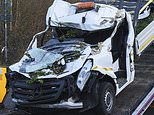
Another man in his 20s was killed in Alton, Hampshire, after a Mercedes-Benz Sprinter pick-up collided with a tree in Old Odiham Road just before midday.
Earlier, a man in Co Wexford, Ireland, was also killed by a falling tree. A member of the public suffered ‘serious injuries’ after being struck by debris from a roof in Henley-on-Thames. Two men were hospitalised following similar, separate incidents in south London.
A Mercedes-Benz Sprinter flatbed van which was crushed by a 40ft tree in Alton, Hampshire
A tree blocks the B3273 road after Storm Eunice, in St Austell, Cornwall, February 19, 2022
A street cleaner sweeps up in Leicester Square in the aftermath of Storm Eunice
Parts of the roof of The O2 arena were damaged by high winds brought on by Storm Eunice yesterday
Around 250,000 people across the UK are still without power, according to power suppliers SSEN, UK Power Networks, Western Power, Northern Power and SP Energy (power outage maps pictured above)
The white-domed roof of the O2 arena is seen damaged by the wind, as a red weather warning was issued due to Storm Eunice, in London, Britain, February 18, 2022
A chimney has collapsed at a Power Plant on the Isle of Graint in Kent due to winds from Storm Eunice. There should be three chimneys (before photo, right)
A roadside filled with debris from the rooftops of three houses which were torn off during storm Eunice, on Kilburn Park Road in north west London
A noticeboard warns of disruption to the train network after Storm Eunice, in St Austell, Cornwall
A person walks past a fallen tree in Cemetery Park after Storm Eunice, in St Austell, Cornwall
A mobile home is seen completely destroyed after Storm Eunice tore through St Albans in Hertfordshire on Friday
Many train services will remain unopened this morning and ‘do not travel’ notices have been reissued for a number of services, according to National Rail Enquiries
Sven Good, 23, with girlfriend Anna Parnanen. was at home at his parents’ house in Brentwood Ess exwhen the Oak Tree smashed through his bedroom window during storm Eunice
Handout photo taken with permission from the Twitter feed of @john_morgan_wal showing a trampoline flying mid air during Storm Eunice in Builth Wells, mid Wales
Switch Island closed yesterday after debris hit a van windscreen, leaving a man injured
Handout photo taken with permission from the Twitter feed of Alan Schneiderman @alan_s01 of fallen scaffolding on a vehicle in North End Road in Golders Green during Storm Eunice
A fallen tree rests against a house blocking a road in Sudbury, Suffolk
Scene on Muswell Hill Road in north London. A woman has died in Muswell Hill, north London, after a tree fell onto a car she was travelling in
Taking a tumble: A shopper struggles to negotiate a pedestrian crossing on London’s Euston Road, and is rescued by a passer by
The Met Office has issued a less-severe yellow wind warning for today (left) and tomorrow (right)
The Environment Agency has kept flood warnings across much of England in place this morning
As of early Saturday morning the National Rail website still listed no services for: Avanti West Coast, Chiltern Railways, Grand Central, Great Western Railway, Greater Anglia, Heathrow Express, South Western Railway, Stansted Express and Transport for Wales.
Meanwhile, CrossCountry Trains has asked passengers not to travel on Saturday ‘following cancelled strike action’.
The provider wrote on Twitter: ‘Whilst a strike has been called off, we have not been able to reinstate our timetable. An amended timetable runs today.’
Cancellations are in place between the following stations: Aberdeen and Edinburgh; Glasgow Central and Edinburgh; Derby and Nottingham; Peterborough and Stansted; Cheltenham Spa and Cardiff Central; Newton Abbot and Paignton; Exeter St David’s and Penzance; Reading and Bournemouth.
Millions of people were urged to stay at home on Friday due to safety fears over the impact of Eunice, while transport woes meant many were unable to travel.
Do not travel alerts were issued across railways in England and Wales on Friday, as seven operators suspended all services, with footage showing a building roof being blown on to tracks.
The train operators which stopped running all services on Friday afternoon were: c2c, Chiltern Railways, Great Western Railway, Greater Anglia, South Western Railway, Southeastern and Transport for Wales.
The Department for Business, Energy and Industrial Strategy and Ofgem published interim reports into the fallout from Arwen this week. It criticised the response from energy companies and accused them of providing ‘overly optimistic’ estimates for when supplies could be restored.
Ministers yesterday scrambled to reassure the public that lessons had been learnt. Damian Hinds told Sky News: ‘Over the longer term, a lot of learning has been done from Storm Arwen, particularly on welfare issues, staying in touch with people, staying in touch with customers for the networks.’
More than 430 flights due to take off or land at UK airports were also cancelled on Friday.
An estimated 5million people watched video of aircraft battling with high winds while they attempted to land at Heathrow. Jerry Dyer, who runs the YouTube channel Big Jet TV, told BBC Radio 4’s Today programme: ‘Yesterday, when the whole Storm Eunice, and prior to that Storm Dudley… I said in the morning… I wonder if we can possibly reach 30,000 people watching live, as many as we did during Storm Ciara.
‘Every now and then you’d glance at the number of people watching and you’re like, 88,000 people… 105,000 people – it was just going mad.
‘At the end of the day we ended up with… normally we’d have about 100,000-plus views, and we had, from when I went to sleep last night, it was 5.5million views.’
Mr Dyer said at one point there were 238,000 viewers watching live during the channel’s peak popularity on Friday.
Both the M4 Prince of Wales Bridge and the M48 Severn Bridge, which link England and Wales across the River Severn, were closed due to high winds. It is believed to be the first time both crossings have been closed simultaneously. Earlier, Network Rail closed all routes in Kent while every line in south-east London was blocked by trees.
Preston train station also closed to passengers, with rail engineers inspecting sections of metal roof panelling that came off due to the winds.
Oliver Le Besque said there was a ‘river of blood running down the road’ after the cab of the flatbed truck was ‘completely crushed’ by the huge tree in Alton, Hampshire yesterday
Mr Le Besque was one of several hero rescuers who sprang into action when the ‘enormous’ tree fell on the vehicle in Alton
A roadside filled with debris from the rooftops of three houses which were torn off during storm Eunice, on Kilburn Park Road in north west London
Debris from the rooftops of three houses torn off during Storm Eunice litter the pavement on Kilburn Park Road, north west London
Strong winds blew a tree into the front of a bus in Biggin Hill in London, adding to the clean-up bill for Storm Eunice. There were no reported injuries from the incident
Handout photo taken with permission from the Twitter feed of @thisissandbanks, of the scene at the Royal Motor Yacht Club in Poole, during Storm Eunice
The popular arena in London’s Greenwich was hard-hit by Friday’s fierce winds, which hit a record 122mph, with large sections of the canvas roof being torn away
It is not yet known how much the roof repairs will cost, but the PTFE-coated glass fibre used to construct the dome in 2000 originally cost £14million. Pictured: At least six panels on the roof were shown as having been torn away on Friday
The Port of Dover announced it was closed ‘in the interests of customer and staff safety’, meaning no ferries could operate between Dover and Calais. Several sailings across the Irish Sea were also cancelled.
Traffic Wales, the Welsh Government’s traffic information service for motorways and trunk roads, warned that ‘many HGVs are ignoring the safety advice on Britannia Bridge’.
The bridge, which connects the island of Anglesey with mainland Wales, is closed to all traffic except cars and car-derived vans.
There were one-hour delays on the M25 due to the closure of the Queen Elizabeth II bridge, which is part of the Dartford Crossing.
The RAC said the number of call-outs to broken-down vehicles was lower than normal, indicating that many people were ‘taking the weather warnings seriously and not setting out’.
It added: ‘The fact many roads are so clear is a sign that today is not a safe day to be driving.’
Transport for London urged people to avoid non-essential journeys in the capital.
As of Friday afternoon there were severe delays on to the tube’s District Line, Jubilee Line and Piccadilly line, while TfL Rail was suspended.
The M4 Prince of Wales Bridge reopened on Friday afternoon. It was believed to be the first time both crossings had been closed at the same time due severe winds.
Areas affected by the warning could experience more bridge closures, travel delays and further power cuts.
Icy stretches are also expected widely across Northern England, Northern Ireland and Scotland, with some snow in the regions. Five flood warnings were also still in place.
Winds of 122mph were provisionally recorded at the Needles on the Isle of Wight on Friday, which, if verified, would be the highest ever recorded in England. The previous record was 118mph at Gwennap Head in Cornwall in 1979.
Yesterday, the Environment Agency issued 10 ‘danger to life’ flood warnings for parts of the River Severn and the Wye Estuary. There were also 26 flood warnings and 101 flood alerts in force.
The Scottish Environment Protection Agency issued one flood warning from Ayr to Troon, with five other flood alerts and one flood warning. And the Coastguard service urged people to stay at home.
The O2 could be closed ‘for months’ as music fans face uncertainty over upcoming performances at the venue after Eunice ripped the dome’s roof apart.
The popular arena in Greenwich was hard-hit by Friday’s fierce winds, with large sections of the canvas roof being torn away.
Dramatic photographs and videos appear to show that at least six sections of the roof, which measures 1200ft in diameter, have been shredded. Around 1,000 people were evacuated from the venue on Friday as firefighters rushed to the scene to make sure ‘no one was injured by any further falling debris’.
After The O2 closed due to the damage, an employee told The Mirror that they had been warned the venue could be closed ‘for a few months’ while repairs are underway.
Another member of staff told the paper they understood that at least part of the building would be shut for the coming weeks.
Power prices plunge after Storm Eunice’s 122mph winds cause some of the highest-EVER output from Britain’s wind turbines
Storm Eunice has caused power prices to plunge after record-breaking gusts created some of the highest-ever output from wind turbines on Friday.
Day-ahead UK power dropped by 11 per cent to £140 per megawatt-hour (MWh) following the surge in wholesale gas prices in recent months, according to the Telegraph.
The newspaper also reported that wind power has significantly outpaced gas over the past week with turbine energy generation averaging 11.48 gigawatts, well above the 7.2GW for gas.
The Telegraph added that prices in Germany dropped by more than two-thirds to their lowest level this year, and that output from wind farms in the country is expected to double by tomorrow.
Wind power has significantly outpaced gas over the past week with turbine energy generation averaging 11.48 gigawatts, well above the 7.2GW for gas
Day-ahead UK power dropped by 11 per cent to £140 per megawatt-hour (MWh) following the surge in wholesale gas prices in recent months, according to the Daily Telegraph. (Stock image)
The top speed of 122mph at Needles on the Isle of Wight, recorded on Friday, is provisionally the highest gust ever in England and means Storm Eunice is now worse than the 1987 Great Storm when gusts peaked at 115mph in West Sussex.
Millions of Britons were urged to stay at home, and the storm claimed its first victim when a man in his early 60s was killed by a falling tree in County Wexford in the Republic of Ireland while out working to clear trees.
A second person, a motorist, is believed to have been killed when a large tree fell and crushed a vehicle in the market town of Alton, Hampshire, this afternoon.
Two further victims have since been announced, a woman in her 30s in Haringey, north London, and a man in his 50s in Netherton, Merseyside.
Yesterday’s red warnings ended at 12pm in the South West and 3pm in the South East, but forecasters continue to be concerned over ‘flying debris resulting in danger to life’ as well as ‘roofs blown off and power lines brought down’.
Damage to the roof of the O2 Arena – known as the Millennium Dome when it opened in 2000 – in South East London
Picture shows the missing brickwork from the rooftops of three houses torn off during Storm Eunice, on Kilburn Park Road in north west London
Isle of Man government is slammed for sexism after ‘offensive’ post saying Storm Eunice had ‘changed her mind like most women’
The Isle of Man government has been slammed for ‘sexism’ and ‘misogyny’ after telling the public Storm Eunice had ‘changed her mind like most women’.
The Department of Infrastructure put out a post on Thursday night warning local residents about a potential road closure near Peel Beach and claimed the wind had changed direction.
The post met a backlash from locals who branded the joke ‘outdated’ and while school librarian Helen Jessopp said it was ‘offensive’ and claimed the Government ‘needed to be called out’ for it.
Now the government have claimed the message ‘fell below the standards expected’ and admitted it would ‘not happen again’.
The Facebook post said: ‘A road closure is in place for Peel Promenade 10am Friday 18 February 2022. Due to a change in the wind direction this closure will not go ahead unless required.
The Isle of Man government posted about a road closure due to the start of Storm Eunice
School librarian Helen Jessopp hit out at the government, claiming it was ‘beyond a joke’
‘Thank you for your patience and understanding, but like most women Eunice changes her mind what she’s doing.’
In reaction to the post, several bemused social media users commented in disbelief, claiming it portrayed an ‘outdated’ view and was an example of a ‘micro aggression’ against women.
School librarian Helen Jessopp hit out at the government, claiming it was ‘beyond a joke’ and an example of ‘everyday sexism’.
Helen, from Port Erin, Isle of Man, said: ‘I thought it was a bit outdated and close to the wire for a government department to post something that could be considered quite inflammatory in this day and age.
‘This is an example of everyday sexism. It’s the sort of micro aggression that needs to be called out.
‘It’s so normalised and a lot of people don’t realise that it’s offensive and outdated.
Waves crash against the sea wall and Porthcawl Lighthouse in Porthcawl, Bridgend, Wales, as Storm Eunice hits the south coast
‘It comes across as it being just a bit of banter or a joke, but when it’s constant and it comes from a government department, that goes beyond a joke and a bit of banter.
‘It’s the small things that add up.’
Helen then thought she would ‘banter back’ by posting an equally ‘sweeping’ and inflammatory statement mocking the initial post.
On Facebook, Helen wrote: ‘Weird how it’s not named after a man then, seeing as like most men it’s going to get violent and unpredictably damage property and maybe people haha.’
Helen said: ‘I thought I’d banter back and make a comparison with a different sweeping statement. The post very quickly got deleted almost immediately after I posted that. The fact it was taken down so quickly and the writing style of it made me think it might have been someone who isn’t normally in charge of social media. They might have thought it was an off-the-cuff, flippant comment and not really thinking it through. I think it was probably someone who doesn’t have those comments aimed at them and realise it’s not just a stand alone thing, but one of many that people can encounter in a short period of time from different places.’
However, Twitter users were divided over the comments, with some claiming it was ‘very disappointing’, while others suggested it was merely ‘old-fashioned’ humour.
Lise Pilkington said: ‘2022 and casual misogyny is still alive and well on the Isle of Man and from an @IOMGovernment department too.’
Trudie Woods said: ‘Very disappointing to see!’
Women of Mann said: ‘Poorly judged, poorly worded, poorly executed. The joke isn’t even funny, don’t understand why the OP thought it was a good idea.’
Tony said: ‘Or take it in the way intended it is called old fashioned humour not offensive or I maybe a grumpy old man can I say that.’
Adam Drewett said: ‘Are people really offended by this?! What a world we live in.’
A spokesperson for the Isle of Man Department of Infrastructure said: ‘The Department of Infrastructure is aware of a message posted on its Facebook page this morning, and subsequently amended, which fell below the standards expected of our organisation.
‘Measures are being taken to ensure this does not happen again.’
How 1987 Great Storm claimed 18 lives, flattened 15million trees and caused £1.5billion worth of damage – after forecaster Michael Fish infamously told the nation ‘don’t worry, there isn’t a hurricane on the way’
It was the ‘hurricane’ that made one BBC weatherman a household name, claimed 18 lives in Britain and caused damage costing £1.5billlion.
The Great Storm of October 1987 was brushed off by forecaster Michael Fish hours before it arrived, as he told viewers worried that a hurricane was on the way: ‘…don’t worry if you’re watching, there isn’t’.
In the hours that followed, winds peaked at more than 120mph, damaging buildings, destroying entire forests as 15million trees were felled in the south-east of England and ultimately leading to tragedy as lives were lost.
Millions of homes were left without power, some for days, and a Channel ferry was driven ashore in what turned out to be the worst storm for nearly 300 years.
At some treasured visitor hotpots, including Emmetts Garden in Kent and Chartwell, the home of Sir Winston Churchill, thousands of trees were lost. At the former, only five per cent of woodland survived.
Elsewhere, entire forests – such as Sandlings Forest in East Anglia – lost nearly all their trees.
Highlighting the unprecedented nature of the storm, the Met Office said that even the oldest at the time in the worst affected areas ‘couldn’t recall winds so strong, or destruction on so great a scale’.
MailOnline readers today recalled their memories of the storm, with one, then aged 14, describing her fear as ‘all the lights went out and it was pitch black in the house and outside’.
Another said: ‘I was living in a tower block on an estate in Battersea on the 14th floor and it was terrifying watching other blocks swaying and the water in the toilet bowl splashing around.’
The phenomenon that made the weather event so fierce was a small area of highly intense wind known as a ‘sting jet’.
It had been expected to form during today’s Storm Eunice, before the Met Office later that the phenomenon will not develop after all.
The Met Office last night issued a rare ‘red warning’ for 100mph winds over southern England and urged millions of Britons to stay at home.
The Great Storm of October 1987 made one BBC weatherman a household name, claimed 18 lives in Britain and caused damage costing £1.5billlion. Above: A man in south-west London leaves a phone box knocked over by a falling tree after the famous storm
Winds peaked at more than 120mph, damaging buildings and felling 15million trees in the south-east of England. Millions of homes were left without power, some for days, and a Channel ferry was driven ashore in what turned out to be the worst storm for nearly 300 years
The 1987 storm took place over two nights, October 15 and 16. Signs that danger was developing in the Bay of Biscay off the coast of Spain emerged at midday on October 15.
When it started to move towards Britain, the job of explaining what might happen fell to Mr Fish on BBC One.
He told viewers shortly after 1pm: ‘Earlier on today, apparently, a woman rang the BBC and said she heard there was a hurricane on the way; well, if you’re watching, don’t worry, there isn’t.
‘But having said that, actually, the weather will become very windy, but most of the strong winds, incidentally, will be down over Spain and across into France.’
As people went to bed that night, there was no warning of what was about to happen.
Shortly before midnight, weatherman Bill Giles said in the BBC’s final weather forecast for the day: ‘It looks like most of the strong winds will stay away, although it’s still going to be very breezy up through the Channel and on the eastern side of the country.’
In the hours that followed, the storm swept across Britain, causing severe damage everywhere it went.
It was the Channel Islands that first felt the storm’s full force, with trees falling and blocking roads.
The worst of the damage occurred in south-east England, with gusts of 70 knots or more recorded continually for three or four hours straight.
When the storm started to move towards Britain, the job of explaining what might happen fell to Mr Fish on BBC One. He told viewers shortly after 1pm: ‘Earlier on today, apparently, a woman rang the BBC and said she heard there was a hurricane on the way; well, if you’re watching, don’t worry, there isn’t
The worst of the damage occurred in south-east England, with gusts of 70 knots or more recorded continually for three or four hours straight. Above: A car crushed by a falling tree in London during the 1987 storm
The 1987 storm damaged the homes of thousands of Britons. Above: A homeowner observes the damage to his property
As for the millions of fallen trees, they forced the National Trust to embark on the biggest outdoor repair job in its history as it planted 500,000 replacement plants across the country. At Emmetts Garden (pictured) in Kent, only five per cent of the woodland escaped the battering
The hill behind Winston Churchill’s family home of Chartwell lost most of its trees – but has since been restored
Thousands of homes were left without power for more than 24 hours, and trees fell onto roads and railway lines, causing severe disruption.
The Met Office also recalled how a number of small boats were wrecked or blown away, with one ship at Dover being blown over and a Channel ferry being blown ashore near Folkestone.
In the aftermath of the storm, questions were raised over how the forecasters got it so wrong.
The Daily Mail’s front page reflected the nation’s anger as it asked: ‘Why weren’t we warned?’
However, Mr Fish was unrepentant immediately afterwards, as he referred to the woman who initially phoned in to express fears that a hurricane was on the way.
He said: ‘The lady was form Wales, which didn’t get the winds, and it was a deep depression, not a hurricane, so I was right’.
The Met Office’s marketing director said afterwards: ‘I don’t think you can call it a mistake – we did forecast stormy weather, we just didn’t get the detail right’.
The AA said that, had they had accurate forecasts, they would have warned motorists to get off the roads.
Instead, thousands of cars were crushed by trees, some with people inside.
The Daily Mail’s original report said: ‘The storm had struck with awesome indifference to human frailty or strength, affluence or poverty.
‘Old age pensioners in seaside nursing homes were bundled out of their ripped-apart wards, weeping in the wind.
‘Drivers of high-priced cars found them crushed and broken, side by side with old bangers equally destroyed.
‘Death struck impartially, it claimed one victim here in a soft hotel bed, another there, sleeping rough on a vagrant’s pavement.
‘It took young and old. People died in their homes, in their cars or doing their jobs in the battle, against the storm’s ravages.’
Kent was one of the worst hit areas, with winds of up to 120mph lashing the county.
In Chatham, a woman was crushed to death in her bed by a falling beech tree, while another victim in the village of Biddenden was killed when two chimney stacks collapsed on his roof and crushed him.
At Howletts Zoo in Canterbury, two leopards escaped when a tree fell on their compound, while looters in Brighton stole electrical goods from the city’s main shopping area after outlets had their windows shattered.
The storm also forced thousands of shops, factories and offices to close, costing the British economy millions of pounds in lost profits.
As for the millions of fallen trees, they forced the National Trust to embark on the biggest outdoor repair job in its history as it planted 500,000 replacement plants across the country.
At Emmetts Garden in Kent, only five per cent of the woodland escaped the battering.
In the aftermath of the storm, questions were raised over how the forecasters got it so wrong. The Daily Mail’s front page reflected the nation’s anger as it asked: ‘Why weren’t we warned?’
The Daily Mail’s original report said: ‘The storm had struck with awesome indifference to human frailty or strength, affluence or poverty. ‘Old age pensioners in seaside nursing homes were bundled out of their ripped-apart wards, weeping in the wind
The newspaper also recorded the immense economic cost of the storm, which hit thousands of businesses and the financial system itself
‘It was like a battle zone,’ gardener Alan Comb recalled in 2014. ‘There were isolated trees sticking up like totem poles.’
At Knole, near Sevenoaks, Kent, sweet chestnuts and other trees fell like dominoes or were stripped of their leaves and branches.
The hill behind Winston Churchill’s family home of Chartwell lost most of its trees – but has since been restored.
And the disruption stretched as far as the City of London’s financial system, with cheques failing to clear – meaning that some Britons were left with their money in limbo.
The failure to accurately forecast the storm led to an internal inquiry in the Met Office, with refinements made to computer models and the training of weathermen.
The storm caused so much damage partly because of the sting jet which formed during it. At the time, forecasters were not aware that the jets existed.
They get their name from their resemblance to the sting in a scorpion’s tail, with the Met Office describing how they can be spotted as they develop on satellite images, where the end of the so-called cold conveyor is marked by a hook-shaped cloud with a point at the end.
A light aircraft is seen lying upside down at Stapleford Abbotts airfield near Epping in Essex after the Great Storm in 1987
A Volkswagen Beetle is trapped under a fallen in the aftermath of the storm. Thousands of homes were left without power for more than 24 hours, and transport disruption was caused due to trees falling onto roads and railway lines
This shaken Briton is seen looking at what may have been his car, which had been crushed by a falling tree in the 1987 storm
The Daily Mail’s original report said: ‘The storm had struck with awesome indifference to human frailty or strength, affluence or poverty’. Above: A car surrounded by fallen scaffolding after the 1987 storm
Damage in London after the Great Storm, which was made so severe by the ‘sting jet’ phenomenon that is set to strike again today
A red Routemaster bus is seen driving past a broken tree in London in the aftermath of the October 1987 storm
This home was one of the many which was severely damaged by falling trees in the 1987 storm. The failure to accurately forecast the storm led to an internal inquiry in the Met Office, with refinements made to computer models and the training of weathermen
The forecaster defines a sting jet as a small area of very intense winds, which can be as strong as 100mph or more, that can form in powerful weather systems crossing the UK.
While the strongest winds usually take place for a short period of time, perhaps around four hours, and across an area as small as 30 miles, the Met Office said the phenomenon can cause ‘significant damage and risk to life’.
Explaining how these jets form, the forecaster said weather fronts separate areas of warm and cold air and their interaction creates and develops wet and windy weather.
There are more focused streams of warm and cold air close to the weather fronts, known as conveyor belts – with the warm conveyor rising and the cold conveyor falling.
The Met Office said these ‘wrap around the area of low pressure and help develop it by feeding warm air and moisture into the system’.
It added: ‘The cold conveyor brings its cold air from higher in the atmosphere and from being in a cold air mass. Sometimes it has help from rain and snow as they fall into it and evaporate.
‘This change from liquid to gas requires heat, which is removed from the conveyor, cooling it further. Now we have even colder air falling along the conveyor, speeding up as it does so, like a rollercoaster taking the first drop.
‘As this wind reaches the surface it can often produce much stronger gusts than would otherwise be made by the storm.
‘However, the cold conveyor catches up with itself after a few hours and consumes the sting jet, keeping the length of time and area of potential damage quite small.’