

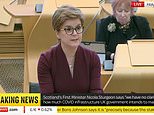
Nicola Sturgeon slams Boris Johnson’s decision to axe free Covid tests
Nicola Sturgeon axes Covid certificates from February 28 and ditches masks from March 21 – but says free tests WILL remain in place ‘from now until further notice’ despite Boris ordering people in England to PAY for them after April 1
Nicolas Sturgeon will set out her pandemic exit plan to Holyrood this afternoonMs Sturgeon has blasted Boris Johnson’s decision to scrap free Covid testsThe First Minister wants free coronavirus testing to continue in ScotlandBut Downing Street has said it will not provide the cash to pay for the provision
<!–
<!–
<!–<!–
<!–
(function (src, d, tag){
var s = d.createElement(tag), prev = d.getElementsByTagName(tag)[0];
s.src = src;
prev.parentNode.insertBefore(s, prev);
}(“https://www.dailymail.co.uk/static/gunther/1.17.0/async_bundle–.js”, document, “script”));
<!–
DM.loadCSS(“https://www.dailymail.co.uk/static/gunther/gunther-2159/video_bundle–.css”);
<!–
Nicola Sturgeon today unveiled her plan for a ‘sustainable return to a normal way of life’ in Scotland as she promised to axe remaining coronavirus rules and blasted Boris Johnson for scrapping free tests in England.
The First Minister said that the use of Covid certificates will end from Monday February 28 and the legal requirement to wear a mask in certain indoor settings will be converted to guidance from March 21.
Ms Sturgeon said that she believes it is ‘reasonable’ to eventually move away from mass asymptomatic Covid testing to a more targeted approach but stressed it must be done in a ‘careful and phased manner’.
She said that access to free tests will therefore continue ‘from now until further notice’, with the Scottish government due to publish a detailed plan in March setting out how it will transition away from mass free testing.
Ms Sturgeon’s pandemic exit plan is notably more cautious than Mr Johnson’s in England after he yesterday announced the end of self-isolation rules from February 24 and the withdrawal of free tests for the general public from April 1.
Mr Johnson’s decision to scrap free testing means people in England will soon have to pay for the checks.
The move has prompted a furious row with the devolved administrations.
Downing Street has said it will not provide any extra cash to maintain free testing given the provision is ending in England.
The SNP is calling on the Treasury to provide more money but Chancellor Rishi Sunak is not expected to budge on the issue.
That means Ms Sturgeon would have to cut spending elsewhere if she wants to continue to provide free tests beyond Mr Johnson’s April 1 cut off date.
Ms Sturgeon said this afternoon that she was still seeking clarity from the Treasury on the testing issue.
Nicola Sturgeon today unveiled her pandemic exit plan for Scotland amid a furious row with Boris Johnson over his decision to scrap free coronavirus tests
Her approach is expected to be more cautious that Mr Johnson’s in England after he yesterday announced the end of self-isolation rules from February 24 and the withdrawal of free tests for the general public from April 1
Ms Sturgeon said the Scottish Government’s new plan for living with Covid will focus ‘much less, hopefully not at all’ on imposing legal restrictions.
The SNP leader said that ‘instead we will rely predominantly on vaccines, treatments and sensible public health behaviours and adaptations’.
Delivering a statement at Holyrood this afternoon, Ms Sturgeon said: ‘At the heart of the framework is a desire for, and increasing confidence in our ability to achieve, a sustainable return to a normal way of life, even as we remain prepared for future threats that Covid may present.’
Confirming the lifting of remaining restrictions, she told MSPs: ‘I can confirm firstly that the Covid certification scheme, requiring certain venues and events to check the vaccine or test status of attendees, will come to an end next Monday, February 28.
‘The app which supports the scheme will remain operational, however, so any business that wishes to continue Covid certification on a voluntary basis to reassure customers will be able to do so.
‘Second, as of March 21, assuming no significant adverse developments in the course of the virus, we expect that the legal requirement to wear face coverings in certain indoor settings and on public transport will be converted to guidance.
‘We will continue to strongly recommend the wearing of face coverings in shops and other indoor public places and on public transport.’
Ms Sturgeon said that Covid testing ‘has been and it will continue to be a vital part of our management of Covid’.
‘However, as the nature of the threat and our approach to managing it evolves, so to will our approach to testing,’ she said.
‘It is reasonable over time and barring adverse developments, to move away from mass population-wide asymptomatic testing towards a more targeted system, focused on specific priorities.’
The First Minister said that it is ‘vital that we make this transition in a careful and a phased manner’, with a detailed plan to be published in March once Holyrood has secured ‘clarity’ from the Treasury on ‘available resources’.
That plan will confirm ‘the duration beyond the end of March of any transition period during which the system will operate broadly on the same basis as now’.
Ms Sturgeon wants some isolation rules and free testing to continue but Downing Street has said on the latter that it will not provide any extra cash to pay for it to continue, given the provision is ending in England
Ms Sturgeon will set out her blueprint for managing and recovering from Covid-19 this afternoon.
When she updated MSPs on the pandemic earlier this month, she said Scotland was ‘through the worst’ of the Omicron wave and the situation was ‘much more positive’ than at the start of the year.
However, her plan is expected to be more cautious than Mr Johnson’s.
The Scottish Government is extending its Covid powers for another six months, with regulations underpinning the use of face masks and vaccine passports now due to expire in September.
That does not necessarily mean that rules will remain in place for another six months because they are subject to review every three weeks.