
Ukraine crisis: Putin asks to use force outside Russia, raising fears of wider invasion
Putin asks for permission to ‘use force outside Russia’ – paving the way for broader attack on Ukraine – after US finally admits Vladimir’s troops HAVE begun an invasion
Vladimir Putin today asked Russian lawmakers for authority to use military force outside the country It raises fears he is planning a wider invasion of Ukraine, having rolled troops into breakaway regionsWestern leaders began sanctioning Putin over the move, with the White House describing it as an ‘invasion’ after hours of dithering – paving the way for ‘severe’ measures to be announced by Joe BidenGermany’s Olaf Scholz cancelled approval of Nord Stream 2 gas pipe in a dramatic hardening of his positionBoris Johnson sanctioned five banks and three of Putin’s cronies, with EU also set to announce penalties
<!–
<!–
<!–<!–
<!–
(function (src, d, tag){
var s = d.createElement(tag), prev = d.getElementsByTagName(tag)[0];
s.src = src;
prev.parentNode.insertBefore(s, prev);
}(“https://www.dailymail.co.uk/static/gunther/1.17.0/async_bundle–.js”, document, “script”));
<!–
DM.loadCSS(“https://www.dailymail.co.uk/static/gunther/gunther-2159/video_bundle–.css”);
<!–
Vladimir Putin has today demanded that Russia’s parliament grant him permission to use military force outside the country, a move that could pave the way for wider invasion of Ukraine after he rolled troops into rebel-held areas.
The Russian strongman made the request in a letter sent to the upper house of parliament, delivered during a hearing to formally recognise his order to send troops into Ukraine’s breakaway eastern regions. Lawmakers are expected to quickly approve the request, having spent the rest of the hearing lining up to praise his decision.
Holding a press conference to defend his decision today, Putin raised fears he is about to stage a land-grab in eastern Ukraine by saying his ‘peacekeeping’ mission will cover the whole of Donetsk and Luhansk regions including areas held by Ukraine. Russia still has around 190,000 troops massed on the border.
It is thought more than 10,000 Russian troops have now moved into rebel-held areas of Donetsk and Luhansk, with videos revealing columns of tanks rolling through the streets in the early hours. Some 6,000 troops were sent to Donetsk, 5,000 to Luhansk and 1,500 to the city of Horlivka, a source with links to Ukrainian intelligence said.
Putin denied that Russia has already sent in troops but vowed that he will ‘fulfil its obligations’ if necessary. He also issued a fresh list of demands to Ukraine – calling on Kiev to drop its bid to join NATO, declare neutrality, and recognise occupied Crimea as part of Russia. It is expected the demands will be rejected out of hand.
Meanwhile the White House began describing Putin’s actions as an ‘invasion’ following hours of dithering, paving the way for Joe Biden to impose crippling financial sanctions after his resolve initially appeared to be wavering.
‘We think this is the beginning of an invasion… and you’re already seeing the beginning of our response, that we said will be swift and severe,’ Biden’s deputy national security advisor Jonathan Finer said early Tuesday, after top aides had shied away from using the word overnight.
As Russia’s troops rolled in, fighting in the region escalated – with shells striking a power plant on the Ukrainian side of the line Tuesday morning after explosions killed two of Kiev’s men and wounded 12 overnight.
German Chancellor Olaf Scholz had earlier led the Western response to Russia, ripping up a deal to open the Nord Stream 2 gas pipe – a move that will cost Russia billions of dollars in revenue but also hurt his own economy, saying that Putin’s actions must have ‘consequences’.
Boris Johnson then announced sanctions on five Russian banks – Rossiya, IS Bank, General Bank, Promsvyazbank and Black Sea Bank – and three ‘very high net wealth’ individuals – Gennady Timchenko, Boris Rotenberg, and Igor Rotenberg – in what he called a ‘first barrage’, accusing Putin of ‘a renewed invasion’. The EU will announce measures this afternoon.
Boris Rotenberg, a former judo training partner of Putin, is the co-owner of SMP Bank while Igor Rotenberg is his nephew. Igor became a billionaire after being handed a raft of investments by his father Arkady – who is currently fighting his ex-wife over ownership of a £27 million mansion in Surrey.
Timchenko is Russia’s sixth richest man thanks to his ownership of investment firm Volga Group, and also an ice hockey fanatic.
Elsewhere today:
Russian foreign minister Sergei Lavrov told Russia’s parliament that Ukraine has ‘no right to exist’ as a sovereign state, as lawmakers voted unanimously to approve Putin’s orderAndrey Rudenko, Russia’s deputy foreign minister, said the country has the right to establish military bases in eastern Ukraine off the back of Putin’s decree – but has no plans to do soUkraine’s defence minister Oleksiy Reznikov steeled his troops to face ‘losses’, saying they will have to ‘overcome fear and despair’ but vowed ‘certain victory’ in the face of Russian threatsDymtro Kuleba, Ukraine’s defence minister, called for ‘tough’ sanctions against Moscow, before flying to Washington to meet US Secretary of State Antony Blinken Zelensky said he is considering cutting all ties with Russia and told his countrymen to be ‘ready’ for Russian provocations, but added he still does not expect widespread fightingPro-Russian separatists in eastern Ukraine continued staging what are widely believed to be false flag operations, claiming three civilians were killed in a car bombing Russian stocks fell more than 8 per cent at opening, the ruble dipped to a two-year low, but oil prices rose 2 per cent amid fears of shortagesVladimir Putin vowed to keeping supplying Europe with gas despite threats of sanctions, though some have already accused him of choking supplies
Russian artillery pieces are pictured in Rostov-on-Don, on the Russian side of the Ukrainian border, on Tuesday – as Vladimir Putin ordered his forces to advance on to Ukrainian territory
Russian mobile artillery and armoured troop carriers are seen in Russia’s Rostov-on-Don region on Tuesday, close to the border with Ukraine’s separatist-held areas
Putin is thought to have moved thousands of troops into rebel-held areas of eastern Ukraine today (dark red area on the map), but there are fears he will try to seize control of the wider regions that separatists lay claim to (lighter shade area)
Russian troops are seen as armoured vehicles manoeuvre in muddy conditions in Rostov-on-Don, Russia, close to rebel-held areas in eastern Ukraine
Vladimir Putin gave a press conference defending his decision to roll into eastern Ukraine today, vowing that Russia stands ready to ‘fulfil its obligation’ to defend the regions if necessary
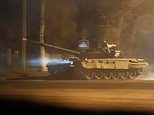
A tank drives along a street after Russian President Vladimir Putin ordered the deployment of Russian troops to two breakaway regions in eastern Ukraine
A tank, believed to be Russian, is spotted on a street near the city of Donetsk in separatist-held regions of eastern Ukraine
Military vehicles drive along a street after Russian President Vladimir Putin ordered the deployment of Russian troops
A military truck drives along a street after Russian President Vladimir Putin ordered the deployment of Russian troops
US ambassador to the UN Linda Thomas-Greenfield leads international condemnation of Russia at an emergency session of the UN security council convened in New York after he recognised parts of eastern Ukraine as independent
General Sir Richard Sherriff, Britain’s former top Nato commander, warned that Europe is now facing its most-perilous moment since the end of the Cold War.
He told BBC Radio 4’s Today programme: ‘This is the most dangerous moment in Europe probably at least since 1962 and the Cuban missile crisis, but it could be much worse than that because this is the invasion of a sovereign country which could turn into a catastrophic war with warfare on a scale not seen in Europe since 1945.
‘So I think it’s difficult to overstate the seriousness of the situation.’
For weeks, Western powers have been bracing for an invasion as Russia massed 75 per cent of its total forces on three sides of neighboring Ukraine.
They warned an attack would cause massive casualties, energy shortages in Europe and economic chaos around the globe – and promised swift and severe sanctions if it materialized. The European Union and Britain announced Tuesday that some of those measures were coming.
Western leaders have long warned Moscow would look for cover to invade – and just such a pretext appeared to come Monday, when Putin recognized as independent two separatist regions in eastern Ukraine, where government troops have fought Russia-backed rebels in a conflict that has killed over 14,000 people.
The Kremlin then raised the stakes further Tuesday, by saying that recognition extends even to the large parts now held by Ukrainian forces.
Kremlin spokesman Dmitry Peskov said that Russia has recognized the rebel regions’ independence ‘in borders that existed when they proclaimed’ their independence in 2014 – broad territories that extend far beyond the areas now under the rebel control and that include the major Black Sea port of Mariupol.
Putin’s move to recognize the territories’ independence opened the door for him to formalize his hold on them and send forces in, though Ukraine and its Western allies have charged Russian troops have been fighting there for years. Moscow denies those allegations.
Condemnation from around the world was quick. Ukrainian President Volodymyr Zelenskyy said he would consider breaking diplomatic ties with Russia and Kyiv recalled its ambassador in Moscow.
But confusion over what exactly was happening in eastern Ukraine threatened to hobble a Western response. While the U.S. clearly called it an invasion, some other allies hedged.
‘Russian troops have entered in Donbas,’ the name for the area where the two separatist regions are located, EU foreign policy chief Josep Borrell said in Paris. ‘We consider Donbas part of Ukraine.’
But in a distinction that could complicate a European and Western response, he added: ‘I wouldn’t say that (it is) a fully fledged invasion, but Russian troops are on Ukrainian soil.’
Poland’s Defense Ministry and British Health Secretary Sajid Javid also said Russian forces had entered Ukraine’s east, with Javid telling Sky News that ‘the invasion of Ukraine has begun.’
Not all in Europe saw it that way. Spanish Foreign Minister Jose Manuel Albares noted ‘if Russia uses force against Ukraine, sanctions will be massive.’
The Kremlin hasn’t confirmed any troop deployments to the rebel east, saying it will depend on the security situation.
Vladislav Brig, a member of the separatist local council in Donetsk, told reporters that the Russian troops already had moved in, but more senior rebel leaders didn’t confirm that.
Late Monday, convoys of armored vehicles were seen rolling across the separatist-controlled territories. It wasn’t immediately clear if they were Russian.
In response to the moves thus far, top EU officials said the bloc was prepared to impose sanctions on several Russian officials and banks financing the Russian armed forces and move to limit Moscow’s access to EU capital and financial markets. They gave few details.
EU foreign ministers are meeting later Tuesday to discuss the measures – but they did not appear to include the massive punishment repeatedly promised in case of a full-fledged invasion.
British Prime Minister Boris Johnson also said the U.K. would slap sanctions on five Russian banks and three wealthy individuals.
While he said that Russian tanks have already rolled into eastern Ukraine, he warned a full-scale offensive would bring ‘further powerful sanctions.’
The White House has also moved to respond, issuing an executive order to prohibit U.S. investment and trade in the separatist regions, and additional measures – likely sanctions – were to be announced Tuesday.
Smoke and flames engulf a power and heating plant generator in Shchastya, on the Ukrainian side of the front line, after being hit by shells fired from the separatist side
Smoke is seen billowing from a Ukrainian power plant close to rebel held areas in the country’s east, after shelling Tuesday morning by separatist troops
Russian troops are seen entering Donetsk in the early hours of Tuesday morning, after Vladimir Putin said he was sending in ‘peacekeepers’
Boris Johnson (left) is seen leaving Downing Street after vowing that the UK is ready to issue an ‘initial barrage’ of sanctions against Russia, while foreign secretary Liz Truss (right) is seen arriving hours earlier at a COBRA meeting
Vladimir Putin last night chaired a meeting of Russia’s full security council, with top aides getting to their feet one by one to lay out the case for war in Ukraine
Russian tanks and armoured vehicles partially covered in white camouflage paint are pictured rolling towards the border with Ukraine, amid fears a wider invasion is still on the cards
Those sanctions are independent of what Washington has prepared in the event of a Russian invasion, according to a senior administration official who briefed reporters on the condition of anonymity.
The Russian moves also pushed Germany to suspend the certification process for Nord Stream 2 pipeline that was to bring natural gas from Russia.
The pipeline was built to help Germany meet its energy needs, particularly as it switches off its last three nuclear power plants and phases out the use of coal, and it has resisted calls by the U.S. and others to halt the project.
As world leaders scrambled to decide on their response, legislation that will likely set the stage for a deeper move into Ukrainian territory moved through Russia’s parliament.
The bills, which sailed quickly through the Kremlin-controlled parliament, envisage military ties between Moscow and the separatist regions, including possible deployment of Russian military bases in the separatist regions.
Even as alarm spread across the globe, Zelenskyy, the Ukrainian president, sought to project calm, telling the country in an address overnight: ‘We are not afraid of anyone or anything. We don’t owe anyone anything. And we won’t give anything to anyone.’
His foreign minister, Dmytro Kuleba, will be in Washington on Tuesday to meet with Secretary of State Antony Blinken, the State Department said.
Russia has long denied it has any plans to invade Ukraine, instead blaming the U.S. and its allies for the current crisis and describing Ukraine’s bid to join NATO as an existential challenge to Russia.
Putin reiterated those accusations in an hourlong televised speech on Monday, when he announced that Russia would recognize the rebels.
‘Ukraine’s membership in NATO poses a direct threat to Russia’s security,’ he said.
Russia says it wants Western guarantees that NATO won’t allow Ukraine and other former Soviet countries to join as members. Moscow has also demanded the alliance halt weapons deployments to Ukraine and roll back its forces from Eastern Europe – demands flatly rejected by the West.
Putin warned Monday that the Western rejection of Moscow’s demands gives Russia the right to take other steps to protect its security.
Sweeping through more than a century of history, Putin painted today’s Ukraine as a modern construct used by the West to contain Russia despite the neighbors inextricable links.
In a stark warning to Ukraine, the Russian leader charged that it has unfairly inherited Russia’s historic land granted to it by the Communist rulers of the Soviet Union and mocked its effort to shed the Communist past in a so-called ‘decommunization’ campaign.
‘We are ready to show you what the real decommunization would mean for Ukraine,’ Putin added ominously in an apparent signal of his readiness to raise new land claims.
Amid the soaring tensions, U.S. President Joe Biden and Putin tentatively agreed to a meeting in a last-ditch effort to avoid war. But the U.S. always said that if Russia moved in, the meeting would be off.
Ukraine U.N. Ambassador Sergiy Kyslytsya demanded that Russia cancel its recognition of the independence of the separatist regions, immediately withdraw its ‘occupation troops’ sent there by Putin, and return to negotiations. He called the Security Council ‘sick’ for its past inaction, and urged members to defend Ukraine’s sovereignty and territorial integrity.
Despite Putin’s actions, he said, ‘The internationally recognized borders of Ukraine have been and will remain unchangeable regardless of any statements and actions by the Russian Federation.’
While Ukraine has the right to self-defense under the U.N. Charter, he said, ‘We are committed to a peaceful and diplomatic path and we will stay firmly on it. We are on our land. We are not afraid of anything or anyone. We owe nothing to anyone, and we will not give away anything to anyone.’
He said ‘there should be no doubts whatsoever’ about this because ‘it is not February 2014,’ when Russia invaded Crimea, which it later annexed, and Ukraine was not prepared. ‘It is February 2022,’ he said.
Russian U.N. Ambassador Vassily Nebenzia accused the United States and its Western allies of egging on Ukraine – which he said has concentrated a 120,000-strong military contingent along the contact line with pro-Russian separatists in the east – toward ‘an armed provocation.’
He accused Ukraine of sharply increasing shelling in residential areas of Luhansk and Donetsk over the past weekend as well as in some Russian towns and villages near the border. ‘So it has become clear that Donbas is on the brink of a new Ukrainian military adventure as was already the case in 2014 and 2015,’ he said, explaining that is why Putin made the announcements earlier Monday.
Putin announced the decision to recognise eastern Ukraine’s Donetsk and Luhansk regions as independent in a lengthy televised address on Monday evening.
He said: ‘I believe it is necessary to take a long overdue decision, to immediately recognise the independence and sovereignty of the Donetsk People’s Republic and the Lugansk People’s Republic.’ He was then shown signing mutual aid agreements with rebel leaders in the Kremlin.
At the end of his lengthy speech, Putin asked Russia’s upper house of parliament, the Federation Council, to ‘support this decision’.
Both Russia’s lower and upper houses of parliament are due to vote on the recognition on Tuesday.
The Russian leader also demanded that Ukraine end military operations against pro-Moscow rebels in the eastern part of the country, or face more possible ‘bloodshed’.
‘We demand an immediate end to military operations,’ Putin said, accusing Kyiv of ‘trying to organise a blitzkrieg’ in east Ukraine.
‘Otherwise, all responsibility for the possible continuation of bloodshed will be fully on the conscience of the regime in power in Ukraine,’ he added.
The West had repeatedly warned Putin not to recognise Ukraine’s rebels, a move that effectively buries a fragile peace agreement regulating the conflict.
Putin spoke for over an hour in a speech heavy with historical references questioning Ukraine’s right to sovereignty and alleging the West had spent years cheating Moscow.
‘Modern Ukraine was entirely and completely created by Russia,’ Putin said.
Volodymyr Zelensky, in a speech to the Ukrainian nation last night, vowed ‘we are not afraid of anyone or anything’ and that ‘we will not give anything to anyone’ in defiance of Russian pressure
Waving Russian flags, people celebrated the latest announcement in the streets in Donetsk, Ukraine on Monday, February 21
Putin’s recognition of the Donetsk and Luhansk rebel regions’ independence paves the way for the long-feared Russian invasion. Pro-Russian residents in Donestk celebrated independence with a fireworks show on Monday
Russian Ambassador to the UN Vasily Nebenzya attends as the United Nations Security Council meets after Russia recognized two breakaway regions in eastern Ukraine as independent entities, in New York City, U.S., on February 21
Appearing visibly angry, Putin said Ukraine should be called ‘Ukraine of Vladimir Ilyich Lenin’, saying it owes its creation to the Russian revolutionary.
He also accused Kiev of waging ‘genocide’ in eastern Ukraine and of preparing to get hold of a nuclear arsenal.
He said the West ‘spat’ on Russia’s security concerns for years by ‘moving NATO eastwards and putting military infrastructure closer to Russia’s borders.’
The Russian leader said the West was trying to ‘blackmail’ Moscow, ‘regardless of the situation in Ukraine.’
‘There is only one aim: to stop Russia from developing. And they will do it, as they did before, even without any formal pretext at all,’ the longtime Russian leader said.
In response, Ms Truss said the UK will announce new sanctions on Russia on Tuesday ‘in response to their breach of international law and attack on Ukraine’s sovereignty and territorial integrity’.
Meanwhile Mr Johnson will chair a Cobra meeting at 6.30am on Tuesday morning to discuss the latest developments in Ukraine, a No 10 spokesperson said.
The spokesperson said: ‘The Prime Minister will chair a COBR (Cobra) at 0630 tomorrow morning to discuss the latest developments in Ukraine and to coordinate the UK response including agreeing a significant package of sanctions to be introduced immediately.’
The European Union’s top officials have also said the bloc will impose sanctions against Russia.
EU Commission President Ursula von der Leyen and Council President Charles Michel say in a joint statement that the recognition is ‘a blatant violation of international law.’
The statement adds that the bloc ‘will react with sanctions’ and ‘reiterates its unwavering support to Ukraine’s independence, sovereignty and territorial integrity within its internationally recognised borders.’
Responding to Putin signing a decree formally recognising rebel-held territories in eastern Ukraine as independent states, Mr Johnson told a press conference: ‘I gather that Vladimir Putin has effectively announced that Russia is recognising the breakaway republics of Donetsk and Lugansk.
‘This is plainly in breach of international law. It’s a flagrant violation of the sovereignty and integrity of Ukraine.
‘It is a repudiation of the Minsk process and the Minsk agreements. And I think it’s a very ill omen and a very dark sign, and certainly does seem to me that it’s certainly an indication – yet another indication – that things are moving in the wrong direction in Ukraine.
‘The UK will continue to do everything we can to stand by the people of Ukraine with a very robust package of sanctions, as you know, fortifying the Eastern flank of NATO in all the ways that we have, but also being one of the few countries to have given the Ukrainians, the defensive weaponry that we think is appropriate to their needs and we will continue to to think about what more we can do to support Ukraine in what is clearly a very, very dark and difficult time.’
Mr Johnson later told the Ukrainian president that he believes a Russian invasion is ‘a real possibility in the coming hours and days’.
A Downing Street spokesperson said: ‘Prime Minister Boris Johnson spoke to Ukrainian President Volodymyr Zelenskyy this evening to discuss the deteriorating situation in and around Ukraine.
‘Outlining his grave concern at recent developments in the region, the Prime Minister told President Zelenskyy that he believed an invasion was a real possibility in the coming hours and days.
‘The Prime Minister strongly condemned the Kremlin’s decision to recognise Luhansk and Donetsk as independent states, and said the move made the Minsk agreements and process unworkable.
‘He added that the UK was already engaging with partners on the issue and said the UK would raise it at the United Nations Security Council and Organisation for Security and Co-operation in Europe in the coming days.’
Mr Johnson also told President Zelenskyy that he would ‘explore sending further defensive support to Ukraine’ at the request of the country’s government.
A Downing Street spokesperson said: ‘He told President Zelenskyy that the UK had already drawn up sanctions to target those complicit in the violation of Ukraine’s territorial integrity, and that those measures would come into force tomorrow.
‘The Prime Minister also said he would explore sending further defensive support to Ukraine, at the request of the Ukrainian government.
‘The leaders agreed that the West needed to support Ukraine in the event of an invasion, but should continue to pursue a diplomatic solution until the last possible second.
‘Regardless of President Putin’s actions, the UK would be steadfast in its full support of Ukraine’s sovereignty and territorial integrity, the Prime Minister said.’
Ms Truss said ‘we will not allow Russia’s violation of its international commitments to go unpunished’ after Putin said he would recognise two separatist Ukrainian republics.
She added: ‘President Putin’s recognition of the ‘Donetsk People’s Republic’ and ‘Luhansk People’s Republic’ as independent states shows flagrant disregard for Russia’s commitments under the Minsk agreements. This step… signals an end to the Minsk process.
‘It demonstrates Russia’s decision to choose a path of confrontation over dialogue. We will co-ordinate our response with allies. We will not allow Russia’s violation of its international commitments to go unpunished.’
Nato chief Jens Stoltenberg tonight condemned Putin’s action in recognising the breakaway republics in eastern Ukraine and accused Russia of ‘trying to stage a pretext to invade Ukraine yet again’.
‘I condemn Russia’s decision to extend recognition to the self-proclaimed ‘Donetsk People’s Republic’ and ‘Luhansk People’s Republic’,’ NATO’s secretary general Mr Stoltenberg said.
‘This further undermines Ukraine’s sovereignty and territorial integrity, erodes efforts towards a resolution of the conflict, and violates the Minsk Agreements, to which Russia is a party.’
The former Norwegian Prime Minister added: ‘In 2015, the United Nations Security Council, which includes Russia, reaffirmed its full respect for the sovereignty, independence and territorial integrity of Ukraine. Donetsk and Luhansk are part of Ukraine.
‘Moscow continues to fuel the conflict in eastern Ukraine by providing financial and military support to the separatists. It is also trying to stage a pretext to invade Ukraine once again.
‘NATO supports the sovereignty and territorial integrity of Ukraine within its internationally recognised borders. Allies urge Russia, in the strongest possible terms, to choose the path of diplomacy, and to immediately reverse its massive military build-up in and around Ukraine, and withdraw its forces from Ukraine in accordance with its international obligations and commitments.’
Russian tanks an armoured vehicles are seen in what observers described as ‘battle formation’ close to the border with Ukraine, with a ‘Z’ symbol painted on the sides which is believed to denote a battle group
Russia has moved its forces to within three miles of the Ukrainian border, with tanks spotted on manoeuvres in Kursk (left) at the weekend and support trucks in Belgorod (right) on Monday
Russian ‘terminator’ tanks – armoured vehicles that are designed to support infantry units fighting in urban areas – were spotted being transferred to the frontlines at the weekend
President Biden called Ukrainian President Volodymyr Zelensky and convened a meeting of his National Security team after Putin signed the decree.
Zelensky revealed the call with Biden on Twitter Monday and said they ‘discussed the events of the last hours’.
‘We begin the meeting of the National Security and Defense Council,’ he posted, adding: ‘A conversation with [UK Prime Minister] Boris Johnson is also planned.’
Mr Johnson’s spokesman said that it appears Putin’s invasion plan has ‘already begun’ while Ms Truss, after meeting with NATO, said an invasion appears ‘highly likely’ but that diplomacy must continue until the last moment.
There are now thought to be 190,000 Russian troops on the border of Ukraine comprising around three quarters of its conventional forces backed by 500 fighter jets, 50 heavy bombers, and dozens of attack helicopters.
The Kremlin denies it has plans to attack, but Western allies say Putin is trying to concoct a pretext to invade by stirring up conflict in two breakaway eastern regions – Donetsk and Luhansk – and staging ‘false flag’ attacks to justify marching his troops in on a mission to ‘protect’ them.
Should Russia go ahead with its attack, the US has warned the UN security council that Moscow has prepared a list of targets for assassination and imprisonment in detention camps.
Officials say the list includes anyone who might oppose the Kremlin – including political figures, journalists, Russian and Belarusian dissidents sheltering in the country, ethnic minorities and members of the LGBTQ community.
‘As we’ve seen in the past, we expect Russia will try to force cooperation through intimidation and repression,’ a US official told Foreign Policy magazine on Friday, before a letter containing the allegations was sent to the US on Monday.
‘These acts, which in past Russian operations have included targeted killings, kidnappings/forced disappearances, detentions, and the use of torture, would likely target those who oppose Russian actions.
‘[That] includes Russian and Belarusian dissidents in exile in Ukraine, journalists and anti-corruption activists, and vulnerable populations such as religious and ethnic minorities and LGBT persons.’
Kremlin spokesman Dmitry Peskov called the claims an ‘absolute lie’.
Heavy shelling was reported along the frontline at the weekend, leaving several Ukrainian troops dead, following what Russian state media claimed were terror attacks targeting top officials and a gas pipeline in the two regions – which the West said was staged.
Fighting continued on Monday, with separatist commanders alleging that artillery had been fired into the Donetsk region and struck a hospital with ‘clashes’ reported near Mariupol. Russia separately claimed that a Ukrainian shell had blown up a guard post in Rostov-on-Don. Ukraine denies firing at either separatist or Russian territory.
The Kremlin has also been pushing claims that ‘mass graves’ containing the bodies of civilians killed by Ukrainian troops have been discovered in the region, and on Monday submitted documents containing those allegations to the UN Security Council.
Tens of of thousands of civilians – mostly women, children and the elderly – have now being evacuated from rebel-held areas into Russia due to the ‘threat’. Fighting-age men have been ordered to stay behind under the threat of legal sanctions if they try to leave.
In what appeared to be a last-ditch diplomatic gambit brokered with the aid of French President Emmanuel Macron, the White House said Biden has agreed ‘in principle’ to a meeting with Putin as long as he holds off on launching an assault. But the Kremlin said no ‘concrete’ plans had been made.
It is the second time that Emmanuel Macron, who has tried to position himself as Europe’s top security negotiator, has been embarrassed by Moscow – given guarantees which were revoked when he made them public. Two weeks ago he claimed Putin had agreed to stop military drills on Ukraine’s border, which Russia immediately denied.
White House press secretary Jen Psaki said the administration has been clear that ‘we are committed to pursuing diplomacy until the moment an invasion begins.’
U.S. Secretary of State Antony Blinken and Russian Foreign Minister Sergei Lavrov are set to meet on Thursday in Europe – as long as Russia does not send its troops into Ukraine beforehand.
‘We are always ready for diplomacy. We are also ready to impose swift and severe consequences should Russia instead choose war,’ Psaki said in statement.
‘And currently, Russia appears to be continuing preparations for a full-scale assault on Ukraine very soon.’
Despite the threat, life in the capital Kiev outwardly continued as usual for many Sunday, with brunches and church services, ahead of what Biden said late last week was an already decided-upon Russian attack.
Katerina Spanchak, who fled a region of eastern Ukraine when it was taken over by Russian-allied separatists, was among worshippers crowded into the capital’s St. Michael’s monastery, smoky with the candles burned by the faithful, to pray that Ukraine be spared.
‘We all love life, and we are all united by our love of life,’ Spanchak said, pausing to compose herself. ‘We should appreciate it every day. That’s why I think everything will be fine.’
‘Our joint prayers will help to elude this tragedy, which is advancing,’ said another worshipper, who identified himself only by his first name, Oleh.
A U.S. official said Sunday that Biden’s assertion that Putin has made the decision to roll Russian forces into Ukraine was based on intelligence that Russian front-line commanders have been given orders to begin final preparations for an attack. The official spoke on the condition of anonymity to describe the sensitive intelligence.
The United States and many European countries have charged for weeks that Putin has built up the forces he needs to invade Ukraine – a westward-looking democracy that has sought to move out of Russia’s orbit – and is now trying to create pretexts to invade.
Western nations have threatened massive sanctions if Putin does.
U.S. officials on Sunday defended their decision to hold off on their planned financial punishments of Russia ahead of any invasion, after Ukrainian President Volodymyr Zelenskyy called passionately Saturday for the West to do more.
‘If you pull the trigger on that deterrent, well then, it doesn’t exist anymore as a deterrent,’ Pentagon spokesman John Kirby told Fox on Washington’s sanctions threat.
Russia held nuclear drills Saturday as well as the conventional exercises in Belarus, and has ongoing naval drills off the coast in the Black Sea.
The announcement that Russia was reversing its pledge to withdraw its forces from Belarus came after two days of sustained shelling along a contact line between Ukraine’s soldiers and Russian-allied separatists in eastern Ukraine, an area that Ukraine and the West worry could be the flashpoint in igniting conflict.
Britain’s Defense Secretary Ben Wallace opens delivers somber comments Tuesday as he opens a conference of defense ministers in the UK following Putin’s decision to send troops into Ukraine
Natalia, the widow of a Ukrainian soldier killed in fighting on the border with separatists, weeps during the funeral of Captain Anton Sidorov in Kiev this morning
The coffin of Ukrainian Captain Anton Sidorov is seen in Kyiv this morning, who died on the front line on Feb 19th
Russia is continuing to evacuate citizens from rebel held areas of Ukraine, with tens of thousands of women, children and the elderly bussed across the border
A child is seen on board an evacuation bus in rebel-held areas of Ukraine, as he is driven to Russian because of ‘threats’ from Kiev – which the government has dismissed as ‘fake news’ propaganda
Women and children are loaded on to buses in rebel-occupied Ukraine, so they can be ‘evacuated’ to Russia
Lawmakers in the self-declared Luhansk People’s Republic meet Tuesday morning to ratify Russia’s acknowledgement of the territory as independent from the wider state
Biden convened the National Security Council at the White House on Russia’s military buildup around Ukraine. White House officials released no immediate details of their roughly two hours of discussion.
‘We’re talking about the potential for war in Europe,’ U.S. Vice President Kamala Harris said earlier Sunday at a security conference in Munich, Germany, that saw urgent consultations among world leaders on the crisis. ‘It’s been over 70 years, and through those 70 years … there has been peace and security.’
Zelenskyy on Sunday appealed on Twitter for a cease-fire. Russia has denied plans to invade, but the Kremlin did not respond to Zelenskyy’s offer Saturday to meet with Putin.
After a call with Macron, Putin blamed Ukraine – incorrectly, according to observers there – for the escalation of shelling along the contact line and NATO for ‘pumping modern weapons and ammunition’ into Ukraine.
Macron, a leader in European efforts to broker a peaceful resolution with Russia, also spoke separately to Zelenskyy, to British Prime Minister Boris Johnson and to Biden.
Blinken intentionally raised the prospect of a Biden-Putin summit in interviews with U.S. television networks on Sunday, in a bid to keep diplomacy alive, a senior U.S. official said. The official spoke on condition of anonymity to discuss U.S. reasoning.
Blinken said that Biden was ‘prepared to meet President Putin at any time in any format if that can help prevent a war’ and the U.S. official said Macron had then conveyed the offer of talks to Putin – conditioned on Russia not invading – in his phone calls with the Russian leader.
Tensions mounted further, however. The U.S. Embassy in Moscow issued an advisory urging greater caution by Americans in Russia overall. ‘Have evacuation plans that do not rely on U.S. government assistance,’ it warned.
Immediate worries focused on eastern Ukraine, where Ukrainian forces have been fighting the pro-Russia rebels since 2014 in a conflict that has killed some 14,000 people.
In the eastern Ukraine regions of Lugansk and Donetsk, separatist leaders have ordered a full military mobilization and sent more civilians to Russia, which has issued about 700,000 passports to residents of the rebel-held territories. Claims that Russian citizens are being endangered might be used as justification for military action.
Officials in the separatist territories claimed Ukrainian forces launched several artillery attacks over the past day and that two civilians were killed during an unsuccessful assault on a village near the Russian border. Ukraine’s military said two soldiers died in firing from the separatist side on Saturday.
‘When tension is escalated to the maximum, as it is now, for example, on the line of contact, then any spark, any unplanned incident or any minor planned provocation can lead to irreparable consequences,’ Putin’s spokesman, Dmitry Peskov, said in an interview that aired Sunday on Russian state television.
On the front lines, Ukrainian soldiers said they were under orders not to return fire. Zahar Leshushun, peering into the distance with a periscope, had followed the news all day from a trench where he is posted near the town of Zolote.
‘Right now, we don’t respond to their fire because …’ the soldier said before the sound of an incoming shell interrupted him. ‘Oh! They are shooting at us now. They are aiming at the command post.’
Relatives and friends attend a funeral service for Anton Sidorov, a Ukrainian serviceman who was reportedly killed by shelling in eastern Ukraine, at a church in Kiev
Ukrainian servicemen attend a funeral service for Anton Sidorov, a Ukrainian serviceman who was reportedly killed by shelling in eastern Ukraine
Vladimir Putin has used these identical tactics and trickery before when he sparked war in Georgia… the West must punish this thug as he rips apart another nation, writes IAN BIRRELL
When Georgia was on the verge of joining Nato in 2008, Russia‘s president Vladimir Putin stirred up bitter separatist tensions, made baseless claims of genocide, and carried out military exercises nearby.
His proxies fired pot-shots over the border, then evacuated civilians from areas under their control, on the bogus pretext of saving them from aggression.
There was a short war that ended with Russian tanks 30 miles from the capital Tbilisi and two chunks of the country breaking away as self-declared republics.
But the former KGB chief denied he had any imperial ambitions, insisting Russia had ‘no wish or grounds to encroach on the sovereignty of former Soviet republics’.
How hollow those words sound now as history looks set to repeat itself, with this hateful dictator using identical tactics and trickery in Ukraine.
Just as when he invaded and illegally annexed Crimea in 2014, he is operating through proxies to achieve his aims of corroding democracy and thwarting a sovereign nation’s desire to find stability under the defensive shield of Nato.
Yet for all his talk of Western influence in Ukraine, Putin’s real aim is simple: To prevent democracy from infecting his own blighted citizens and leading them to challenge his corrupt regime, one that has failed them so badly.
Russian President Vladimir Putin signs a document recognising the independence of separatist regions in eastern Ukraine in the Kremlin in Moscow, Russia, on Monday
Once again we see Putin’s stooges in two breakaway republics –Donetsk and Luhansk in the Donbas region of eastern Ukraine – fabricating attacks and evacuating civilians.
And, once again, Putin makes phoney assertions of genocide, as well as lying about Ukrainian attacks on mother Russia.
With his customary twisting of the truth, the president claimed last night he had always treated his neighbour in an ‘honest way and with respect to Ukraine’s interests’.
That could not be further from reality – especially as he signed the decree formally recognising the two republics, paving the way for a possible further invasion that might have cataclysmic consequences for our continent.
The current conflict began in 2014 when a corrupt Russian-backed president of Ukraine fled after pro-democracy protests erupted across the nation following his decision to abandon moves to sign a co-operation deal with the European Union.
Putin reacted to the ousting of his ally by stealing Crimea – the first annexation of sovereign territory in Europe since the Second World War.
He then sent in his tanks and troops when it seemed Ukraine was on the point of crushing rebels that he supported in Donbas.
This led to full-scale fighting, followed by a peace deal known as Minsk 2 that resulted in a 173-mile frontline across eastern Ukraine between the Kiev regime and the two self-declared republics. The conflict, which left 14,000 people dead and two million people displaced, has flickered ever since.
Russian and Belarus soldiers during joint exercises of the armed forces of Russia and Belarus as part of an inspection of the Union State’s Response Force, at a firing range near Brest
U.S. Army soldiers assigned to the 82nd Airborne Division, deployed to Poland to reassure NATO allies and deter Russian aggression
The hastily-agreed peace treaty, backed by Putin and signed under pressure by Kiev, was imperfect and never fully implemented. It envisaged ‘special status’ for the two ‘republics’ – although their status and political structures were ill-defined – and would have given Russia control over Ukraine’s future.
Now Putin has torn up the treaty after a carefully-choreographed routine that began last Tuesday when the lower house of the Russian parliament voted to ask their puppet-master to recognise the separatist regions.
Then the Russian leader called a meeting of his security council, at which ministers and security chiefs lined up to demand recognition of the ‘republics’. ‘We were left with no choice,’ claimed foreign minister Sergey Lavrov.
So what can we deduce from the latest manoeuvres?
First, that Putin has effectively stolen another chunk of Ukraine and breached international law by undermining another nation’s territorial integrity – even if those in charge of the ‘republics’ have not yet asked to formally join Russia as I write.
However, they have signed a ‘friendship and mutual assistance’ treaty which means Putin can be asked to send in ‘military assistance’ or ‘peacekeepers’ – and last night, in an ominous move, it emerged he has already given an order to send his armed forces into the ‘republics’.
Given the forces massed on the border and his ceaseless lies about Ukrainian attacks and Nato aggression, this could lead to ‘defensive’ intervention elsewhere in the country.
Indeed, if full-scale war erupts, the start might be dated to last Thursday when the shelling across the border was massively increased – from an average of five a day to 60 – 66 on Friday, and more than 100 on Saturday.
Meanwhile, Putin claimed last night that ‘Ukraine’s military strategy is nothing less than the preparation for military actions against Russia’ – an absurd suggestion that would be suicidal for Kiev given the imbalance of forces between the two nations.
We must hope the West stands firm and imposes every possible sanction on this brutal thug to punish him as he rips apart a neighbouring nation based on specious historical arguments and makes preparations to invade again on utterly spurious grounds. Pictured: Boris Johnson on Monday
Yet this malevolent dictator – with four yachts and a billion-pound palace on the Black Sea – who has overseen the pillaging of his resource-rich nation by his band of patsy oligarchs, even had the cheek to argue that corruption had eroded Ukrainian ‘statehood’ and Kiev’s politicians were robbing their people.
Having spent five weeks in Ukraine – and having previously been witness to the appalling events of 2014 – I can feel only sorry for all those decent people I have met and interviewed whose only desire is peace and security for themselves, their families and their friends.
And my sorrow extends to a nation that has been struggling to escape the Soviet shadow in pursuit of democracy but is being dismembered by a despot who once worked for the Communist secret police and now seeks to protect himself and his thieving pals from his own people.
We must hope the West stands firm and imposes every possible sanction on this brutal thug to punish him as he rips apart a neighbouring nation based on specious historical arguments and makes preparations to invade again on utterly spurious grounds.