

Freedom Day arrives! England finally scraps all its remaining emergency Covid laws
Freedom Day arrives! England finally scraps all its remaining emergency Covid laws after nearly two years of economically-crippling on-off lockdowns – with self-isolation rules now officially over
<!–
<!–
<!–<!–
<!–
(function (src, d, tag){
var s = d.createElement(tag), prev = d.getElementsByTagName(tag)[0];
s.src = src;
prev.parentNode.insertBefore(s, prev);
}(“https://www.dailymail.co.uk/static/gunther/1.17.0/async_bundle–.js”, document, “script”));
<!–
DM.loadCSS(“https://www.dailymail.co.uk/static/gunther/gunther-2159/video_bundle–.css”);
<!–
England woke up to freedom today after nearly two years of crippling on-off lockdowns as all emergency Covid laws introduced to tackle the pandemic ended at midnight.
Self-isolation rules for the infected are now officially over, masks are no longer necessary on public transport in London and NHS hospitals are finally being told to lift visiting restrictions.
Despite the shackles being thrown off with vaccines and life-saving new drugs leaving the ‘grimmest years in our peacetime’ behind us, the nation has been told to remain ‘sensible’ in the next stage of the country’s battle with Covid.
Health Secretary Sajid Javid branded ‘Freedom Day’ — how February 24, 2022 will go down in the history books — ‘important’.
But reiterating the challenges the nation still faces even with cases, hospitalisations and deaths having been in freefall for weeks, he said today that ‘Covid is not done with us’.
Mr Javid told The Times: ‘We must never lose sight of the fact the rules and regulations we introduced were an extraordinary response to an extraordinary challenge, they were never intended to be the new normal.’
Since Boris Johnson told the nation to ‘stay at home’ in a landmark Downing Street press conference on March 23 2020, England has been through three blanket lockdowns, months of ‘whack-a-mole’-style local restrictions and blanket school closures.
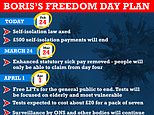
From today, however, anyone who receives a positive Covid test will no longer be obliged to quarantine at home for five days by law — although the advice remains. Routine contact tracing has also been axed, as has the £500 self-isolation payments.
Changes to statutory sick pay and employment support allowance designed to help people through the pandemic will end on March 24, when Britain embarks on another vaccine roll-out to give 8million elderly adults and over-12s with weakened immune systems a fourth jab.
And then in the final step to pre-Covid life, free universal testing will end on April 1 and will instead be focused on the most vulnerable. High street pharmacies will sell rapid swabs for as little as £1.89.
Dozens of commuters disembark a train at London King’s Cross railway station at rush hour this morning, as England woke up to freedom
Boris Johnson hailed a new post-Covid era as he declared that self-isolation laws are being axed from tomorrow and free tests will go from April
All coronavirus laws in England including the legal requirement for people who test positive to isolate are ending today. The lifting of remaining restrictions on normal life come after Boris Johnson unveiled his ‘Living with Covid Plan’ on on Monday, in which he insisted that vaccines and new treatments can be relied on to keep the public safe
Hospitals will also be told to lift visiting restrictions – after it emerged that as many as 20 per cent of trusts still have all routine visits suspended
Meanwhile, public transport users in London will no longer be required to wear face masks after Transport for London dropped its ruling saying they were compulsory
The news about the possible lifting of hospital visiting restrictions comes after it was revealed that many hospitals were still restricting visits.
The new guidance being drawn up on Wednesday reportedly said: ‘The visiting guidance is being reviewed in light of the ‘living with Covid-19′ plans and we will be communicating the outcome of this review shortly so that visitors can attend hospitals and healthcare settings in a manner that continues to protect patients and staff.’
According to The Telegraph, the new guidance is expected to tell trusts that they need to be more open with their visiting policies.
Relatives previously reported not being able to see loved ones for weeks at a time, with the isolating negatively affecting patients and their recoveries.
The news about the ending of all legal restrictions was heralded by Health Secretary Sajid Javid, although he struck a note of caution.
He said: ‘This is an important day as we move from rules set by the Government to more personal responsibility.
‘And although we might be done with Covid, Covid is not done with us. It is here to stay so please continue to be sensible as we move forward on the road to recovery.
Transport for London was the last bastion of masks on public transport but it has now dropped the requirement for coverings.
Office for National Statistics (ONS) statisticians estimated there were 2.1million infections on any given day in England in the week up to February 19, down 14 per cent on the 2.4million per day the week before
It announced that face coverings will stop being a condition of carriage following the ‘shift in the Government’s approach’ towards living with coronavirus.
It added that ‘decreasing infection rates in London’ were also a factor in its decision.
Despite the good news, an Ipsos survey of 1,018 people aged 16-75 found that 46 per cent of those polled believe that the Government is relaxing coronavirus restrictions too quickly, while 39 per cent believe it is about the right time.
The survey found that 49% of people do not support the end of legal self-isolation for those testing positive for Covid, while 33 per cent of those polled do support the end of the legal requirement.
Almost four in 10 Britons surveyed said it is likely they will go to the shops (37 per cent) even if they have tested positive for Covid, and the same proportion of workers feel they would go into work if they were positive.
The survey found that 24 per cent said it is likely they would travel on public transport if they had tested positive, while 20% said they would visit elderly relatives.
More than half of those polled (52 per cent) said it is likely that they would go for a walk outside if they had tested positive for the virus.
Just 29% of those surveyed support the decision to no longer provide free Covid-19 test kits.
The news about the ending of all legal restrictions was heralded by Health Secretary Sajid Javid, although he struck a note of caution
Keiran Pedley, at Ipsos, said: ‘While the public are divided on whether or not this is the right time for the Government to relax Covid-19 restrictions, it’s clear that the decision to stop providing free Covid-19 tests to anyone who requests them is not a popular one.
‘It is notable that British workers are split on whether they would go into work even after testing positive which may have implications for plans to get people back into offices.’
On Monday, England’s chief medical officer Professor Sir Chris Whitty said people should still isolate if they have Covid-19 despite the legal requirement ending.
He said it is ‘standard public health advice’ as he warned that while rates are coming down it is ‘still a very common infection’.
Mr Johnson acknowledged there is likely to be another variant that will ’cause us trouble’, saying he did not want people to think ‘there’s some division between the gung ho politicians and the cautious, anxious scientists’.
He said: ‘The most important thing is that – and I hope this is the big take-out from this – the sun is shining but we’re keeping our umbrella.’
But the British Medical Association warned that the ‘living with Covid’ strategy ‘fails to protect those at highest risk of harm from Covid-19, and neglects some of the most vulnerable people in society’.
Groups representing vulnerable individuals also sounded the alarm over the end to isolation laws, with the Scope disability equality charity saying it would usher in a life ‘living with fear’.
Blood Cancer UK warned that the plan ‘will cause huge anxiety among immunocompromised people and leave many of them feeling abandoned’, while the MS Society said the scrapping of free universal testing is ‘not only reckless but dangerous’.