

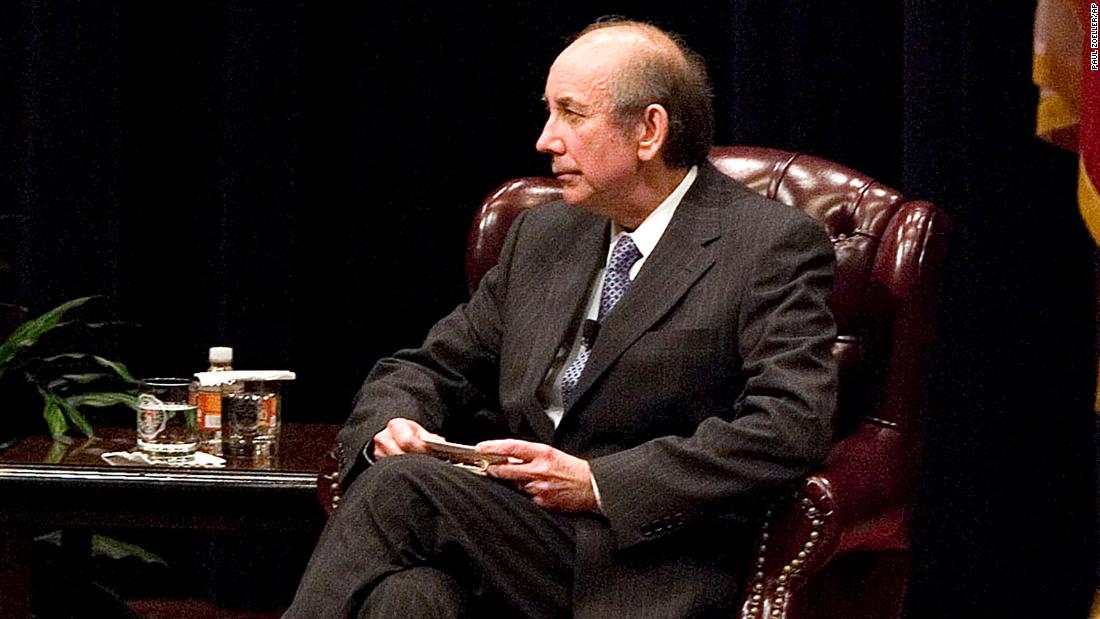
Analysis: 1st US ambassador to Ukraine: ‘I think we handled it wrong from the get-go’
And he offers a blunt verdict on the US government’s performance during that time: “I think we handled it wrong from the get-go.”
That’s not a partisan statement. Popadiuk spent his career not as a political appointee but as a foreign service officer. He has a quintessentially American story.
His family, assisted by a Catholic charity, ended up in Brooklyn after a brief stint on an Iowa farm. In 1959, when Popadiuk was 9 years old, an immigration official handed him a citizenship certificate for his adopted country just before Thanksgiving.
“He said, ‘Do you like turkey?’ ” Popadiuk recalls with a chuckle. ” ‘You’re an American.’ “
As ambassador, he initiated discussions over what became known as the Budapest Memorandum. Under its terms, Ukraine surrendered a large nuclear arsenal within its borders in return for security assurances from Russia, the US and Britain.
Ukraine’s concession was less than met the eye, since Russia had retained the nuclear launch codes for those weapons. But Popadiuk says the fledgling government in Kyiv should have gotten more US economic and military aid.
“Both administrations fell short in realizing the threat,” Popadiuk concludes.
“If you knew they were going to attack Ukraine, why didn’t you give them everything they needed ahead of time?” Popadiuk says. “We needed to get ahead of him.”
The bravery of Ukraine’s soldiers and ineptness of his own appear to have caught Putin by surprise. So has the unity that Biden and his European counterparts have maintained.
“We’ve let Putin define the rules of the game,” he explains, rather than making the risk of a catastrophic exchange the Russian leader’s burden.
The more they happen, the stiffer the test of allied resistance to direct confrontation with Russia through steps such as a NATO-imposed no-fly zone.
“There’s got to be a red line for the West,” says Popadiuk. The objective is imposing a price high enough to shift Putin’s cost-benefit analysis.
An ugly end is already assured. Distasteful as it would be, he fears halting the conflict will eventually require recognizing Russian control over Crimea and parts of eastern Ukraine.
At 71, Popadiuk is long removed from any active role in foreign policy. He retired ten years ago as diplomat-in-residence at the George H.W. Bush Foundation, which like Bush’s presidential library is at Texas A&M University.
What Popadiuk knows for certain is that, whatever America and its European allies do, Ukrainians won’t stop defending their country.
“This is about a cultural war of survival for Ukrainians,” he says. “If there’s one standing, that fight’s going to go on.”