

Netflix shares drop 25% after LOSING viewers for first time
Netflix shares drop 25% after LOSING viewers for first time: Streaming giant sheds 200,000 subscribers and blames ‘password-sharing’ for slump after its post-Covid boom
Netflix shares have dropped by 25% after it lost 200,000 subscribers in January-March this yearStreaming giant is now projecting to lose another 2million customers during the April-June periodNetflix said Covid boom had ‘created a lot of noise’ and blamed households sharing passwordsBut it also admitted it faced rising competition and lost 700,000 subscribers after quitting RussiaBosses are now considering curbing password sharing and creating ad-supported subscription
<!–
<!–
<!–<!–
<!–
(function (src, d, tag){
var s = d.createElement(tag), prev = d.getElementsByTagName(tag)[0];
s.src = src;
prev.parentNode.insertBefore(s, prev);
}(“https://www.dailymail.co.uk/static/gunther/1.17.0/async_bundle–.js”, document, “script”));
<!–
DM.loadCSS(“https://www.dailymail.co.uk/static/gunther/gunther-2159/video_bundle–.css”);
<!–
Netflix shares crashed by an eyewatering 25% after it revealed that it had lost hundreds of thousands of subscribers this year – bringing its many years of uninterrupted expansion to a juddering halt, and potentially throwing it into reverse.
The US streaming giant’s customer base fell by 200,000 subscribers during the January-March period, the company admitted in a quarterly report released Tuesday – and it is now projecting a loss of another 2million during the April-June period.
Netflix bosses said the Covid boom had ‘created a lot of noise’ and blamed the large number of households password sharing for the slowdown – despite previously saying that the practice ‘likely helped fuel our growth by getting more people’ using the service.
The California-based company estimated that about 10million households worldwide are watching its service for free by using the account of a friend or another family member, including 30million in the US and Canada.
However, it has now started testing different ways of curbing password sharing in Chile, Costa Rica and Peru – and could extend this elsewhere.
Netflix also claimed that the market had now been ‘saturated’ by rising competition from streaming services including Disney+, Apple TV, Now TV, Warner Bros Discovery and Paramount, the cost-of-living crisis gripping the US, Canada and Western Europe, and its decision to quit streaming in Russia after Putin’s invasion of Ukraine in February.
This is despite the company releasing a variety of recent hits including Squid Game, Bridgerton, Sex Education, and political drama Anatomy of a Scandal.
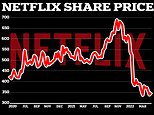
Upon news that it had shed 200,000 subscribers, Netflix shares plunged by 25%. So far this year, its shares are down about 40%, after markets jolted in January when it said that subscriber growth would slow significantly in 2022. If the stock drop extends into Wednesday’s regular trading session, Netflix shares will have lost more than half of their value so far this year – wiping out about $150billion (£115billion) in shareholder wealth in less than four months.
Responding to the development, billionaire Tesla magnate Elon Musk – who is Twitter’s second-biggest shareholder and is attempting to takeover the social media company for $43billion – taunted: ‘The woke mind virus is making Netflix unwatchable’.
It is the first time that Netflix’s subscribers have fallen since the streaming service became available throughout most of the world outside China six years ago.
Upon news that it had shed 200,000 subscribers, its shares plunged by 25%. So far this year, its shares are down about 40%, after markets jolted in January when it said that subscriber growth would slow significantly in 2022
General views of the Netflix Hollywood campus on Vine on April 19, 2022
Netflix CEO Reed Hastings during the See What’s Next event at Villa Miani in Rome, Italy, April 18, 2018
Responding to the development, Elon Musk taunted in a tweet: ‘The woke mind virus is making Netflix unwatchable’
Netflix is losing billions of dollars a year because of illegal password-sharing ‘marketplaces’ that offer access for just $1, experts have claimed. The popular streaming app is missing out on up to $6.25billion annually as customers use the services to dodge the $19.99 a month premium account fee. But the firm last month launched its first major counteroffensive to password sharing by letting watchers add up to two other users for just $2 in some countries. Netflix is not the only website to be hit by the scams, with HBO Max and Disney+ subscriptions also being ripped off by dodgy so-called marketplaces
The company told shareholders on Tuesday: ‘Our revenue growth has slowed considerably. Streaming is winning over linear, as we predicted, and Netflix titles are very popular globally. However, our relatively high household penetration – when including the large number of households sharing accounts – combined with competition, is creating revenue growth headwinds.’
Netflix was previously stung by a customer backlash in 2011 when it unveiled plans to begin charging for its then-nascent streaming service, which has previously been bundled for free with its traditional DVD-by-mail service before its international expansion.
In the months after that change, Netflix lost 800,000 subscribers, prompting a apology from Netflix CEO Reed Hastings for botching the execution of the spin-off.
Tuesday’s announcement was a sobering comedown for a company that was buoyed two years ago when millions of consumers corralled at home were desperately seeking diversions – a void Netflix was happy to fill. Netflix added 36million subscribers during 2020, by far the largest annual growth since its video streaming service’s debut in 2007.
But Hastings now believes those outsized gains may have blinded management. ‘Covid created a lot of noise on how to read the situation,’ he said in a video conference Tuesday.
Netflix began heading in a new direction last year when its service added video games at no additional charge in an attempt to give people another reason to subscribe.
Escalating inflation over the past year has also squeezed household budgets, leading more consumers to rein in their spending on discretionary items. Despite that pressure, Netflix recently raised its prices in the US, where it has its greatest household penetration – and where it’s had the most trouble finding more subscribers.
In the most recent quarter, Netflix lost 640,000 subscribers in the US and Canada, prompting management to point out that most of its future growth will come in international markets. Netflix ended March with 74.6million subscribers in the US and Canada.
The news deepens troubles that have been mounting for the streaming service since a surge of signups from a captive audience during the pandemic began to slow.
It marks the fourth time in the last five quarters that Netflix’s subscriber growth has fallen below the gains of the previous year.
Now investors fear that its streaming service may be mired in a malaise that has been magnified by stiffening competition from well-funded rivals such as Apple and Walt Disney.
Jefferies analyst Andrew Uerkwitz told the FT that the announcement was a ‘change in tone’ from Netflix, which he said rarely acknowledged that it faced competition in the past. He added: ‘It sounds like they’re in rebuilding mode.’
Paolo Pescatore, an analyst at PP Foresight, said the subscriber loss was a ‘reality check’ for the company, as it tries to balance retaining subscribers with raising its revenue.
‘While Netflix and other services were key in lockdown, users are now thinking twice about their purchasing behaviour based upon changing habits,’ he told the BBC.
Aptus Capital Advisors analyst David Wagner said it’s now clear that Netflix is grappling with an imposing challenge. ‘They are in no-(wo) man’s land,’ Wagner wrote in a research note Tuesday.
The Los Gatos, California, company estimated that about 100million households worldwide are watching its service for free by using the account of a friend or another family member, including 30million in the US and Canada.
Previously, Netflix bosses said password sharing was ‘something you have to learn to live with, because there’s so much legitimate password sharing, like you sharing with your spouse, with your kids… so there’s no bright line, and we’re doing fine as is’.
In its shareholder note, the company said: ‘Sharing likely helped fuel our growth by getting more people using and enjoying Netflix. And we’ve always tried to make sharing within a member’s household easy, with features like profiles and multiple streams.’
However, Netflix has indicated it will expand a trial program it has been running in three Latin American countries – Chile, Costa Rica and Peru – to prod more people to pay for their own accounts. Hastings said: ‘Those are over 100million households already are choosing to view Netflix.
‘We’ve just got to get paid at some degree for them.’
This image released by Netflix shows a scene from the popular Korean series Squid Game
Simone Ashley as Kate Sharma and Jonathan Bailey as Anthony Bridgerton in Netflix series Bridgerton
Rupert Friend and Sienna Miller in new Netflix political drama Anatomy of a Scandal
In this photo illustration a computer screen and mobile phone display the Netflix logo on March 31, 2020 in Arlington
In this locations, subscribers can extend service to another household for a discounted price. In Costa Rica, for instance, Netflix plan prices range from $9 to $15 a month, but subscribers can openly share their service with another household for $3.
Netflix offered no additional information about how a cheaper ad-supported service tier would work or how much it would cost. Another rival, Hulu, has long offered an ad-supported tier.
While Netflix clearly believes these changes will help it build upon its current 221.6million worldwide subscribers, the moves also risk alienating customers to the point they cancel the service.
However, Netflix is not the only streaming service finding that accounts are being cancelled, with new figures showing that more than 1.5million households in the UK alone left Disney+, Now and Apple TV+ during the first three months of the year.
While 58 per cent of households still retain at least one paid-for streaming service, the number that do so fell by 215,000 in the first quarter of this year.
‘With many streaming services having witnessed significant revenue growth during the height of Covid, this moment will be sobering,’ said Dominic Sunnebo, the global insight director at Kantar Worldpanel, the publisher of the Entertainment on Demand report.
‘The evidence from these findings suggests that British households are now proactively looking for ways to save, and the subscription video-on-demand (SVoD) market is already seeing the effects of this.’
The Kantar Worldpanel report found that 16.9 million UK households had at least one subscription service at the end of the first quarter.
While there were 1.29 million new subscriptions to SVoD services in the UK in the first three months, this was outweighed by 1.51 million cancellations.
Unsurprisingly, the world’s two most popular streaming platforms proved to have the lowest rate of customers leaving in the first quarter, with cost-conscious subscribers identifying Netflix and Amazon’s Prime Video as their ‘must-have’ services.
Kantar said that despite ‘churn’ rates – the rate at which customers cancelled subscriptions – increasing almost across all streaming platforms, there was a ‘clear difference’ in the number of subscriptions cancelled outside of Netflix and Amazon.
‘Netflix and Amazon can be seen to be hygiene subscriptions for Brits; the last to go when households are forced to prioritise spend,’ Kantar said.
‘Disney, Now TV, Discovery+ and BritBox all saw significant jumps in churn rates quarter-on-quarter.’
Prime Video’s thriller series, Reacher, and Netflix dramas Ozark and Inventing Anna proved to be the most popular shows on SVoD services in the UK in the first three months of 2022.
Kantar’s research, which was based on interviews with 14,500 people, found that cancellations of streaming subscriptions accelerated from 1.2 million a year ago and from 1.04 million during the final three months of 2021 to 1.5 million.
The first quarter of 2022 also saw the lowest ever rate of new subscribers, according to Kantar.
Amazon Prime Video led the way for new subscribers in Britain, taking a 27 per cent slice of the market, while Disney+ was second with 14 per cent and Now third on 9 per cent, just edging out Netflix and Apple TV+.