

Pfizer asks FDA to authorize its COVID vaccine for children from six months to four years
BREAKING: Pfizer asks FDA to authorize its COVID-19 vaccine for children from six months to four years
Pfizer-BioNTech has asked the Food and Drug Administration to authorize the use of its COVID vaccine for kids between six months and four years oldThe company submitted data showing that its vaccine is safe and generated a strong immune response in young childrenIt is recommending two doses, given three weeks apart for children ages six months to four years that would be 3 micrograms eachThe FDA will now consider that request, and review the applicable dataIts advisory group is already set to meet on June 15 to offer guidance on pediatric doses and if they recommend it, it could be cleared within daysThe Centers for Disease Control and Prevention, though, would still have to sign off on it
<!–
<!–
<!–<!–
<!–
(function (src, d, tag){
var s = d.createElement(tag), prev = d.getElementsByTagName(tag)[0];
s.src = src;
prev.parentNode.insertBefore(s, prev);
}(“https://www.dailymail.co.uk/static/gunther/1.17.0/async_bundle–.js”, document, “script”));
<!–
DM.loadCSS(“https://www.dailymail.co.uk/static/gunther/gunther-2159/video_bundle–.css”);
<!–
Pfizer-BioNTech announced on Wednesday it has asked the Food and Drug Administration to authorize the use of its COVID-19 vaccine for young children between the ages of just six months and four years.
That age group is the only one not yet eligible for the COVID vaccines, and Pfizer is recommending two doses, given three weeks apart for children in that age group. Those shots would be just three micrograms each – one-tenth the dose given to adults.
Pfizer’s move comes as COVID cases are once again on the rise and follows a similar one from its rival, Moderna, submitted in late April for COVID vaccines for children under the age of six – though COVID cases remain mild in young children.
The FDA will now consider both requests, NBC News reports, and will review the applicable data. It could grant the emergency authorization later this month.
Its advisory group, the Vaccines and Related Biological Products Advisory Committee, is already scheduled to meet on June 15 to offer guidance on pediatric doses – and if the group recommends the use of the vaccine on the young children, the FDA could clear the way for doses within a few days.
But the Centers for Disease Control and Prevention would still need to sign off on the doses before they could be administered.
In a statement to ABC News, FDA officials confirmed they have received Pfizer’s request for an Emergency Use Authorization for children under four.
‘We recognize parents are anxious to have their young children vaccinated against COVID-19, and while the FDA cannot predict how long its evaluation of the data and information will take, we will review any EUA request we receive as quickly as possible, using a science-based approach,’ they said.
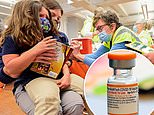
Pfizer-BioNTech announced on Wednesday it is seeking approval from the Food and Drug Administration to administer its COVID-19 vaccine to children between six months and four years old. Jack Wasserman, 6, is seen receiving his Pfizer booster vaccine on May 19
Moderna has also requested authorization for the use of its vaccine for children under the age of six. A girl from Kentucky is seen here getting her COVID jab in November
As part of its application, Pfizer submitted clinical trial data that found that three doses of its vaccine (pictured) was safe for young children and generated a strong immune response
As part of its application, NBC reports, Pfizer submitted clinical trial data of 1,678 children found last month that three doses of the vaccine for the youngest of children was safe and generated a strong immune response.
It showed that antibody levels tested one month after the third dose showed the vaccine produced a similar immune response as the two-dose regimen for those ages 16 to 25.
It also found that the vaccine was 80 percent effective against the omicron variant – but the efficacy rate won’t be finalized until at least 21 symptomatic cases are found in the vaccine group and then compared to the number of symptomatic cases in the placebo group, CNN reports.
The data was released on May 23, but has not been peer-reviewed or published in a medical journal.
‘Our COVID-19 vaccine has been studied in thousands of children and adolescents, and we are pleased that our formulation for the youngest children, which we carefully selected to be one-tenth of the dose strength for adults, was well-tolerated and produced a strong immune response,’ Pfizer CEO Albert Bourla said at the time.
This is not the first time Pfizer asked the FDA to authorize a vaccine for the youngest of children, however.
In February, the company asked the FDA to authorize a two-dose vaccine, but an advisory committee meeting to review the regimen was postponed after Pfizer admitted that the two doses did not generate enough of an immune response in a trial of children ages two to five.
It said at the time it would wait on data for its three-dose regimen before again seeking authorization.
The company’s main rival, Moderna, meanwhile, submitted its application for a two-dose vaccine regimen for children under 6 at the end of April – though the company said it also expects to seek authorization for a booster dose.
Moderna’s vaccine would be administered as two 25-microgram doses, four weeks apart.
Data from the company showed that its vaccine regimen was 51 percent effective against infection – including asymptomatic and mild infection – among those six months old to under 2 years old, and 37 percent effective for those ages 2 to 5.
The advisory committee will now review both applications at its meeting on June 15.
Pfizer had previously asked the FDA to authorize a two-dose vaccine for young children, but pulled back after revealing it was not effective
Pfizer’s vaccine would be given as two doses, administered three weeks apart for children six months to four years. A three-year-old boy, Hudson, is seen participating in a Moderna COVID-19 vaccine trial last year
Moderna’s vaccine would be administered as two 25-microgram doses, four weeks apart. Ahmed Ali is seen administering a Pfizer dose to 9-year-old Loic Schlagel, while his father Kyle and brother Remi, 6, watched him in November
The move to vaccinate young children comes as case figures are increasing around the country – as hospitalizations and deaths remain at the same rates they were in previous periods of the pandemic.
According to the most recent figures, the nation is averaging 99,748 COVID cases every day, an 8 percent drop over the past week. Deaths have not occurred at the same levels, though, with America recording 611 per day.
At the same time, interest in the vaccines has waned among the public.
A recent Gallup poll finds that a third of Americans are no longer worried about the pandemic, one of the lowest figures recorded yet, and national data shows the country’s booster fallout fell flat, with demand for the additional shots being much lower than many officials expected.
a Kaiser Family Foundation survey from April found that only 18 percent of parents of children younger than five plan to vaccinate them.
Many remain hesitant, with 27 percent saying they will ‘definitely not’ get their young children vaccinated, and 11 percent reporting that they would only do so if it was required for school.
The remaining 38 percent said they want to ‘wait and see’ before getting their children vaccinated.
In Florida, health officials have already recommended against using the COVID vaccine on ‘healthy’ children, as they face little risk from the virus, with hospitalizations or deaths being especially rare.
‘The Florida Department of Health is going to be the first state to officially recommend against the COVID-19 vaccines for healthy children,’ Florida Surgeon General Dr. Joseph Ladapo announced last month.
‘We´re kind of scraping at the bottom of the barrel, particularly with healthy kids, in terms of actually being able to quantify with any accuracy and any confidence the even potential of benefit.’
He, nor Republican Gov Ron DeSantis, specified what would classify as a ‘healthy’ child or when the guidance would officially go into effect.
But the announcement came as some health experts expressed their concerns about vaccinating children, and doubting whether they were necessary.
Children face little risk from COVID-19, with a ever-growing trove of data showing that they are not nearly as affected by it as adults are.
The CDC reports that children only account less than 0.1 percent of COVID deaths in the U.S. since the pandemic first began.
And a study from the University of Utah last year found that 50 percent of pediatric Covid cases are asymptomatic. The study was performed before the more-mild Omicron variant emerged, meaning the risk for children to even feel symptoms is likely lower now.
Children may also be less likely to spread the virus when infected, with a German study finding that they release as little as only 25 percent of virus particles as adults do.
Data revealed by New York state officials at the end of last month also found that the shot was only 12 percent effective at preventing COVID infection for children aged five to 11.
Dr Joseph Ladapo (pictured) said Monday that Florida will formally recommend against COVID-19 vaccinations for healthy children