

Analysis: Georgia’s restrictive voting law puts the GOP at a crossroads
But those efforts were largely swept into oblivion after the arrival of Donald Trump and his divisive politics. And the passage of Georgia’s restrictive new voting law on Thursday night amounted to a capitulation on those goals. The fact that Democrats carried Georgia at the presidential level for the first time since 1992, and then flipped both of Georgia’s US Senate seats, was an acknowledgment that the GOP isn’t winning through the politics of addition. The new law signals the party will rely on the politics of subtraction instead.
Republican power grab
The GOP’s naked power grab was evident in the provisions that remove Secretary of State Brad Raffensperger, another Republican who stood up to Trump’s efforts to overturn the November election, as the chair of the State Board of Elections, replacing him with “a chairperson elected by the General Assembly” while making him “an ex officio nonvoting member of the board.” The Georgia law also grants state officials authority to replace local election boards, giving them more control over the process.
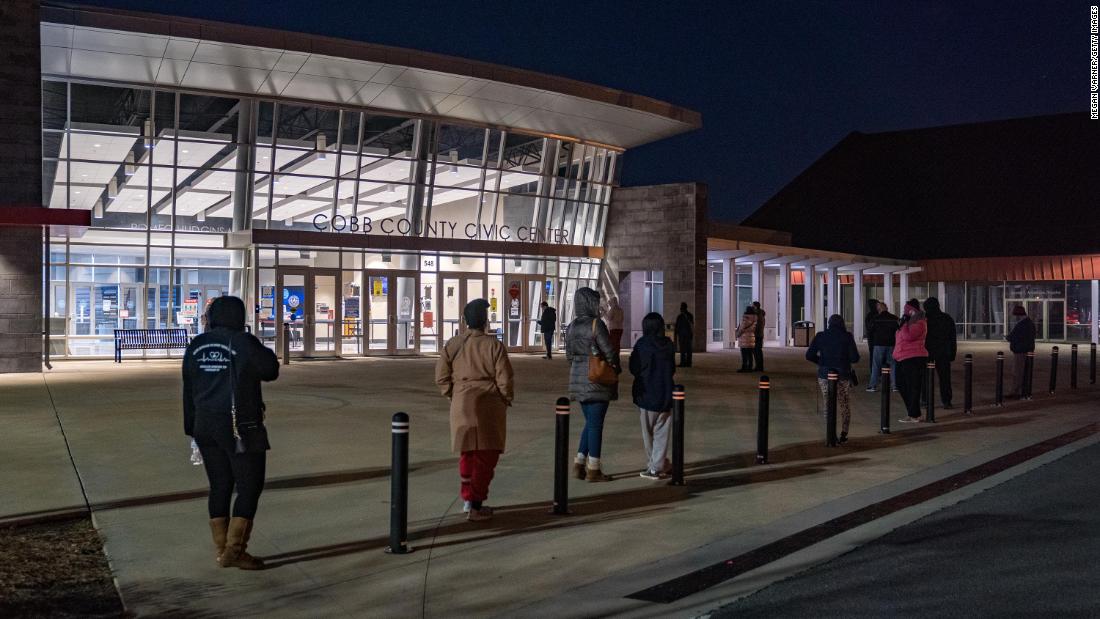
Voters will now be required to provide driver’s license or state identification card information when requesting an absentee ballot (and if they do not have that information, they must affix a photocopy or electronic image of other identifying information to their request). Most ballot drop boxes must now be housed inside early voting locations, which are generally only required to be open during normal business hours — limiting the usefulness of drop boxes for anyone who needs to drop their ballot off outside the normal work day. And in a state where long lines in minority precincts are notorious, there is a new ban on giving food or water to people waiting in line.

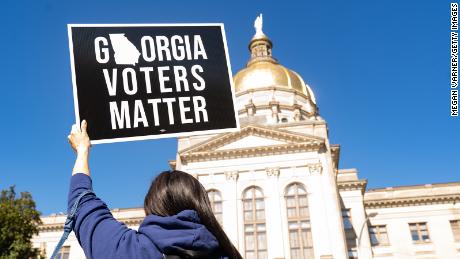
“What in their mind would think that it’s not right to give a thirsty person some water, in any situation, whether they’re voting, or whatever. It’s ridiculous,” said Kimberly Wallace in an interview with CNN as she attended Saturday’s rally against Georgia’s new law outside of Atlanta City Hall. “You’re supposed to be making it easier for people to vote, not harder.”
“There’s no rational argument against requiring state ID — provided for free to those who don’t have a driver’s license — for absentee ballots,” Raffensperger said, even though voting advocates note that those rules will disproportionately affect poorer voters and voters of color.
Court battles
Georgia’s battle over access to the ballot is already playing out in the courts. Nsé Ufot, CEO of The New Georgia Project — one of the groups challenging the new law on the grounds that it violates the First and Fourteenth Amendments — told CNN Saturday that “we absolutely are going to court to make sure that this bill in Georgia is invalidated.”
“I have no idea how long the battle takes. I would like for it to be quick. But we will see what the judge has to say about this,” she said on “Newsroom.”
Ufot rejected the governor’s argument that the legislation is an election security bill and argued that the only reason Republicans are seeking to curtail mail-in voting is because “they lost.”
“They will continue to lose because in a marketplace of ideas, fewer and fewer people are buying what they are selling, and the only way for them to continue to hold onto power is to make it difficult for more people to vote,” she said.
Testifying before Congress this past week about the “For the People Act,” Michael Waldman, the president of the Brennan Center for Justice, noted the number of restrictive voting bills sweeping through state legislatures has created “a time of crisis for our democracy.”
America has come too far for voting rights to be a partisan issue in the 21st century. Reasonable Republicans have a chance to halt these efforts or let them languish in statehouses around the country, potentially winning back the trust of voters the party lost during Trump’s relentless assault on democracy.
If they don’t, these attempts to block voters from casting ballots may become a stain on their party’s legacy and reverse their efforts to create a bigger tent for many years to come.