

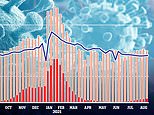
Weekly Covid deaths in England and Wales rise 17% to 668 with virus now behind one in 15 fatalities
Weekly Covid deaths in England and Wales rise 17% to 668 with virus now behind one in 15 fatalities, official data reveals
Some 10,628 deaths were registered in England and Wales in the week ending August 27, the ONS revealed Of those recorded, 6.5 per cent (668) had the coronavirus mentioned on their death certificate And the virus was the direct cause of 586 of these 668 deaths (87.7 per cent), according to the ONSThis is a 17 per cent hike compared to one week earlier, when 570 of 10,013 deaths were linked with Covid Meanwhile, a further 45 daily Covid deaths were added to the toll yesterday, according to official figuresIt comes as a SAGE source said there may be a ‘firebreak’ lockdown in October if hospitalisation keep rising
<!–
<!–
<!–<!–
<!–
(function (src, d, tag){
var s = d.createElement(tag), prev = d.getElementsByTagName(tag)[0];
s.src = src;
prev.parentNode.insertBefore(s, prev);
}(“https://www.dailymail.co.uk/static/gunther/1.17.0/async_bundle–.js”, document, “script”));
<!–
DM.loadCSS(“https://www.dailymail.co.uk/static/gunther/gunther-2159/video_bundle–.css”);
<!–
Weekly deaths in England and Wales linked with the coronavirus rose by 17 per cent at the end of August, according to official figures.
The Office for National Statistics said there were 668 people who had Covid mentioned on their death certificated in the week ending August 27, up from 570 in the previous seven days.
There were a total of 10,268 deaths from all causes in the most recent week, with Covid behind one in 15 of them (6.5 per cent).
The 668 deaths registrations in the two countries is the highest figure since March 26, when 719 deaths were recorded. Deaths dropped as low as 84 in the week to June 11.
Of the weekly deaths where Covid was mentioned on the death certificate, the ONS said the virus was the direct cause of 586 (87.7 per cent).
The remaining 82 fatalities were linked with the virus – such as the person testing positive within 28 days of their death – but died from another underlying cause.
The latest figures show the impact of the third wave, which began in the UK in May and has led to an increase in the number of new cases of coronavirus as well a smaller but steady rise in hospital patients.
Meanwhile, a further 45 daily Covid deaths were added to the toll yesterday. It marked a six per cent fall compared to last Monday, but the figures were impacted by the bank holiday and weekend.
The rising ONS death data comes as ministers today refused to rule out a two-week ‘firebreak lockdown’ in England during the October school holidays if hospitalisations continue to rise and put the NHS under pressure.
But a full lockdown is unlikely, as officials are confident that the vaccine rollout is working – with deaths registered in the most recent week just 7.9 per cent of the January spike, when 8,433 were logged in one week.
Vaccinations in England are estimated to have directly averted 105,900 deaths, according to latest research by Cambridge University and Public Health England.
In England, 9,630 deaths were registered in the most recent week, which is 1,070 more and 12.5 per cent higher than the five year average. It is also an increase of 229 deaths compared to last week.
Of the total fatalities, 649 (6.7 per cent) involved Covid, an increase of 17.8 per cent from the 551 fatalities linked with the virus one week earlier.
Deaths that involved Covid increased in seven of the nine regions in England, with the largest increase spotted in the South East where the figure jumped 65.9 per cent from 44 to 73 in just seven days.
London saw the most deaths connected with the virus (107), followed by the North West (101), the West Midlands (75) and the South East (73).
The East Midlands (60), South West (54), East (51) and North East (45) recorded the lowest number of Covid fatalities.
Deaths linked with the virus dropped in Yorkshire and the Humber (83) and the West Midlands (75), but the fatalities in these regions was still higher than most regions in the country.
Meanwhile, 616 deaths were registered in Wales, 18 more deaths than the previous week and 7.5 per cent higher than the five-year average. Some 16 of these deaths involved Covid, which is two less than one week earlier.
This marks the eighth week in a row that the ONS has reported a higher number of deaths than they would expect to see at this time of year.
Since the beginning of the pandemic last March, 882,231 people in England and Wales have died from all causes.
Of these, 144,382 (16.4 per cent) mentioned the virus on their death certificate.
And during this 17-month period, 110,595 deaths were recorded above the five-year average.
The vast majority of these fatalities were recorded in England, where 827,317 deaths occurred between March 13 and August 27, which is 106,410 more than the average from the last five years. Some 136,160 death certificates (16.5 per cent) mentioned the virus.
In Wales, 53,821 died since last March, with 8,018 deaths (14.9 per cent) being linked with Covid. The total death figure is 5,333 fatalities above the five-year average.
Of the total deaths recorded across England and Wales in the most recent week, respiratory disease was linked with 3,059 deaths, while the flu and pneumonia was linked with 1,508.
Meanwhile, a SAGE member revealed the Government has plans for a ‘firebreak lockdown’ in October that would extend the one-week school holiday to two weeks if Covid hospitalisation continue to rise.
It is believed that closed schools over the summer holidays helped the UK avoid an even bigger rise in cases after restrictions were lifted on so-called Freedom Day.
Vaccine Minister Nadhim Zahawi said he has not ‘seen any plans’ for the measure and he hopes the Government can avoid strict restrictions with the rollout of booster jabs.
There are about 930 Covid hospital admissions across the UK on average now — four times fewer than in the second wave — but there are concerns that the country is starting from a high baseline as it heads into winter.
Officials are confident that the jabs are doing their job, which makes a full lockdown very unlikely. Covid deaths are 10 times lower now than in January and doctors say Covid hospital patients are coming in with more mild illness.
The anonymous SAGE source said: ‘It would be sensible to have contingency plans, and if a lockdown is required, to time it so that it has minimal economic and societal impact.’
They added: ‘We are going to be at a peak, albeit an extended peak, quite soon, so it’s not really the same situation as last year, when failure to reduce prevalence would have resulted in collapse of NHS and people dying in car parks.
‘Hospitals might be overflowing before deaths reach the same level. Acting early will prevent this level.’
Asked about the claims on BBC Breakfast, Mr Zahawi said: ‘No, I haven’t seen any… I know where this question comes from.
‘The i newspaper was reporting that they think there could be a possible lockdown.
‘Look, vaccines have given us the ability to reduce infections, to save 100,000 lives.
‘It is through the booster programme that I hope… we can transition the virus from pandemic to endemic status and deal with it year in, year out – it is going to be with us for many years – but not have to close down our economy or take the severe measures we had to sadly take in December of last year.’