

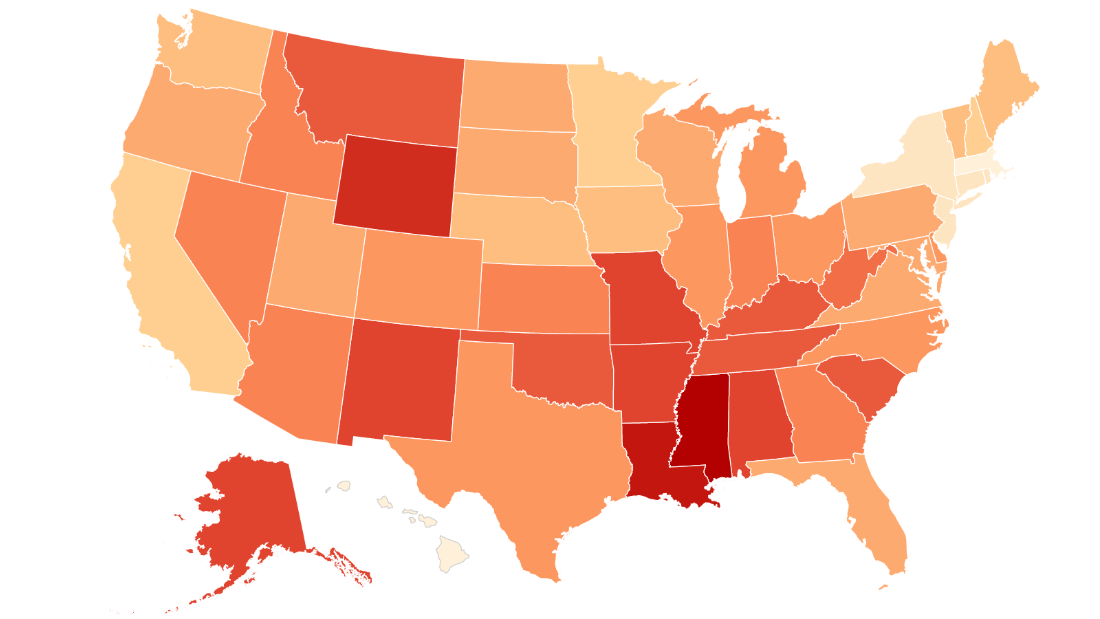
States with weaker gun laws have higher rates of firearm related homicides and suicides, study finds
The research team then weighed the list of gun safety policies based on their efficacy, ranked each state on its implementation of those policies and compared that score with the rates of gun deaths in each state, he said.
The analysis, first reported by CNN, put California at the top of the list for gun law strength — a composite score of 84.5 out of 100, with a low rate of 8.5 gun deaths per 100,000 residents, and below the national average of 13.6. Hawaii has the lowest rate of gun deaths in the country with the second strongest gun law score. It also has the lowest rate of gun ownership, with firearms in 9% of households, the data shows.
Legislators consider gun laws in 2022 session
As state legislatures begin to convene for their 2022 legislative sessions, lawmakers will consider a breadth of bills that either loosen or expand gun protections across various states.
Mississippi has the weakest gun laws with a score of 3 out of 100 and has a rate of 28.6 gun deaths per 100,000 residents — the highest of all states, the research shows.
Massachusetts has adopted 37 of the 50 policies and has the second-lowest rate of gun deaths, while Missouri has only eight of the gun safety policies and the fourth highest rate of gun deaths in the US. Louisiana and Wyoming are among the top five states with the highest gun deaths and the weakest gun safety laws.
“As a mother, when I look at him, I see everything that was taken away,” Dycus said. “My son was a dreamer. He was a scholar. He was on this road to being something great.”
“But on the flip side, I see this little boy who has made such an impact, not just on our city but our country, as it pertains to what it looks like to survive,” she said. “Dre has embodied that.”
Secure storage laws deemed essential to gun safety
Everytown designated a list of five foundational laws that have proven to be the most effective in lowering gun violence rates. These include requirements for a background check and/or permits to purchase handguns; a permit to carry concealed guns in public; the secure storage of firearms; the rejection of ‘Stand Your Ground’ laws; and the enactment of ‘extreme risk’ laws that temporarily remove a person’s access to firearms when there is evidence that they pose a serious risk to themselves or others, according to Everytown.
Last year, several conservative states — such as Texas, Iowa, Tennessee, Montana, Utah and Wyoming — passed legislation allowing some form of permitless carry as President Joe Biden pushed forward executive actions to address gun violence following several high-profile mass shootings.
Supporters of the bill have argued that by removing the licensing requirement they are removing an “artificial barrier” to residents’ right to bear arms under the Constitution and ensuring more Texans have access to “the protection of themselves or their families” in public. But law enforcement officials and experts have expressed concerns that the open carrying of firearms makes it more difficult for police to quell violence.
“As we’ve seen gun extremism continue to rise in this country, we’ve also seen people who open carry start out at marches and rallies and then show up in elected officials’ homes, in polling places, statehouses and then on January 6th at the US Capitol,” Watts said.
According to Watts, the shooting in a Michigan high school in December that killed four students is a “textbook example” of why laws that require the secure storage of firearms are essential to gun safety.
Only 23 states currently have some semblance of a secure storage requirement, Watts said.
Last year, Everytown successfully worked to pass secure storage laws in Maine, Colorado, and Oregon, among others, according to Watts.
During this year’s legislative session, Watts said the organization will work with lawmakers in hopes of passing such laws in at least 14 states. States such as California, Michigan and New Jersey are working on first-of-its kind legislation that requires parents to be notified about secure storage.
Everytown’s research shows that 21 of the country’s states have rejected Stand Your Ground laws, which allow individuals to use deadly force in public as self-defense even if they can safely walk away from the situation.
Despite strong gun laws, some states still feel the effects of being close to a state with more lax regulations. For example, Illinois has the sixth-strongest gun safety laws in the country, but its neighboring state of Indiana has much weaker gun laws, Suplina says.