

Ukraine tensions: US warns Russia of consequences if ‘any’ troops cross border
Russia will be met with a ‘united, swift and severe’ response should it invade Ukraine, US Secretary of State Antony Blinken warns as he arrives in Geneva for talks with Moscow
Antony Blinken has arrived in Switzerland for crunch talks with Sergei Lavrov Blinken said the US remains ‘committed to a path of diplomacy’ over Ukraine But he warned of a ‘united, swift and severe’ response if Putin opts to invade Lavrov said he is not expecting a ‘breakthrough’ today, but does want ‘concrete’ response to security demands including that Ukraine is banned from NATO
<!–
<!–
<!–<!–
<!–
(function (src, d, tag){
var s = d.createElement(tag), prev = d.getElementsByTagName(tag)[0];
s.src = src;
prev.parentNode.insertBefore(s, prev);
}(“https://www.dailymail.co.uk/static/gunther/1.17.0/async_bundle–.js”, document, “script”));
<!–
DM.loadCSS(“https://www.dailymail.co.uk/static/gunther/gunther-2159/video_bundle–.css”);
<!–
The US has warned of a ‘united, swift and severe’ response if Putin invades Ukraine as Secretary of State Antony Blinken arrived for talks with his Russian counterpart in Switzerland today.
Blinken, arriving at the Geneva hotel where the crunch talks are now taking place, said Washington is ‘committed to a path of diplomacy’ for resolving border tensions between Russian and its ex-Soviet neighbour.
But he added that America stands ready with a ‘united, swift and severe’ response if Moscow invades. ‘This is a critical moment,’ he said.
Both sides said they are not expecting a ‘breakthrough’ today, though there are fears that a complete failure of diplomacy could spark a Russian attack and the most-serious East-West confrontation since the Cold War.
Lavrov stressed ahead of the talks that Moscow is expecting a ‘concrete’ response to its security demands, including that Ukraine be banned from joining NATO.
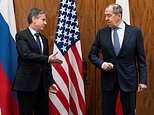
Antony Blinken is sitting down for talks with Russian counterpart Sergei Lavrov in Geneva today (pictured) to try and find a diplomatic solution to the Ukraine border crisis
Blinken told Lavrov that the US remains committed to diplomacy but is ready with a ‘severe’ response should Moscow invade
Lavrov (pictured yesterday) said he is not expecting a breakthrough, but does expect a ‘concrete’ response to Moscow’s demands including that Ukraine be banned from NATO
Ukrainian troops are pictured manning their posts in a trench close to frontlines where they have been fighting a years-long war with Russian separatists
Moscow has demanded concessions from Nato over the western alliance’s relationship with Ukraine, a former Soviet republic.
Washington and its allies have repeatedly promised ‘severe’ consequences such as tough economic sanctions – though not military action – against Russia if an invasion goes ahead.
Mr Blinken repeated that warning on Friday. He said the US and its allies were committed to diplomacy, but were also committed, ‘if that proves impossible, and Russia decides to pursue aggression against Ukraine, to a united, swift and severe response’.
But he said he also wanted to use the opportunity to share directly with Mr Lavrov some ‘concrete ideas to address some of the concerns that you have raised, as well as the deep concerns that many of us have about Russia’s actions’.
On Thursday in Berlin, Mr Blinken warned of a ‘swift, severe’ response from the US and its allies if an invasion is launched, and the US treasury department slapped new sanctions on four Ukrainian officials.
Mr Blinken said the four were at the centre of a Kremlin effort which began in 2020 to damage Ukraine’s ability to ‘independently function’.
Mr Blinken took pains to stress US unity with its allies in opposition to a possible Russian invasion.
It came after US President Joe Biden drew widespread criticism for saying retaliation for Russian aggression in Ukraine would depend on the details and that a ‘minor incursion’ could prompt discord among Western allies.
On Thursday, Mr Biden cautioned that any Russian troop movements across Ukraine’s border would constitute an invasion and that Moscow would ‘pay a heavy price’ for such an action.
‘I’ve been absolutely clear with President Putin,’ Mr Biden said. ‘He has no misunderstanding: Any, any assembled Russian units move across the Ukrainian border, that is an invasion.’
British Prime Minister Boris Johnson also cautioned yesterday that Russia marching on Ukraine would have repercussions beyond the continent. ‘It would be a disaster for the world,’ he said.
And Foreign Secretary Liz Truss, speaking in Australia amid talks on the new AUKUS submarine pact, today warned Putin to ‘desist and step back’ from Ukraine before making ‘a massive strategic mistake’.
‘Invasion will only lead to a terrible quagmire and loss of life, as we know from the Soviet-Afghan war and conflict in Chechnya,’ she said.
‘We need everyone to step up. Together with our allies, we will continue to stand with and urge Russia to de-escalate and engage in meaningful discussions. What happens in eastern Europe matters for the world.’
Russian sappers are pictured taking part in mine-clearing exercises in the Voronezh region, which is close to the border with Ukraine
Russia sappers take part in drills to practice mine-clearing in Voronezh, close to Ukraine
A Russian rocket artillery vehicle takes part in live-fire drills in the Voronezh region
Rockets explode during live-fire drills in the Voronezh region, near the border with Ukraine
Moscow has for weeks been massing tens of thousands of troops, tanks and artillery pieces along its eastern flank, sparking fears of an invasion, though the Kremlin has insisted it is merely a defence force (pictured, Russian forces currently massed in border regions)
Elsewhere today, Russian lawmakers in the lower house floated the idea of asking Putin to officially recognise self-declared breakaway republics in the east of Ukraine.
Russian-backed separatists have for years been fighting Ukrainian forces in the Luhansk and Donetsk regions, under the banner of the Lugansk and Donetsk people’s republics. Both regions contain significant minorities of ethnic Russians.
Vyacheslav Volodin, speaker of the lower house, said it is time for Russia to take concrete steps to ‘ensure the safety of our citizens and countrymen’.
His comments parrot Kremlin propaganda pushing the idea that overseas Russians are under threat from Ukraine, which observers fear Putin could use as a pretext to justify invading.
Moscow insists it has no plans to invade but has at the same time laid down a series of demands – including a ban on Ukraine joining NATO – in exchange for de-escalation.
Washington has rejected Moscow’s demands as ‘non-starters’ and NATO chief Jens Stoltenberg this week insisted that the alliance ‘will not compromise on core principles such as the right for each nation to choose its own path’.
Upping the ante, Russia announced new naval drills that will see it deploy to the Atlantic, Pacific, Arctic and Mediterranean ‘more than 140 warships and support vessels, more than 60 aircraft, 1,000 pieces of military equipment, and about 10,000 servicemen’.
The announcement followed an angry condemnation from the Kremlin of what it described as ‘destabilising’ remarks from US President Joe Biden, after the American leader vowed a ‘severe’ response to any invasion of Ukraine.
Russia already held joint military drills Wednesday with forces of ex-Soviet republic Belarus, which also neighbours Ukraine.
A US official said the exercises could presage a permanent Russian military presence involving both conventional and nuclear forces in Belarus.
The West has repeatedly warned Russia it would pay a ‘high price’ of economic and political sanctions should it invade Ukraine.
Hours before Blinken arrived in Berlin to coordinate the possible response to Russia, Biden sparked controversy as he appeared to indicate that a ‘minor incursion’ might prompt a smaller reaction from NATO allies.
‘It’s one thing if it’s a minor incursion, and then we end up having a fight about what to do and not do, et cetera,’ he said.
Blinken in Berlin clarified the comments, saying that ‘if any Russian military forces move across the Ukrainian border and commit new acts of aggression against Ukraine, that will be met with a swift, severe response from the United States and our allies and partners.’
A Ukrainian soldier sits inside a trench along the frontline where government forces have been fighting against Russian-backed rebels for years
Ukrainian troops move through a trench network close to the frontlines with Russian-backed rebel forces in the east of the country
Russian S-400 anti-aircraft batteries are moved to the frontlines with Ukraine as Putin continues to mass his troops
S-400 anti-aircraft batteries are loaded on to transports to be taken to the frontlines
Speaking to the German television channel ZDF on Thursday, Blinken added that any crossing of the border into Ukraine by Russian soldiers would constitute a very clear aggression, irrespective of whether it was a single soldier of a thousand, according to a German translation of his remarks.
Biden also took pains to calm frazzled nerves, saying that any entry of Russian troops into Ukraine will be treated by the West as ‘an invasion’.
But smarting from Biden’s Wednesday remark, Ukrainian President Volodymyr Zelensky hit back that there was no such thing as ‘minor incursions’.
‘We want to remind the great powers that there are no minor incursions and small nations. Just as there are no minor casualties and little grief from the loss of loved ones,’ Zelensky wrote on Twitter.
The West’s diplomatic machine has been running on full power over recent weeks to defuse tensions, but with positions entrenched on both sides, a series of talks between Western and Russian officials in Geneva, Brussels and Vienna has failed to yield any breakthrough.
NATO allies have signalled their willingness to keep talking but Moscow has demanded a written response on its proposals for security guarantees.
On the Russian wish list are measures that would limit military activities in the former Warsaw Pact and ex-Soviet countries that joined NATO after the Cold War.
But in Kyiv on Wednesday, Blinken said he would not present such a formal response at Friday’s talks with Lavrov in Geneva. Rather it was on Russia to dispel fears of any expansionist intentions.
Ukraine has been fighting Moscow-backed forces in two breakaway eastern regions since 2014, when Russia annexed the Crimean peninsula from Ukraine.
More than 13,000 people have been killed, and the latest Russian troop build-up has also greatly rattled neighbours in the Baltics.
Washington said Thursday it has approved requests from the Baltic nations to ship US-made weapons to Ukraine.
Britain has also said it would send defensive weapons to Ukraine as part of a package to help the country secure its borders.
In a speech in Sydney Friday, British Foreign Secretary Liz Truss will warn Russian President Vladimir Putin against making a strategic blunder and becoming embroiled in a ‘terrible quagmire’ if Russia invades Ukraine, according to prepared remarks.