

Russia ‘moves military equipment towards Finnish border after warning Finland not to join NATO’
Russia ‘moves heavy military equipment including missile systems towards Finnish border after warning Finland not to join NATO’
Video appears to show two Russian coastal defence missile systems driving past a sign to Helsinki Finnish prime minister Sanna Marin has said her country may apply to join NATO by summer following supportKremlin said move would ‘not improve’ security situation in Europe as NATO ‘geared towards confrontation’Opinion polls have put 84% of Finns as viewing Russia as a ‘significant military threat’, up by 25% on last yearSweden is also debating the possibility of abandoning neutrality to join the military alliance amid Ukraine war
<!–
<!–
<!–<!–
<!–
(function (src, d, tag){
var s = d.createElement(tag), prev = d.getElementsByTagName(tag)[0];
s.src = src;
prev.parentNode.insertBefore(s, prev);
}(“https://www.dailymail.co.uk/static/gunther/1.17.0/async_bundle- -.js”, document, “script”));
<!–
DM.loadCSS(“https://www.dailymail.co.uk/static/gunther/gunther-2159/video_bundle- -.css”);
<!–
Russian heavy weapons including missile systems have been seen moving towards the border with Finland, hours after Russia warned its northern neighbour against joining NATO.
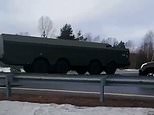
An unconfirmed video uploaded last night appears to show two Russian coastal defence missile systems moving along a road on the Russian side of the border that leads to Helsinki.
The missile systems are thought to be the K-300P Bastion-P mobile coastal defence system, designed to take out surface ships up to and including aircraft carrier battle groups.
The Russian deployment comes as Finnish Prime Minister Sanna Marin said she expects her government ‘will end the discussion before midsummer’ on whether to apply for NATO membership.
Recent opinions polls by a Finnish market research company put 84% of Finns as viewing Russia as a ‘significant military threat’, up by 25% on last year.
In response, Kremlin spokesperson Dmitry Peskov euphemistically warned the move would ‘not improve’ the security situation in Europe, and Moscow lawmaker Vladimir Dzhabarov added more bluntly it would mean ‘the destruction of the country’.
‘We have repeatedly said that the alliance remains a tool geared towards confrontation and its further expansion will not bring stability to the European continent,’ Peskov said.
An unconfirmed video uploaded last night appears to show two Russian coastal defence missile systems moving along a road on the Russian side of the border that leads to Helsinki
The video clearly shows road signs leading to the Finnish capital of Helsinki. Finland, currently neutral, shares a 830 mile long border with Russia
A current map of Nato membership in Europe. Sweden and Finland have historically avoided membership in order to not provoke Russia, but the Russian invasion of Ukraine has changed their calculus
A man walks past the Kharkiv Regional Institute of the National Academy of Public Administration building which was destroyed during Russian shelling in Kharkiv on Tuesday
Yesterday NATO announced two multinational naval groups of sixteen ships led by the Royal Netherlands Navy will be patrolling the Baltic Sea coasts of members such as Poland and Estonia to ‘maintain a credible and capable defensive capability’.
Finland, along with neighbouring Sweden, has historically avoided NATO membership, despite close alignment with the West, in an effort not to provoke Russia.
But the Scandinavian country shares a 830 mile long border with Russia and has been unnerved by Putin’s invasion of Ukraine, having been invaded once before by the Soviet Union in 1939.
Meanwhile, Sweden’s ruling party formally began debating the possibility of launching a bid for membership yesterday, a move which would signal a complete role reversal in policy for the Scandinavian kingdom that has remained militarily neutral for decades.
Party secretary Tobias Baudin told local media that the NATO review should be complete within the next few months.
‘When Russia invaded Ukraine, Sweden’s security position changed fundamentally,’ the party said in a statement.
Finnish Prime Minister Sanna Marin (left) indicated that Finland would decide whether to apply for Nato membership before midsummer, angering the Kremlin which said the move ‘would not improve the security situation in Europe’. Meanwhile, Swedish Prime Minister Magdalena Andersson (pictured right with European Commission President Ursula von der Leyen), has begun discussing the possibility of joining NATO today
Residents stand outside their apartments as shops burn after a Russian attack in Kharkiv, Ukraine, on Monday
Ukrainian tanks move down a street in Irpin, on the outskirts of Kyiv, on Monday after Russian troops retreated from the area
Firefighters clear the debris and search for bodies under the rubble of a building hit weeks ago by a Russian attack after receiving reports of a smell emerging from the area, in Kharkiv on Monday
A man walks with a bicycle next to a truck that carries black bags with corpses of people killed during the war with Russia and exhumed from a mass grave for investigations in Bucha, on the outskirts of Kyiv on Monday
In Sweden, the ruling centre-left Social Democrats have historically opposed NATO membership but the more than six-week conflict in Ukraine has reignited debate in the Scandinavian kingdom.
A policy reversal for the party, which ruled for an uninterrupted 40 years between the 1930s and 1970s, would be historic and could pave the way for Sweden to apply to join NATO.
The party, led by Swedish Prime Minister Magdalena Andersson, are said to have begun discussing the possibility of joining NATO today, with the issue expected to be a central to parliamentary elections scheduled for September 11.
Sweden is officially non-aligned militarily, although it is a NATO partner and abandoned its position of strict neutrality after the end of the Cold War.
Having initially stressed that non-alignment had ‘served Sweden’s interests well,’ Andersson recently conceded that she was ready to discuss the policy and in late March said she ‘did not rule out’ a bid to join NATO.
Mr Peskov made clear that Russia would have to ‘rebalance the situation’ with its own measures were Sweden and Finland to join Nato.
The spiral of escalation has seen both countries increase their defence spending, with Helsinki announcing plans to spend £11 on drones and Stockholm adding another £243 million to their military budget.
In Ukraine, Russian forces are continuing to pull out of Belarus to support operations in the east as Putin focuses his invasion on the Donbas region where Russian-allied separatists have claimed independence.
‘Fighting in eastern Ukraine will intensify over the next two to three weeks as Russia continues to refocus its efforts there,’ the UK Ministry of Defence said today in its latest intelligence briefing.
‘Russian attacks remain focused on Ukrainian positions near Donetsk and Luhansk with further fighting around Kherson and Mykolaiv and a renewed push toward Kramatorsk.’
U.S. officials also point to further signs Russia’s military is gearing up for a major offensive in Ukraine’s eastern Donbas region, switching its focus after Russian forces failed in their initial drive to capture Kyiv.
Donbas has been torn by fighting between Russian-allied separatists and Ukrainian forces since 2014, and Russia has recognised the separatists’ claims of independence.
Military strategists say Russian leaders appear to hope local support, logistics and terrain in Donbas favour Russia’s larger and better-armed military, potentially allowing Russian troops to gain more territory and weaken Ukraine’s fighting forces.
An elderly walks past an unexploded tail section of a 300mm rocket which appear to contained cluster bombs launched from a BM-30 Smerch multiple rocket launcher embedded in the ground after shelling in Lysychansk, Lugansk region, on Monday
Russian troops drive a tank on a road outside the southern port city of Mariupol on Sunday
People walk down a street near past a building damaged by shelling in Irpin, in the outskirts of Kyiv, on Monday
Ukrainian soldiers shoot with assault rifles in a trench on the front line with Russian troops in Lugansk region on Monday
Russian troops have continued to shell Mariupol, with a British soldier fighting alongside Ukrainian marines in the besieged port city saying his unit has no choice but to surrender to the Russians.
Former care worker Aiden Aslin, 28, who moved to Ukraine in 2018 after falling in love with a woman from Mykolaiv, said forces have run out of supplies with Russians closing in.
It comes after claims Russia used chemical weapons dropped from a drone over Mariupol last night, as Putin continues his brutal assault on the strategic port city.
Aslin said in a message posted via a contact on Twitter: ‘It’s been 48 days, we tried our best to defend Mariupol but we have no choice but to surrender to Russian forces.
‘We have no food and no ammunition. It’s been a pleasure everyone, I hope this war ends soon.’
The post added: ‘We’re putting this out after direct consultation with his family. Until we’re told otherwise we’ll continue working on sharing the facts of the war. Hope for a prisoner exchange.’
Aiden Aslin is a former carer who previously fought against Isis in Syria. Now he says his unit will have to surrender to the Russians
Aiden Aslin, 28, moved to Ukraine in 2018 after falling in love with a woman from Mykolaiv , another Black Sea port close to Odessa. He is now in his fourth year with the Ukranian armed forces and was due to get married this Spring and complete his service in September
Aslin, from Newark, Nottinghamshire, is now in his fourth year with the Ukranian armed forces and was due to get married this Spring and complete his service in September.
When Russia launched their brutal invasion, Aslin was stationed in the Donbass region where separatists and the Ukrainian armed forces have been fighting since 2014.
There are an estimated 10,000 civilians who have been killed by Putin’s army in Mariupol which has seen some of the worst fighting of the war.
Corpses are now ‘carpeted through the streets’ of the crucial port city, according to its mayor Vadym Boychenko.
He accused Russian forces of having blocked weeks of attempted humanitarian convoys into the city in part to conceal the carnage. Boychenko said the death toll in Mariupol alone could surpass 20,000.
Boychenko also gave new details of allegations by Ukrainian officials that Russian forces have brought mobile cremation equipment to Mariupol to dispose of the corpses of victims of the siege.
Russian forces have taken many bodies to a huge shopping center where there are storage facilities and refrigerators, Boychenko said.
‘Mobile crematoriums have arrived in the form of trucks: You open it, and there is a pipe inside and these bodies are burned,’ he said.
Boychenko spoke from a location in Ukrainian-controlled territory but outside Mariupol.
The mayor said he had several sources for his description of the alleged methodical burning of bodies by Russian forces in the city, but did not further detail the sources of his information.
The discovery of large numbers of apparently executed civilians after Russian forces retreated from cities and towns around the capital, Kyiv, already has prompted widespread condemnation and assertions that Russia is committing war crimes in Ukraine.
Meanwhile, a pro-Putin separatist leader has called for Russia to use chemical weapons to ‘smoke out’ 4,000 Ukrainian defenders at a key strategic steel plant in Mariupol.
Eduard Basurin, deputy head of the so-called Donetsk People’s Republic, claimed up to 4,000 Ukrainian fighters are taking shelter in the Azovstal complex, one of Europe’s largest iron and steel works, which has so far defied Russian attempts to seize it.
He made the dire warning just hours after Ukraine accused Russia of unleashing a toxic agent from a drone over Mariupol, causing breathing issues.
This morning, the Azov Battalion showed footage purporting to show victims of the apparent attack, who said they have since suffered respiratory problems, high temperatures and tinnitus.
Making further threats on Russian state TV, Basurin said today: ‘What is Azovstal? It is a plant built back in Soviet times. There is a lot or concrete, iron, there are many underground floors. So it makes no sense to take this facility by storm.
‘Therefore, at the moment it is necessary to deal with the blocking of this plant, find all the exits and entrances. In principle, this can be done.
‘And after that, to turn, I think, to the chemical troops, who will find a way to smoke moles out of their holes.’
Yesterday’s alleged chemical attack has not been confirmed but would be the first time Russia is believed to have used toxic weapons in Putin’s barbaric invasion, which the Pentagon said is ‘deeply concerning’.
US Defence Department spokesman John Kirby said: ‘We are aware of social media reports which claim Russian forces deployed a potential chemical munition in Mariupol, Ukraine. We cannot confirm at this time and will continue to monitor the situation closely.