

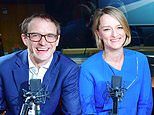
Chris Mason will be BBC’s next political editor
Chris Mason will be BBC’s next political editor: ‘Any Questions?’ presenter says it is a ‘tremendous privilege’ to take over from Laura Kuenssberg after bosses rejected all-female shortlist for £260,000-a-year job
<!–
<!–
<!–<!–
<!–
(function (src, d, tag){
var s = d.createElement(tag), prev = d.getElementsByTagName(tag)[0];
s.src = src;
prev.parentNode.insertBefore(s, prev);
}(“https://www.dailymail.co.uk/static/gunther/1.17.0/async_bundle–.js”, document, “script”));
<!–
DM.loadCSS(“https://www.dailymail.co.uk/static/gunther/gunther-2159/video_bundle–.css”);
<!–
The BBC’s hunt for Laura Kuenssberg’s replacement has ended, after bosses announced that Radio 4 presenter Chris Mason will next month take up the £260,000 post of Political Editor – arguably the biggest brief in political journalism.
Yorkshire-born Mason, the current host of debate show Any Questions? on Radio 4, was tipped to be the favourite following reports that Corporation chiefs were unhappy with the all-female shortlist, which included ITV News’s Anushka Asthana and Sophy Ridge from Sky.
The 41-year-old, a Cambridge geography candidate who has spent most of his career covering Westminster and has worked at the BBC since 2002, had previously ruled himself out of the running – but is believed to have applied for the post last month after he was ‘courted by rival broadcasters’.
Mason would likely have to stop presenting Any Questions?, it is understood, but it could later put him in good stead to take over Fiona Bruce on Question Time, The Sunday Times reported.
Regarded as an ‘adept broadcaster’, with ‘sound judgement’ and ‘a flair for political analysis’ by his colleagues, Mason, who now earns less than £150,000, would see his pay rise shoot up to at least £260,000, Kuenssberg’s reported salary.
Kuenssberg, a titan in the world of political journalism who was accused of Left-wing bias by the Conservative Party, revealed she was stepping down as Political Editor in Autumn last year, with her final assignment at the BBC set to be the local elections coverage next month.
She was last month announced as the new permanent presenter of the BBC’s Sunday morning politics show, replacing Andrew Marr.
Speaking with a Yorkshire accent, Mason’s appointment could combat criticisms of the broadcaster for being London-centric and not having enough regional voices. Culture Secretary Nadine Dorries previously instructed the BBC to present plans to improve regional and class diversity in the corporation before agreeing the new licence fee settlement.
Mason’s promotion is also likely a PR victory for the BBC, which has fought allegations of a ‘brain drain’ of top talent including Jon Sopel, Emily Maitlis, Andrew Marr and Dan Walker ditching the broadcaster.
In a statement, Mason said: ‘What a tremendous privilege to take on what, for me, is the most extraordinary job in British broadcasting and journalism. I clamber upon the shoulders of giants like Laura, Nick and Andrew with a smattering of trepidation and a shedload of excitement and enthusiasm.
‘To lead the best team of journalists in the business on the best news patch of the lot is something I’d never even dared dream of. I can’t wait to get started.’
The BBC’s hunt for Laura Kuenssberg’s replacement has ended, after bosses announced that Radio 4 presenter Chris Mason will take up the £260,000 post of Political Editor next month
Regarded as an ‘adept broadcaster’, with ‘sound judgement’ and ‘a flair for political analysis’ by his colleagues, Mason, who now earns less than £150,000, would see his pay rise shoot up to at least £260,000, Kuenssberg’s reported salary
Mason, who studied geography at Cambridge, took over Radio 4’s Any Questions? show, a topical discussion with a panel of people from politics and media who are posed questions by the public, in October 2019. After spending two decades at the BBC, Mason, who is from Grassington in north Yorkshire, has spent most of his career covering Westminster (pictured amidst an anti-Brexit pro-Europe demonstration)
Kuenssberg, a titan in the world of political journalism who was accused of Left-wing bias by the Conservative Party, revealed she was stepping down as Political Editor in Autumn last year, with her final assignment at the BBC set to be the local elections coverage next month
Kuenssberg tweeted her congratulations, writing: ‘Huge congrats and welcome to the best daily job in the business, to colleague, great friend and of course #newscaster @ChrisMasonBBC’
Yorkshire-born Mason, the current host of debate show Any Questions? on Radio 4, was tipped to be the favourite following reports that Corporation chiefs were unhappy with the all-female shortlist, which included ITV News’s Anushka Asthana and Sophy Ridge from Sky
Kuenssberg tweeted her congratulations, writing: ‘Huge congrats and welcome to the best daily job in the business, to colleague, great friend and of course #newscaster @ChrisMasonBBC’.
The interim director of BBC News, Jonathan Munro, said: ‘Chris has been an exceptional correspondent in an extraordinary time for British politics. His calm, incisive analysis and signature candid style have been invaluable for audiences when navigating complex stories.
‘His ambition and vision for the political editor role is really exciting and I wish him every success in the new post.’
Beth Rigby, Sky News’s political editor and presenter, was also among those congratulation Chris Mason on his appointment as her counterpart at BBC News.
She tweeted: ‘What a great choice. Huge congratulations @ChrisMasonBBC and welcome to the Pol Ed role – the best and busiest beat in the business. I’m looking forward to seeing a lot more of you Chris!’.
Mason began his journalism career as a trainee at ITN the week after 9/11, before moving to BBC Radio Newcastle one year later. He also then worked for 5 Live, the Regional Political Unit, the Westminster Hour on Radio 4 and in Brussels as a Europe correspondent.
Mason took over as presenter for Radio 4’s Any Questions?, a topical discussion with a panel of people from politics and media who are posed questions by the public, in October 2019, and is regularly on the podcast Newscast.
After spending two decades at the BBC, Mason, who is from Grassington in north Yorkshire, has spent most of his career covering Westminster.
Initially the Corporation appealed for internal candidates, but then the three BBC front-runners – the deputy political editor, Vicki Young, Mason and former North America editor Sopel – made it clear that they did not want the job.
They then extended the search, whittling down to an all-female shortlist of applicants including ITV News’s Anushka Asthana, the deputy political editor, and Sophy Ridge from Sky.
It comes at a difficult time for the BBC, which has been battling a ‘brain drain’ of talent – allegations it has denied – and a war with the Government over its licence fee.
In January, Boris Johnson’s ‘most loyal Cabinet ally’ Nadine Dorries signalled that the licence fee will be scrapped after 2027.
The gung-ho Culture Secretary indicated that she wants to put in place a new funding model for the broadcaster when the current licence fee deal expires in five years’ time.
The Cabinet minister has hit the Corporation with a two-year licence fee freeze and her allies have warned ‘the days of state-run television are over’, as tensions between the Government and the BBC continue to rise.
Dorries tweeted: ‘This licence fee announcement will be the last. The days of the elderly being threatened with prison sentences and bailiffs knocking on doors, are over. Time now to discuss and debate new ways of funding, supporting and selling great British content.’
Tense negotiations between the Government and the BBC over the cost of the annual fee until the end of 2027 have concluded, with Dorries deciding to hold the licence at £159 for the next two years.
Officials calculate that – due to inflation currently running at 5.1 per cent – the Corporation will have to find savings of more than £2billion over the next six years.
However, the Culture Secretary is also considering pegging future fee increases below inflation between 2024 and the end of the current Royal Charter on December 31, 2027 – meaning the savings the BBC must make could end up being even higher.
It was previously suggested said that Kuenssberg, who earned £250,000, could become a presenter on Radio 4’s flagship Today programme as part of a major reshuffle of senior on-air staff.
However, it was later confirmed that she will be replacing Marr on his Sunday morning politics show.
Marr presented the last episode of his long-running Sunday politics programme yesterday, leaving the BBC after 21 years to host radio shows on LBC and Classic FM, for rival broadcaster Global.
After spending two decades at the BBC, Mason, who is from Grassington in north Yorkshire, has spent most of his career covering Westminster
Commanding a salary of more than £250,000 as political editor, Kuenssberg also found a new audience by appearing on the Brexitcast podcast throughout the UK’s Brexit negotiations with the EU.
However, she has faced accusations of bias from across the political spectrum. Last year, she was criticised after appearing to defend Dominic Cummings following reports that he had flouted lockdown rules.
Within 30 minutes of the story breaking, Kuenssberg had shared a rebuttal from an unnamed source claiming that the then Prime Minister’s senior aide’s 260-mile trip from London to his parents’ home in Durham was ‘within [the] guidelines’.
In response to the Daily Mirror journalist who broke the story, Kuenssberg tweeted: ‘Source says his trip was within guidelines as Cummings went to stay with his parents so they could help with childcare while he and his wife were ill – they insist no breach of lockdown’.
Her reply was immediately met by a chorus of condemnation from Labour-supporting trolls, with some accusing her of being a ‘mouthpiece for the Government’ and a ‘Tory stooge’.
Kuenssberg was revealed to be Cummings’s only regular contact, due to the broadcaster’s ‘special position’ in the country.
During his bombshell evidence session to MPs last year, the former Downing Street aide said the political editor was the ‘main’ journalist he would speak to – but stressed they would only talk once every ‘three or four weeks’ to ‘give guidance on big stories’.
Cummings then made a series of scathing claims about the Prime Minister’s handling of the Covid pandemic – including that Johnson allegedly viewed the virus as a ‘scare story’ just a month before the first lockdown – in a sit-down interview with Kuenssberg.
During the 2019 General Election, Kuenssberg, along with ITV’s political editor Robert Peston, tweeted the false claim that an aide of disgraced ex-minister Matt Hancock was punched by a Labour activist.
The claim was quickly disproved by video evidence, forcing them to back down and apologise for the misleading information.
At the Labour Party conference in 2017, she had to be protected by security guards following abuse she had received for her reporting on Jeremy Corbyn. Critics claimed she was not neutral and treated the former Labour leader unfairly.
Kuenssberg also attracted controversy earlier this year after a complaint was made against her over her use of the phrase ‘nitty gritty’ while discussing Downing Street business on the Brexitcast.
Anti-racism campaigners claim the term originates from the slave trade, and was reportedly banned by Sky Sports last year amid concerns.
However, programme bosses threw out the complaint against Kuenssberg.
Prior to becoming the BBC’s politics editor, Kuenssberg served as the corporation’s chief political correspondent. She also previously held senior roles at ITV News and BBC Two’s Newsnight.
In 2016, Kuenssberg was awarded Broadcaster of the Year by the Political Studies Association, recognising her work covering the Brexit Referendum and subsequent follow-up stories.
She was also honoured as the Journalist of the Year at the British Journalism Awards the same year.