

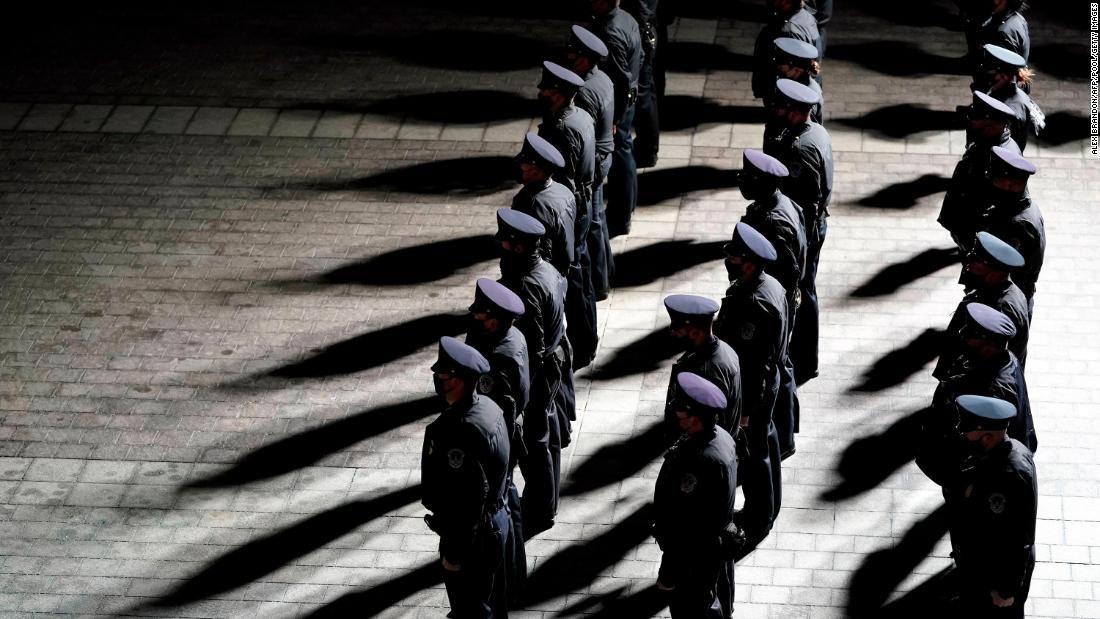
Hopes of a Jan. 6 commission have been extinguished, and what was already a tense relationship between officers and some lawmakers has only gotten worse
Officers could take solace in the fact that they’d done their job, and that it appeared there would be a sweeping examination of the events of the day, one that could bring to light the systemic failures that led to the attack and ensure that nothing like it could ever happen again.
CNN spoke to more than a dozen current and former Capitol Police officers for this story, interviews that revealed deep levels of frustration among rank-and-file officers who had hoped for reforms in the wake of the attack but are now largely resigned to nothing of consequence changing. “
“We are exactly the same as we were if not muddier,” said one officer. “I personally have a very pessimistic view of the future.”
“We have heard all of this support for police, police, police, and then your own police force is battered and bruised and now you drag your feet?” said another officer, who like others spoke to CNN on the condition of anonymity to offer a candid assessment of relations between Capitol Police officers, lawmakers and Capitol Hill leadership.
“I kind of got lulled, I got fooled, I listened to (Senate Minority Leader Mitch) McConnell’s words that same night when they reconvened (on January 6),” the officer said. “I bought into it, I thought, ‘Wow, we are really going to get some answers.’ “

The fallout from January 6 has also exposed the normally private relationship between Capitol Police officers and members of Congress, revealing a power dynamic that is unique across law enforcement, one where lawmakers often believe they command authority over the officers who are sworn to protect them, officers say.
“They think we’re like servants,” said one officer who recently left the department.
“I would rather work outside in the heat or the cold,” the officer said, adding, “I would rather have to deal with people overdosing on drugs” than deal with members’ staff.
“We are hemorrhaging people still. It’s amazing to watch these young officers leave,” a senior Capitol Police officer told CNN.
In a statement to CNN, the US Capitol Police described the rigorous amount of work that goes into recruiting officers and said that since January 6, it has brought in one class of 23 recruits, and four additional classes are scheduled for later this year.
‘We are political pawns’
The problems Capitol Police officers describe are twofold. Current and former officers tell CNN that one of the defining characteristics of working security on Capitol Hill is persistent pressure from congressional members and their staffs who believe they are in control of officers’ actions, and who, worse, barely acknowledge their hard work.
Officers have also watched as efforts to bolster Capitol Hill security funding — which would include hiring hundreds of new officers and upgrading outdated Capitol Police equipment– have become mired in political infighting.
Many officers expressed concerns that the building itself remains unsecure, and that much more needs to be done to strengthen weak points, such as windows that rioters were able to smash with flagpoles and stools.
House Democrats last week passed a $1.9 billion emergency funding package for the Capitol, which would include funding to hire more officers, buy new equipment and install retractable fencing. It was approved by the narrowest of margins, 213-212, amid united GOP opposition, and the legislation faces an uncertain future in the Senate, where Appropriations Committee leaders in both parties have had a cool reception to the House bill.


A Capitol Police Officer pays her respects before a ceremony memorializing U.S. Capitol Police Officer Brian D. Sicknick, 42, as he lies in honor in the Rotunda of the Capitol on Wednesday, February 3, 2021
“We are political pawns,” one officer said. “Now the people we are sworn to protect and did protect on the 6th don’t want to fund us or figure out what really happened that day.”
“It is inconceivable that some of the Members we protect, would downplay the events of January 6th. Member safety was dependent upon the heroic actions of USCP. It is a privileged assumption for Members to have the point of view that ‘It wasn’t that bad,’ ” the letter said. “That privilege exists because the brave men and women of the USCP protected you, the Members.”
The letter was issued on official Capitol Police letterhead, sparking confusion that the department was taking an official position on the pending legislation. Capitol Police leaders quickly issued a statement distancing the department from the letter — though it hardly softened the sentiment.
The letter exposed the normally private friction between officers and lawmakers, and generated tension among rank and file. Some officers, unhappy the letter was released, suggested internal dissent should remain in house.
Republicans have charged that the effort led by House Speaker Nancy Pelosi, a California Democrat, to create a commission has been marred by politics from the beginning, arguing that the commission proposal is politically slanted.
“For months, the Speaker of the House refused to negotiate in good faith on basic parameters that would govern a commission to examine the January 6 attack on the U.S. Capitol,” House Minority Leader Kevin McCarthy, a California Republican, said in a statement explaining his opposition.
Both McCarthy and McConnell have pointed to the ongoing investigations in Congress and at the Justice Department, and a Senate GOP aide noted that two Senate committees are preparing to release a bipartisan report on the security failures next month, something many Senate Republicans have pointed to in explaining their opposition to the commission. The Senate GOP aide also said that revisions within the Capitol Police were expected once a new chief is hired.
‘Caught up in a three-way fight’
Capitol Police have been drawn into the political fray in smaller ways as well. As a result of the numerous changes and security measures put in place by Pelosi, many officers now spend large parts of their day manning metal detectors that members must pass through as they enter the House floor.


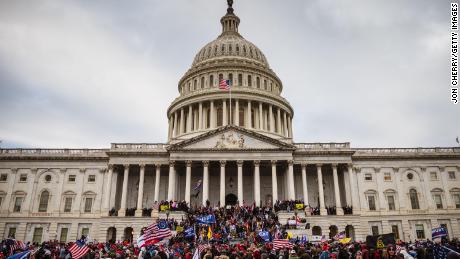
Police officers attempt to push back a pro-Trump mob trying to storm the US Capitol following a rally with President Donald Trump on January 6, 2021 in Washington, DC.
Republicans outraged after Pelosi installed the metal detectors vowed to ignore them, prompting the speaker to institute fines for House members who blow through the metal detectors.
And Capitol Police are stuck in the middle.
Some officers complain they’ve been relegated to doing the work of hall monitors, citing members for rules violations and caught in the middle of a political fight in the House over the January 6 fallout.
The senior Capitol Police officer said USCP is “caught up in a three-way fight: USCP leadership, the speaker and the members,” and that all of them “are moving, in every way, in the wrong direction on this.”
“We have too many people being in charge. But these aren’t safety rules, these are political rules,” the officer said. “If it was McConnell and McCarthy in charge, it would still be the same. Everyone wants to control us.”
Pelosi has defended her decision to install metal detectors outside the House floor, and she’s pushed for the new security funding based on recommendations from retired Lt. Gen. Russel Honoré, who was tapped by the speaker to review the January 6 attack. In a floor speech last week, Pelosi also noted that the House would be voting on reviewed legislation to award Capitol Police officers the Congressional Gold Medal next month, which had the support of McCarthy.
‘I know you have better things to do’

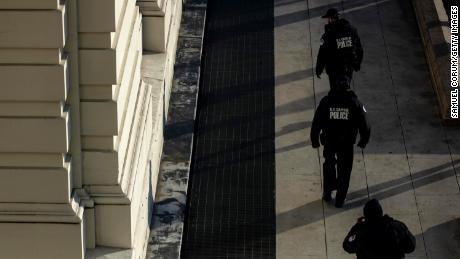
Capitol Police officers sweep the grounds of the U.S. Capitol building on January 7, 2021 in Washington, DC.
In the wake of the riot, many officers hoped the relationship with lawmakers would grow warmer and more grateful. And it did for a period, with several lawmakers doing things like bringing officers breakfast or popping by with snacks or lunch or making a special point of saying thank you. But to some officers, these acts of kindness come across as hollow, given the reticence of some members to back them up with votes on the House or Senate floor.
Said one officer, “I can buy my own f**king doughnut. I can’t vote.”
To other officers, some lawmakers’ memories seemed quick to fade.
In April, Republican Rep. Jeff Fortenberry of Nebraska tested the duress button in his office twice to check the response time of Capitol Police, Fortenberry chief of staff Andrew Braner said in a statement to CNN.
“The Congressman repeatedly said to the police, ‘I know you have better things to do than this.’ But, given the violent mob insurrection at the Capitol, we thought it wise to test our systems,” Braner said in the statement.
Still, the tests annoyed officers, who told CNN they felt that lawmakers should well know that they will always respond to a panic call by a lawmaker.
Earlier this month, Rep. Virginia Foxx rushed through the metal detectors on her way to a House vote, throwing her bag on the floor next to the magnetometer and ignoring the attempts by Capitol Police officers to slow her down, according to a House Ethics review.
“Good thing no one stopped me,” the North Carolina Republican said after she eventually returned to get screened, according to the review. She was fined $5,000, one of several lawmakers who have been fined under the new rules.
Some officers say incidents with members and staff only reinforce the notion that they are there for the members’ convenience, not protection.
“I call our department the United States Convenience Police,” one officer told CNN. “Our main job is to make their lives easier and don’t question them on anything.”
Said another officer, “They treat us like ‘Paul Blart Mall Cop.’ “