

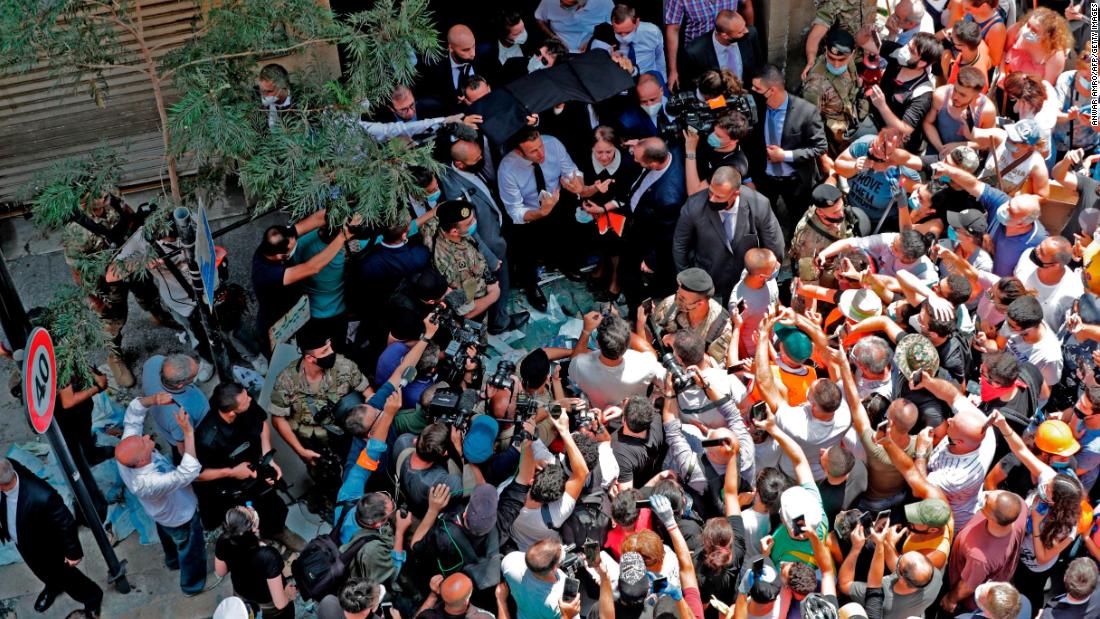
French President Emmanuel Macron toured a neighborhood devastated by Tuesday’s massive explosion and was swarmed by large crowds
Macron told a crowd of reporters and angry people that he would propose a “new political pact” to Lebanon’s embattled political class during his visit to a predominantly Christian quarter of the city.
“The people want the fall of the regime,” the protesters shouted, echoing calls for the downfall of Lebanon’s long-time political elite that were popularized during a nationwide uprising late last year. “Michel Aoun is a terrorist! Help us,” one man pleaded, referring to the Lebanese president. One woman screamed inaudible words inches away from Macron’s face. “They are terrorists,” came the repeated cries.
Most people were masked, including the French president, who removed his face covering to speak to the press. There was no social distancing.
An Elysée Palace spokesperson told CNN that Macron said to Lebanese protesters: “I am here and it’s my duty to help you, as a whole population, to bring medication and food.
“This aid, I guarantee it, won’t end up in corrupt hands. I will speak to all political forces to ask for a new pact,” Macron said, adding: “I am here today to propose a new political pact. If they [the political forces] are not able to keep this pact, I will take my responsibilities.”
This was one of the first major displays of public disgruntlement after an explosion ripped through the city, damaging many of its buildings, and leaving neighborhoods in tatters.
The country was already seeing rising unemployment, soaring prices and a currency in free fall — for many, the explosion is further proof of government ineptitude and corruption.

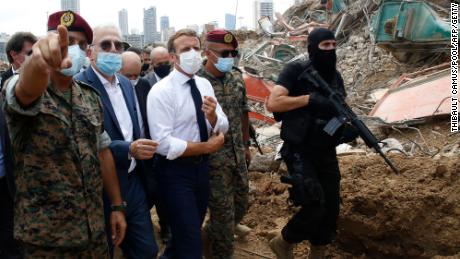
Macron, surrounded by Lebanese servicemen, visits Beirut’s devastated port.
Massive clean-up effort
On Thursday, groups of young volunteers carrying brooms and shovels filled the streets of some of the worst affected areas to clear the rubble. Some arrived from faraway Lebanese towns.
In downtown Beirut, an army of volunteers launched into a massive clean-up effort Thursday, with people coming from all over city to help sweep streets, pulling debris off cars, or handing out food and water, as residents picked through the rubble of their homes and businesses, trying to salvage what they could.
Lebanon’s Economy Minister Raoul Nehme said that every apartment and business in the city has been impacted in some way by the blast, and state-run media said 90% of the hotels in the Lebanese capital had been damaged.
The number of deaths is expected to climb amid ongoing search and rescue efforts. Many people were still missing two days after the blast, and 300,000 have been displaced from their homes.
The city’s emergency services, already under strain due to the Covid-19 pandemic, were operating at decreased capacity after four hospitals were damaged in the explosion, which sent a shock wave that was felt 150 miles away in Cyprus and damaged buildings 10 kilometers (6 miles) away.
The Lebanese cabinet has ordered an unknown number of port officials to be placed under house arrest in the coming days, pending the results of an investigation into the blast, according to Ghada Shreim, the minister for displaced people. Those involved in “the storage, guarding and investigating of Hangar 12 from 2014 until today” will be included in the arrests, Shreim said.
‘Criminal attack’
Lebanese President Michel Aoun promised a transparent investigation into the causes of the explosion, vowing Wednesday that those responsible would be held accountable and face “severe punishment.”
“This accident here, this crisis, for 20 years they’re going to talk about it. The investigation, it’s never going to end. No conclusion, no results,” said one resident in downtown Beirut.
Jad Chaaban, associate professor of economics at the American University of Beirut, said “this is a criminal attack by the ruling state.”
“They have committed a crime by storing these nitrates for more than a decade there, with no accountability,” Chaaban said, adding that there is a rising anger among the people.
Chaaban asked how the city can rebuild under such circumstances.
“People will go up to their destroyed homes, to shattered glass, destroyed trucks and cars, they have no dollars because the banks have blocked their dollar account to pay for any imports. Prices have more than quadrupled in the past few months, so nobody can afford to build anything. There is exasperation on the street, and there is a lot of anger,” he said.
Political aftershocks
Initial reports in state media blamed the blast on a major fire at a firecrackers warehouse near the port. Later, the country’s general security chief Abbas Ibrahim said a “highly explosive material” had been confiscated years earlier and stored in the warehouse, just minutes’ walk from Beirut’s shopping and nightlife districts.
The director-general of Beirut Port Hassan Kraytem said Wednesday he knew the materials stored “in warehouse number 12” were dangerous, “but not to that extent.” Maintenance was conducted on Warehouse 12’s door hours before the blast on Tuesday, according to Kraytem.
The director of Lebanese Customs, Badri Daher, told CNN that officials had written to legal authorities six times calling for that cargo be removed from the port, but the requests went unheeded despite repeated warnings by him and others that the cargo was the equivalent of “a floating bomb.”
On Wednesday, Lebanese Information Minister Manal Abdel Samad Najd said there are papers and documents dating back to 2014 proving the existence of an exchange of information about the “material” confiscated by Lebanese authorities. She told Jordan’s state-owned channel Al Mamlaka that the exchange is being considered in relation to the potential cause of the deadly Beirut blast.
Asked in a telephone interview if there are any early findings in the investigations related to the cause of the explosion, she said, “There are no preliminary results or clarification.”
Calls have been growing for an international investigation into the blast. “Former Prime Ministers Najib Mikati, Fouad Siniora, Saad Hariri, and Tammam Salam find it necessary to ask the United Nations or the Arab League to form an international or Arab investigation committee,” according to a joint statement released by Hariri’s office.
Rami Khouri, adjunct professor of journalism at the American University of Beirut and senior fellow at Harvard University, said, “My expectation is that the political aftershocks will be as great as the explosion itself.”
“This explosion was the culmination of decades of poor governance that has shattered almost every aspect of the lives of some people in Lebanon. And all they want is to get these people who are running the country out of their lives,” he said.
Food and medical supplies hit
There are also growing fears of food and medicine shortages, as the port where the explosion occurred is the main maritime hub for a nation heavily dependent on goods from abroad, with 60% of all imports passing through it.
Beirut’s main grain silo, located at the port, was heavily damaged in the blast and the grain supply stored there was either destroyed or rendered unusable as a result of the chemicals released into the air in the explosion, Economy Minister Nehme said. He added that there are additional grain stores in mills and other ports in the country.
Tuesday’s explosion resulted in an estimated $3 billion to $5 billion worth of damage, Beirut governor Marwan Abboud told reporters Wednesday. Though Nehme said “no one can know the numbers right now” but “it’s very high and more than our capacity.”
The economy minister said the government’s priority was to secure people’s basic necessities — mainly food but also supplies to help repair the extensive damage to homes and infrastructure across the city.
“We need glass, we need aluminum, we need wood, we need doors … everything was damaged,” he said.
World leaders, including from Israel, the United Kingdom, United States, France, Turkey, UAE, Jordan, Kuwait, Qatar, Russia and Spain have offered support and humanitarian medical assistance to Lebanon.
Lebanon’s Health Minister Hamad Hassan said that an emergency plan was in place with field hospitals being sent from Qatar, Iran, Kuwait, Oman and Jordan. Hassan estimates that six to eight field hospitals will be ready “soon.”
CNN’s Mary Ilyushina, Katie Polglase, Isaac Yee, Charbel Mayo, Jessie Yeung, Raja Razek, Samantha Beech, Mostafa Salem, Kareem Khadder, Schams Elwazer, Mohammed Tawfeeq, Tara John, Alessandria Masi, Nada AlTaher, Hamdi Alkhshali, Amir Tal, Andrew Carey, Jennifer Hansler and Paul Murphy contributed to this report.