

Britain and US will build Australia’s first fleet of NUCLEAR submarines as part of new security pact
New security pact to combat China threat: Britain and US announce plans to build Australia’s first fleet of nuclear-powered submarines and share defence technology – as Beijing denounces ‘Cold War mentality’
Unprecedented security partnership was announced by Boris Johnson, Joe Biden and Scott MorrisonThe agreement will see UK, US and Australia share nuclear technology secrets in tech battle with the ChineseThe pact means Australian navy will be equipped with nuclear-powered vessels made in the UK and the USFrance was due to make Australia’s new subs – but claimed last night it had been ‘stabbed in the back’ New Zealand also isolated with Jacinda Ardern declaring the submarines will be banned from their waters
<!–
<!–
<!–<!–
<!–
(function (src, d, tag){
var s = d.createElement(tag), prev = d.getElementsByTagName(tag)[0];
s.src = src;
prev.parentNode.insertBefore(s, prev);
}(“https://www.dailymail.co.uk/static/gunther/1.17.0/async_bundle–.js”, document, “script”));
<!–
DM.loadCSS(“https://www.dailymail.co.uk/static/gunther/gunther-2159/video_bundle–.css”);
<!–
Britain and America are to help Australia build a fleet of nuclear-powered submarines as part of an alliance to combat China‘s naval dominance in the South China Sea.
Boris Johnson last night announced the unprecedented security partnership in a joint press conference with Joe Biden and Scott Morrison to share nuclear technology secrets in the face of an increasingly provocative China, which has the largest navy in the world including 350 ships and submarines.
China has already responded to the historic pact, denouncing it as an ‘exclusionary bloc’ and accusing the trio of having a ‘Cold War mentality’ against them. The UK, US and Australia say the new alliance is ‘directed to lots of different threats’ without specifically naming Beijing.
But there is little doubt over its true purpose, with Australia growing increasingly concerned about China‘s military build-up in the South China Sea – where it has constructed bases on artificial islands including the Spratleys and Paracels – and in nearby Papua New Guinea.
Australia-China relations are also at an all-time low with no direct diplomatic contact between the two for 18 months. Their leaders have sparred over Covid, with with Canberra leading calls for a probe into the virus’s origins and Beijing responding with trade tariffs estimated to have cost the Australian economy some $2.3bn.
Under the pact, known as AUKUS, the Royal Australian Navy will receive at least eight nuclear-powered submarines – the first time it has possessed such technology. Because the subs do not need to refuel very often they can stay submerged longer, making them harder to detect, and roam further, allowing them to push into waters that China claims as its own but are in fact hotly disputed.
Beijing is trying to claim authority over the entirety of the South China Sea – which is criss-crossed by valuable trading routes – with President Xi warning foreign vessels in the waters will be viewed as ‘hostile’. Western nations have been pushing back, sailing so-called ‘freedom of navigation’ missions through the region to test his resolve.
The most-recent such mission was sailed by Britain’s newest aircraft carrier – the £3bn HMS Queen Elizabeth – and her Carrier Strike Group, comprised of British and American destroyers alongside support vessels.
Staff at Rolls-Royce near Derby and BAE Systems in Barrow-in-Furness are expected to be involved in the design and build of the submarines over the next 18 months, creating hundreds of highly-skilled scientific and engineering roles in the UK.
The decision has upset France, who were due to make Australia’s next generation of submarines, with a senior diplomat declaring last night that they had been ‘stabbed in the back’. The $90billion contract has been torn up by Mr Morrison and instead they will acquire nuclear-armed subs from the US and the UK for the Royal Australian Navy much sooner than the previous mid-2030s deadline.
The move has also left New Zealand looking isolated, with Jacinda Ardern admitting she was not even consulted before the deal was signed. Her country has a long-standing ‘nuclear free’ policy that she confirmed will not change any time soon, meaning means Australia’s new submarines will not be welcome in New Zealand waters.
Canada is also a surprise exclusion from the new pact, since it is part of the long-standing Five Eyes intelligence-sharing alliance – which includes the UK, US, Australia and New Zealand. AUKUS is not strictly an intelligence-sharing deal so is unlikely to fully replace Five Eyes, but does reduce its importance.
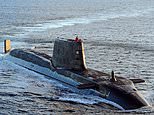
Britain and America are to help Australia build a fleet of nuclear-powered submarines as part of an unprecedented alliance known as the AUKUS pact to combat China’s naval dominance and will likely be the similar design as this Astute class submarine HMS Ambush (pictured)
Britain’s Prime Minister Boris Johnson, Australia’s Prime Minister Scott Morrison (C) and US President Joe Biden attend a joint press conference to announce the AUKUS partnership last night
A man waves a Union flag as the British Royal Navy aircraft carrier HMS Queen Elizabeth sails out of Tokyo bay on September 08, in a journey that has inflamed tensions with China
Why Australia needed a new deal with the UK and the US: Australia’s defence capabilities are dwarfed by those of China
China has inflamed tensions in the South China Sea in recent years by expanding its claimed territory, to the objection of its neighbors in the Asia-Pacific
Australia already has diesel-electric submarines but the new stealthier fleet will be faster and can stay underwater for longer, covering a greater distance without expelling traceable exhaust gases.
The new submarines, built using UK and US components, will ‘protect and defend our shared interests in the Indo- Pacific’, Downing Street said.
Britain will also share its cyber capabilities, artificial intelligence, quantum technologies and undersea systems with allies as part of the deal, ushering in a new era of collaboration on security and defence-related science, technology, industrial bases and supply chains.
China already has a substantial number of nuclear-powered submarines. The Pentagon assessed in its 2020 China Military Power report that China has the largest navy in the world, with an overall battle force of approximately 350 ships and submarines, including more than 130 major surface vessels.
China was not mentioned in the cross-continental briefing but there was frequent reference to the changing situation in the region.
Tom Tugendhat, Conservative chairman of the Commons Foreign Committee, said: ‘The reason for all this is clear – China.’
He tweeted: ‘After years of bullying and trade hostility, and watching regional neighbours like the Philippines see encroachment into their waters, Australia didn’t have a choice.’
China’s U.S. embassy reacted, however, by saying that countries ‘should not build exclusionary blocs targeting or harming the interests of third parties.’
‘In particular, they should shake off their Cold-War mentality and ideological prejudice,’ it said.
Australia’s plea for help to replace its ageing Collins-class subs prompted the new deal agreed by Mr Johnson, US President Joe Biden and Australian Prime Minister Scott Morrison.
The last time Britain and the US formally agreed collaborate on nuclear technology to build submarines was in 1958.
Although Britain has operated nuclear-powered submarines for over 60 years, Canberra has never built its own.
Australia is seen as essential to counter China’s regional influence, especially in the contested South China Sea.
In recent years, the UK and Australia have increasingly worked together on defence, with joint training exercises.
Last night Mr Johnson said: ‘The UK, Australia and US are natural allies.
‘While we may be separated geographically, our interests and values are shared. The AUKUS alliance will bring us closer than ever, creating a new defence partnership and driving jobs and prosperity.’
As part of a joint statement with the other two leaders, Mr Johnson added: ‘The endeavour we launch today will help sustain peace and stability in the Indo-Pacific region.
‘For more than 70 years, Australia, the United Kingdom, and the United States, have worked together, along with other important allies and partners, to protect our shared values and promote security and prosperity.
‘Today, with the formation of AUKUS, we recommit ourselves to this vision.’
In a live broadcast from Downing Street, the Prime Minister said the partnership would make the world safer.
The three countries already share extensive intelligence through the Five Eyes alliance, which also involves Canada and New Zealand.
It is not known when the vessels will be ready, but officials said the initial scoping phase is expected to take 18 months when it will be determined where they will be built and by whom.
Mr Johnson said Scotland and parts of the north of England and the Midlands would feel the benefit of the work on the nuclear-powered submarines, with the Government keen to exploit the Royal Navy’s decades-worth of knowledge of using such machines.
At a later press conference in Canberra, Mr Morrison said it was undecided if Australia would purchase British-built BAE Systems Astute class submarines or the Virginia class vessels constructed in the US.
French foreign minister Jean-Yves Le Drian and armed forces minister Florence Parly said in a statement issued by the country’s embassy in Canberra that it had taken note of Australia’s decision to halt the Future Submarine programme with France.
‘This decision is contrary to the letter and spirit of the cooperation that prevailed between France and Australia, based on a relationship of political trust and on the development of a very high-level defence industrial & technological base in Australia,’ the statement added.
Earlier this year, in the integrated review of security and foreign policy, the UK Government outlined plans for a ’tilt’ in focus to the Indo-Pacific.
Aircraft carrier HMS Queen Elizabeth was earlier this year deployed on a voyage East in a decision said to be about sending a message to Beijing and Russia about Britain’s military might.
The Indo-Pacific area is of particular concern due to increasing geopolitical tensions such as unresolved territorial disputes and the risk of nuclear proliferation.
In a live broadcast, the Prime Minister said the partnership would make the world safer
The US assessed in 2020 that China has the largest navy in the world with 350 ships and subs, including more than 130 major surface vessels. Pictured: Chinese warship (stock image)
Pictured: Chinese ships docked at Garden Island Naval Base in Sydney Harbour in June 2019
France has been ‘stabbed in the back’ by the Australian nuclear submarine deal, a former top diplomatic official has said.
‘The world is a jungle,’ ex-ambassador to the US Gerard Araud tweeted on Thursday.
‘France has just been reminded this bitter truth by the way the US and the UK have stabbed her in the back in Australia. C’est la vie.’
Australia has for years been planning to build a fleet of 12 diesel-powered submarines in Adelaide via French company Naval Group, with a deal made in 2016 valued at $90billion.
The French government later on Thursday said Australia’s decision to ditch the agreement was ‘contrary to the spirit of cooperation which prevailed’ between the two countries.
France has been ‘stabbed in the back’ by the Australian nuclear submarine deal, a former top diplomatic official has said. French President Emmanuel Macron with Prime Minister Scott Morrison at the Elysee Palace in Paris in June
‘The world is a jungle,’ ex-ambassador to the US Gerard Araud tweeted on Thursday morning
Foreign Minister Jean-Yves Le Drian and Armed Forces Minister Florence Parly said the change in plan ‘marks an absence of coherence that France can only observe and regret’.
Prime Minister Scott Morrison reportedly held concerns Naval Group would be unable to deliver submarines until 2030 with deadline and price disputes.
Defence officials have openly discussed abandoning the deal since June and told a Senate estimates hearing in June there were ‘challenges’ with the agreement.
Australia will instead embrace nuclear power after decades of debate – marking the first time the US and UK have shared their nuclear submarine technology with another nation. orrison