

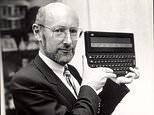
Home computing pioneer Sir Clive Sinclair dies aged 81 after a long illness
Sir Clive Sinclair dies aged 81: Tributes are paid to tech pioneer who brought computers into people’s homes with his ZX Spectrum… but failed to revolutionise transport with the C5
The inventor and entrepreneur passed away at his home in London this morningHis daughter Belinda, 57, revealed that the entrepreneur had passed away todayHe was famed for bringing computers into people’s homes with his ZX SpectrumHe also created the pocket calculator but his C5 electric trike flopped in the 80s
<!–
<!–
<!–<!–
<!–
(function (src, d, tag){
var s = d.createElement(tag), prev = d.getElementsByTagName(tag)[0];
s.src = src;
prev.parentNode.insertBefore(s, prev);
}(“https://www.dailymail.co.uk/static/gunther/1.17.0/async_bundle–.js”, document, “script”));
<!–
DM.loadCSS(“https://www.dailymail.co.uk/static/gunther/gunther-2159/video_bundle–.css”);
<!–
Home computing pioneer Sir Clive Sinclair has died aged 81 following a long illness, his daughter revealed today.
The inventor and entrepreneur passed away at his home in London this morning, Belinda Sinclair said.
Sir Clive was famed for bringing computers into people’s homes with his ZX Spectrum, which proved inspirational for today’s games industry bosses.
They learnt the craft on his creation or its rival the Commodore 64 when they were growing up. Sir Clive also invented the pocket calculator.
Despite many successes during the inventor’s life, he failed to revolutionise transport with the Sinclair C5.
The battery-powered trike was launched in 1985 – with him expecting 100,000 sales in the first year – but it tanked and Sinclair Vehicles went into receivership that year.
Video games giants led tributes to Sir Clive today, with many saying they would not have gone into the industry if it was not for his creations.
The inventor and entrepreneur (pictured) passed away at his home in London this morning, Belinda Sinclair said
Despite many successes during the inventor’s life, he failed to revolutionise transport with the Sinclair C5 (pictured)
Sir Clive (pictured with his ex-wife Angie Bowness) was famed for bringing computers into people’s homes with his ZX Spectrum, which proved inspirational for today’s games industry bosses
Belinda, 57, told the Guardian: ‘He was a rather amazing person. Of course, he was so clever and he was always interested in everything.
‘My daughter and her husband are engineers so he’d be chatting engineering with them.’
She added: ‘It was the ideas, the challenge, that he found exciting. He’d come up with an idea and say, ”there’s no point in asking if someone wants it, because they can’t imagine it”.’
Born in Richmond, Sir Clive left school when he was 17 before becoming a technical journalist for four years to make enough money to start Sinclair Radionics.
One of his first creations, in the 1970s, were a number of compact calculators that could fit into people’s pockets – at a time when most were the size of a shop till.
The inventor’s made his first home computer in 1980, called the ZX80, which transformed the market.
It cost just £79.95 and undercut its competitors in the rest of the market by about one-fifth, selling 50,000.
But he pushed down the price again with his next model, the ZX81, which was priced at just £69.95, selling 250,000.
These proved the inspiration for many of today’s video games tycoons, with them growing up playing 3D Monster Maze and Mazogs.
They also proved the starting blocks for his huge fortune, with him making £14million in just two years and well over £100million at the peak of his powers.
Video games giants led tributes to Sir Clive today, with many saying they would not have gone into the industry if it was not for his creations. He is pictured with a drawing of a C15 electric car
Sir Clive left school when he was 17 before becoming a technical journalist for four years to make enough money to start Sinclair Radionics. He is pictured with a Sinclair MTV1 Microvision pocket television in 1977
Sir Clive produced the ZX Spectrum 48K in 1982, which had numerous faults – such as poor visuals and sound – but proved popular with games such as Jet Set Willy
Sir Clive produced the ZX Spectrum 48K in 1982, which had numerous faults – such as poor visuals and sound – but proved popular with games such as Jet Set Willy.
He was knighted for his efforts in 1983 and quickly became a household name with his eponymous company.
Despite the huge successes, he failed to revolutionise transport with his Sinclair C5 battery-powered trike.
The machine was launched in 1985 and Sir Clive expected to flog around 100,000 in the first year.
But it tanked, Sinclair Vehicles was plunged into receivership by the end of the year and customers raised safety concerns with it.
He also failed with his pocket TV, the Sinclair TV80, but his vision proved helpful for today’s inventors, with small screens frequently used.
Sir Clive went on to sell his computer firm to electronics company rival Sir Alan Sugar’s Amstrad a year later.
Despite his numerous inventions, he did not use them himself, with Belinda saying he never had a pocket calculator and did not use computer.
Video games giants led tributes to Sir Clive today, with many saying they would not have gone into the industry if it was not for his creations.
Retro Gamer magazine posted: ‘Sir Clive Sinclair, the creator of the Zx Spectrum has passed away.
‘His influence on the UK games industry was huge. How many of today’s developers coded on one of the machines he developed?’
Video game developer Ste Pickford wrote: ‘Another hand up here as someone whose whole career path was massively influenced by Sir Clive Sinclair, along with most of the UK games industry (oldies at least).
‘I always wanted to draw comics as a kid, but got sucked into doing computer game graphics via the ZX Spectrum.’
Film director Edgar Wright, who directed Baby Driver, Hot Fuzz and Shaun of the Dead, put: ‘For someone whose first glimpses of a brave new world were the terrifying graphics of 3D Monster Maze on the ZX81, I’d like to salute tech pioneer Sir Clive Sinclair.
‘He made 21st Century dreams feel possible. Will bash away on the rubber keys of a Spectrum in your honour. RIP.’
Comics writer Tony Lee said: ‘Gutted to learn that Sir Clive Sinclair has died – my first computer was a ZX81, and I can honestly say that without my first paid writing job as a ‘Your Sinclair’ games reviewer in 1987, I wouldn’t be where I am today.’
Screenwriter Gary Whitta put: ‘Sir Clive Sinclair has died. One of the 20th century’s great genius inventors and a true father of the modern computing age.
‘I’m not sure I’d be where I am today were it not for his ZX Spectrum igniting my love of computers and games. RIP.’
Writer Julian Rignall posted: ‘Sad to hear that pioneering technologist Sir Clive Sinclair died today.
‘His groundbreaking ZX Spectrum and ZX81 home micros helped kickstart the British computer industry and usher in a new era of interactive entertainment. His products inspired and delighted millions.’
Channel 4’former s video gaming programme GamesMaster presenter Dominik Diamond wrote: ‘All your UK videogame companies today were built on the shoulders of giants who made games for the ZX Spectrum.
‘You cannot exaggerate Sir Clive Sinclair’s influence on the world. And if we’d all stopped laughing long enough to buy a C5 he’d probably have saved the environment.’
Wired Productions, which makes Indie video games, wrote: ‘Hugely sad news that British computing pioneer Sir Clive Sinclair has passed away.
‘The ZX Spectrum was the start of my lifelong love affair with videogames and it is wonderful to see so many gamers reminiscing about him, his machines and all those games.’
DJ and a social media pioneer Jonathan Morter said: ‘Sad to hear that Sir Clive Sinclair has died.
‘He was the one who got me into the world of gaming back in the 80s. I still haven’t completed Jet Set Willy either.’
Writer Jared Petty put: ‘Sir Clive Sinclair died. It is impossible to exaggerate the monumental effect he had on the computer and game industries.
‘He kicked down the door to affordable computing in the UK and created a hobbyist software playground and mainstream game marketplace that defined a generation.’
In his personal life Sir Clive was fascinated by poetry, running marathons and poker, with him featuring in the Late Night Poker TV series.
Due to his extraordinary intellect he was also a member of British Mensa, the largest IQ society in the world, and had an IQ of 159.
He gained honorary doctorates from Bath University, Heriot-Watt University and Warwick University and was a fellow at Imperial College London.
Sir Clive was married twice, first to Ann Trevor-Briscoe, who he split from in 1985, then Angie Bowness, who he divorced in 2017.
Ms Bowness, a former lapdancer, was 36 years his junior and the millionaire stayed with her for seven years.
But in 2017 he rekindled his relationship with his devoted former secretary Elaine Millar.
For 25 years the pair had an on-off relationship but it ended when Sir Clive met Ms Bowness at Stringfellows nightclub where she worked as a dancer named Paris.
They married in Las Vegas in 2010 and afterwards Lady Sinclair announced she was ‘over the moon’.
When asked about the separation, the former model burst into tears saying: ‘I can’t talk about anything right now. I’m so sorry, I just can’t comment.’
Sir Clive said at the time: ‘Following a prolonged hospitalisation in 2016, Sir Clive filed for divorce before his discharge from the hospital.
‘The divorce become final in January 2017. Financial settlement proceedings are ongoing and Sir Clive has asked that he be allowed to conduct this matter in private.’
Prior to his marriage to Angie, Ms Millar helped Sir Clive run his business and the pair once lived in adjoining flats in the building on Trafalgar Square.
She accompanied him to public events and he was said to have showered her with expensive gifts.
But after his 2010 wedding Sir Clive and Ms Millar did not speak and she moved to a flat in Harrogate.
In 2016 Lady Sinclair resigned as a director of Sinclair’s company, and a Home Rights Notice was placed on the couple’s £5million Central London home.
This prevented Sir Clive from selling the property without her consent.
Lady Sinclair was previously married to businessman Mark Thornton with whom she had a son, but they broke up just months after his birth.
While married to Sir Clive, she divided time between London and a house in Nottinghamshire which she shared with her mother Shirley.
After 23 years of marriage, Sir Clive divorced his first wife, Ms Trevor-Briscoe with whom he had three children, in 1985.
Sir Clive leaves behind Belinda, his sons Crispin, 55, and Bartholomew, 52, as well as five grandchildren and two great-grandchildren.