
Woman who survived Ireland’s mother and baby home has emotional meeting with brother and sister
Woman, 63, who survived one of Ireland’s notorious mother and baby homes and lived in America after being adopted aged three has an emotional first meeting with the British brother and sister she didn’t know existed
Kathy Bellise, 63, survived children’s home that was run by Bon Secours nunsShe lived all her life in Long Island, New York after she was adopted aged threeShe meets brother and sister who live in Lincolnshire in the UK for the first time The Missing Children will air on ITV at 10.20pm on Sunday
<!–
<!–
<!–<!–
<!–
(function (src, d, tag){
var s = d.createElement(tag), prev = d.getElementsByTagName(tag)[0];
s.src = src;
prev.parentNode.insertBefore(s, prev);
}(“https://www.dailymail.co.uk/static/gunther/1.17.0/async_bundle–.js”, document, “script”));
<!–
DM.loadCSS(“https://www.dailymail.co.uk/static/gunther/gunther-2159/video_bundle–.css”);
<!–
A woman who survived Tuam mother and baby home in Ireland and lived in America after being adopted aged three has an emotional first meeting with the brother and sister she never knew existed.
Exposure: The Missing Children, which airs tonight on ITV, tells the extraordinary and moving stories of some of the children who survived life at Tuam mother and baby home in Ireland.
At the notorious institution, which was run by the Bon Secours nuns, 796 children born to unwed mothers have disappeared. The bodies of some have been found in a sewage tank.
In tonight’s documentary, Kathy Bellise, 63, from Long Island, New York, discovers she has siblings Carol and Steven living in Licolnshire in the UK and tells how she came to America in 1959 when she was almost three.
‘My adopted parents were both in WWII and they ended up eloping to North Carolina and got married,’ she explains. ‘My mother couldn’t have children so they decided they were going to adopt. My grandmother on my father’s side was from Ireland. So I guess he felt that he wanted to adopt a child from Ireland.’
‘My adopted parents always told me my mother and father died in a car accident. It was years after my father passed that my mother told me that it wasn’t true.
‘That my mother was unwed and I was in a mother and child home in Tuam in Ireland for unwed mothers. And the Catholic Church was very involved with everything here and there.’
Tuam Mother & Baby home adoptee Andrew and Kathleen Bellise in Long Island, New York holding a photo of Kathleen as a young girl with her adoptive parents, Harry and Fran
Kathy Bellise, 63, from Long Island, New York, discovers she has siblings Carol and Steven living in Licolnshire in the UK and tells how she came to America in 1959 when she was almost three.
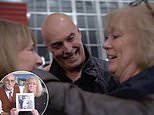
Kathy is pictured hugging her sister after meeting for the first time in tonight’s extraordinary documentary
The scandal of Ireland’s mother and baby homes made headline news in January 2021 when the final report from the Mother and Baby Homes Commission of Investigation was released.
The report concluded that approximately 9,000 children died in 18 institutions under investigation, and the Taoiseach Mícheál Martin apologised in parliament and described the events as a ‘dark, difficult and shameful chapter’ of Irish history.
Some of the children kept there still recall the cruelty of the nuns. Others like Kathy were adopted to America and are only now discovering relations in Ireland and the UK.
Fergus Finlay who worked in the Department of Foreign Affairs in the mid-90s claims they found an enormous cache of papers in the basement of the department.
‘They were effectively signed passport applications for babies, who were going abroad, and passports were issued in respect of those babies in the 30s, 40s, 50s and so on,’ he says. ‘The vast majority of them were signed by local priests. They would have been taken from their mothers and sent to the States.’
Kathy’s husband, who has always known about her adoption, notes that finding out this information was ‘like finding a treasure trove of history.’
Local historian Catherine Corless at the Tuam mother and baby home memorial site
Kathy is pictured with her whole family in Long Island, New York
He then can be seen looking into a box containing all of Kathy’s records of her adoption process which were found in her mother’s attic.
‘This is a letter from the children’s home, from one of the nuns that Kathleen’s adoptive parents spoke to and the nun goes onto describe that there’s 170 children presently living in the home, all under 7 years of age,’ he explains.
‘Right now they’re in the middle of an epidemic that has a lot of the children in ill condition. But they go onto say that, “I have here a girl. A nice one who’ll be one years old. She has beautiful big blue eyes” and that they’re working on getting the legal sign off from the birth mother.’
Andrew adds: ‘It’s not a question of asking the mother if she wants to surrender or sign over the legal rights of her child. “You will surrender and you will sign over your child and the papers.” I think that’s a pretty strong sentence.’
Author Mike Milotte notes that there was initially no organisation behind the process and that it was just soldiers and airmen coming to Ireland and taking babies away with them.
‘After a while the Archbishop of Dublin, Charles McQuaid got to hear about this and became very unhappy that there was a risk of Catholic babies falling into the hands of people who weren’t Catholics, primarily protestants,’ he explains. ‘So McQuaid started to put some rules and regulations and procedures in place to try and bring this into some sort of coherent system.’
He adds that the nuns initially resisted but eventually were brought around.
‘The first requirement was that the natural mother of the child had to sign a surrender document basically allowing the child to be adopted in the first place,’ he says. ‘A second document had to be signed allowing the child to be taken to America and adopted there. So there are essentially two different documents that had to be produced.’
Kathy’s husband Andrew also reads aloud a letter from The Angel Guardian Home – the United States agency located in New York that would work with the mother and baby’s home in Tuam to help in the adoption process for the United States citizens.
‘This letter basically states that they’re doing their best to locate the surrender from the birth mother,’ he explains. ‘If that’s not possible they will arrange to have new ones drawn up.’
He goes on to read the letter and continues: ‘Therefore I would suggest that you do nothing forward in contacting the sister in the Tuam Mother & Baby’s Home in Ireland. Or any one regarding this matter. This could easily jeopardise the girl’s happiness if any slip were made on our part.’
Andrew claims it’s ‘highly suspicious’ they they were told not to ask questions.
Tuam adoptee Michael Byrne in Boston, Massachusetts holding his childhood passport photo that sealed his adoption to the US. He also features in the documentary
Kathy explains how her adopted mother told her she was on the Irish black market because there were so many babies being adopted from Ireland and so many illegal adoptions.
‘I honestly don’t think the home ever got in touch with my birth mother,’ she explains. ‘They might have done in the beginning to get her, but after that I don’t think she was in touch with them. And I think they just did it themselves to be honest with you.’
Later in the documentary, Kathy decides to do a DNA test and after receiving the results back a couple of days later, gets a message which reads: ‘I think we’re first cousins. I’m Rory MacDonnell.’
She explains how the pair went from messaging on Ancestries to texting and then calling each other.
Then, she not only realised that it was her birth father’s family but that she also had a brother called Steven and sister named Carol in England.
Kathy’s sister Carol, who first heard the news through her cousin Rory, says she came up with a partial match and that Kathy’s story matched up with what they know of her dad – who has since passed away – leaving Ireland.
She adds: ‘I just want to hug her.’
Meanwhile, Steven goes on to say how Kathy has missed out in lots of ways regarding family – especially since their dad has now passed away.
‘I think it’s very sad for her that she can’t actually meet Dad,’ he says. ‘But we are going to see her and we can try and make up for what she has lost. We’ll build a new family.’
Annette McKay reading the death certificate of her sister, Mary Margaret O’Connor, who died at the Tuam home aged just six-months-old. She also features in the documentary
As Kathy heads to JFK airport to meet her brother and sister for the first time, she says: ‘I often wondered, always wondered what if I had a brother or sister? It’s exciting. I can’t wait to meet them. It’s beyond words.’
She recalls: ‘I was standing in the airport waiting for the plane to land, waiting for them to come off. And I’m standing there saying to myself, “What am I doing? I’m inviting people into my house, that I never met. I must be crazy.”‘
Carol goes on to say how Kathy is ‘very, very welcome’ and adds that she and Steven will make sure that she knows what her dad was like and that he ‘would have loved her.’
Following the meeting, Kathy enthuses: ‘There’s no way to describe the feeling I have, that’s inside me. I just never imagined that at sixty-three-years old, I would have a family.
And to say I have a brother and a sister, it’s like wow. And to say, it’s my own, that’s the biggest thing, to say this is my own family, is a big thing..
The Missing Children is on ITV at 10.20pm on Sunday