

Hero surgeon killed by Covid was DOUBLE-JABBED
Hero surgeon killed by Covid was DOUBLE-JABBED but missed out on booster by just six days: Heartbroken wife says ‘devoted’ father-of-four, 45, lost Covid battle ‘after catching virus on a ward’ despite having second vaccine in January
EXCLUSIVE: Saila Halim revealed Dr Irfan Halim, 45, had a shot last year and a second in January but still died The leading surgeon passed away at Royal Brompton Hospital in London on November 14 at 7.51pm, she saidMrs Halim said she did not think he had booster before he died surrounded by relatives after nine-week battleShe said the family had decided not to tell him his father Kamal, 75, died in another London hospital from virusHe was also double jabbed but died of Covid-19 at Northwick Park Hospital, north London, on September 24
<!–
<!–
<!–<!–
<!–
(function (src, d, tag){
var s = d.createElement(tag), prev = d.getElementsByTagName(tag)[0];
s.src = src;
prev.parentNode.insertBefore(s, prev);
}(“https://www.dailymail.co.uk/static/gunther/1.17.0/async_bundle–.js”, document, “script”));
<!–
DM.loadCSS(“https://www.dailymail.co.uk/static/gunther/gunther-2159/video_bundle–.css”);
<!–
A hero surgeon who died of Covid while saving patients on the frontline was double-vaccinated but caught the virus before boosters were available, his devastated family has revealed.
Grieving widow Saila Halim said Dr Irfan Halim, 45, passed away at Royal Brompton Hospital on November 14 at around 7.50pm following a nine-week battle with the virus.
The doctor – who had no known health conditions — received his second vaccine in January but was struck down by the disease on September 10 just days before Britain’s booster programme was given the green-light.
As a frontline NHS worker who was vaccinated nine months ago, he would have been at the front of the queue for the crucial third shot when they were rolled out on September 16.
Dr Halim’s death came just two months after he had taken up work on the Covid ICU wards at Great Western Hospital, Swindon, where he collapsed on shift and is believed to have contracted the virus.
The surgeon was thought of as a medical powerhouse and described by colleagues as like ’10 men in one body’ after treating 250,000 patients throughout his career.
He was isolated from his family for four months at the height of the pandemic last spring while treating Covid patients on the front lines.
Mrs Halim revealed she spared her husband the additional grief that his father Kamal, 75, also a doctor, died in another London hospital from Covid on September 24.
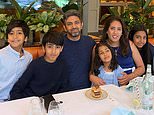
Dr Irfan Halim, 45, who earned widespread praise for his work, passed away at Royal Brompton Hospital in London on November 14, surrounded by his heartbroken family (pictured, their last photo together) following a nine-week battle against the virus
Dr Halim (pictured), 45, who had been working in Swindon, Wiltshire, passed away at a London hospital last weekend after a nine-week battle with the virus
He went to work on September 10 but never returned after catching coronavirus and becoming increasingly ill. He is pictured with his children
Dr Halim (pictured with his wife), who was a father of four children under the age of 12, was a skilled surgeon at Swindon Hospital
Mrs Halim said: ‘My husband worked away from London and I’m not sure which vaccine he received but he was double vaccinated and always wore full PPE when he was on the wards.’
Fighting back the tears, she continued: ‘He never said anything about getting the booster and I don’t think he got one.
‘It makes you question the efficiency of the vaccine but now is not the time for me to think about these things because I’m so heartbroken.
‘It’s a double tragedy for the family and we are in too much pain to consider anything else.’ His death came two months after he had taken up work on the Covid intensive care unit wards at Great Western Hospital, Swindon.
He is believed to have contracted the virus here before collapsing during a shift on September 10. After initially being treated at the Swindon hospital, he was transferred to the Royal Brompton on September 26. He had extracorporeal membrane oxygenation treatment to help him breathe as he bravely fought the virus.
Mrs Halim, 44, recalled her husband’s last day, when he was surrounded at his bedside by her and their four children; Zara, 13, Adam, 12, Zain, 11 and Alisa, five. Dr Halim’s brother, sister and mother were also with him.
His heartbroken widow went on through tears: ‘I held him in my arms and whispered prayers and love. We have lost our hero. He was an incredible husband, father and son. He was a best friend to the whole family.
‘We all feel empty and I’m not coping. He was my life, my world, my everything. Nothing could have prepared us for this.’
She recalled how her children had decorated his hospital room and spoke to him every day, either during visits or video calls at Swindon and in London.
She said: ‘I was convinced that our love would pull him through. And even when he was in hospital, he was being his happy, loving self. He would play chess via video calls with our son and even dealt with work matters.’
His wife Saila Halim (pictured with her husband) said when he died she was ‘whispering prayers and love into his ears’
Dr Halim had spent the past two years saving Covid patients and on September 10 was on a ward round when he collapsed having allegedly caught Covid at work. His children are pictured
In a heart-breaking post on social media, Mrs Halim said: ‘Irfan you gave me fifteen magical years as your wife, four beautiful children, wonderful memories that will last me until my remaining days in this world.’ Pictured: His hospital room
Despite the dangers of working on the Covid frontline, Mrs Halim insisted she never tried to stop her husband, even though they had four young children.
She said: ‘He was an incredibly gifted and dedicated doctor, right up until the very end. He always put his patients first and continued to support them after their treatment.
‘Sometimes I would get very frustrated because it always felt as if he was in the hospital or working on medial matters.
‘But he was a compassionate, caring man who made a real difference to people’s lives. I never tried to stop him from working with Covid patients because that was his life; caring for people.’
She said she met Dr Halim in 2003 at an ice-skating rink, where he was her instructor before moving into medicine.
She said: ‘I met my best friend and that was the person I went on to marry. The 18 years we were together were the best of my life and I will cherish them forever. The world has lost an incredibly caring human being.’
The couple married in 2006, with them going on to have four children, which Mrs Halim home schooled with her husband’s help.
Dr Halim qualified from Guy’s and St Thomas’ Hospitals Medical School in 2000 with prizes and distinctions. He trained in general surgery with sub specialisation in laparoscopic gastrointestinal surgery.
The medic completed his specialist training in GI surgery at UCL Hospitals, with additional specialist training in cancer surgery at the Royal Marsden Hospital.
He won numerous awards and in 2014 became fellow to the Royal College of Surgeons England. He was qualified in law and has a master’s in surgical technology from Imperial College London as well as an MBA from the US.
He previously worked as an NHS consultant surgeon at West Hertfordshire NHS Hospitals Trust and the North East London NHS Treatment Centre from 2016.
But Dr Halim moved into full-time private practice on the prestigious Harley Street and worked on day case procedures including gallbladder, hernia surgeries and cosmetic skin procedures.
He had one of the highest volume practices in Britain, with about 300 new patients arriving monthly and him operating on more than 1,200 people.
Mrs Halim said earlier online: ‘Irfan you gave me fifteen magical years as your wife, four beautiful children, wonderful memories that will last me until my remaining days in this world.
‘You gave 25 dedicated years service to the NHS working as a Consultant General Surgeon. Irfan you were not only my best friend but a best friend to all our children and so many others.’
A former colleague added: ‘Being a fighter, he never gave up. He kept believing he would recover. He didn’t smoke or drink and was someone who just helped people all the time.’
A GoFundMe page set up in Dr Halim’s memory with Mrs Halim revealing that the money raised will be used to support a number of charities he was involved in.
She said: ‘This money is not for our family because Irfan has taken care of our financial position. He helped a lot of charities while he was alive, and we want his legacy to live on by raising funds for them in his name.’
The GoFundMe says: ‘This fund has been set up for the family of Dr Irfan Halim, a wonderful talented and incredible NHS Doctor who worked hard to help others.
‘Irfan was dearly loved and touched so many peoples lives. Sadly, he was taken far too soon from those who love him.
‘Not only was he a loving husband, a devoted father of four young beautiful children, but an incredibly awesome human being to all that were blessed to have met him.
‘He spent four months away from his family at the height of the pandemic, working in the covid wards. Irfan and the NHS worked frantically to bring him home to his beautiful family, but tragically he passed away after a nine week fight against Covid.
‘We have set up this fund as close friends and family to ease the burden of losing Irfan. Irfan was the sole breadwinner for his family. May Irfan’s memory be a blessing to all who met and loved him.’
His death comes as Britain braces for another winter battling coronavirus, with death and cases data becoming increasingly hard to predict.
Infections have increased week-on-week on seven of the previous eight days, following the return of schools from half-term at the start of the month.
There were also 199 coronavirus deaths registered yesterday, marking a two per cent increase on last week’s toll. Latest hospital data shows there were 799 admissions on November 14, down 9 per cent in a week.
The Government has not put a threshold on the number of daily hospital admissions it is willing to tolerate before rolling back restrictions.
But one of its top scientific advisers, ‘Professor Lockdown’ Neil Ferguson suggested last month that figure could be 1,200.
Meanwhile Britain’s largest symptom-tracking study found the number of people falling ill with the virus every week fell by a tenth last week.
Professor Tim Spector, the eminent King’s College London scientist who runs the study, said he was ‘cautiously optimistic’ restrictions will not be needed.
Fears of Christmas curbs were raised this week when Boris Johnson admitted the draconian action was not off the cards.
The PM pointed to infection across Europe, which have sent nations back into lockdowns, as a sign of what could happen here.
King’s College London scientists estimated 65,059 people were falling ill with the virus on any given day in the week to November 13, down from 72,546 previously. This was a dip of 10% and down for the third week in a row
Professor Spector said: ‘In terms of what it means for Christmas, I’m cautiously optimistic for the remainder of the year. It’s becoming clear that children and the school holidays play a key role in the waves of infection.
‘I think it’s safe to say that we can expect to see another rise in the new year after the holidays.’ But he still called on all Britons to get fully vaccinated against the virus, as well as ensuring they have their booster doses.
And he urged everyone to start using face masks in crowded spaces such as public transport. This was a softening of his tone from barely three weeks ago when he warned ministers should consider Plan B.
Professor Spector’s symptom study relies on daily reports from more than 750,000 Britons on whether they are feeling unwell and if they test positive for Covid.
It is based on self-reporting and dose not ask participants to give evidence of their symptoms. The latest estimates used 40,000 tests for the virus over the fortnight to November 13.
PM Mr Johnson said earlier this week that it still was not possible to rule out some Covid restrictions being reimposed.
He said: ‘Clearly we cannot rule anything out and the most important thing people can do to prevent further NPIs from being taken is to — non-pharmaceutical interventions that is, further restrictions — get the boosters.’
But he added there was still nothing in the data to suggest further restrictions were needed. Scientists fear further Covid measures may be needed if a new variant emerges that is more transmissible and better able to dodge vaccine-triggered immunity.
Last winter the Kent ‘Alpha’ variant triggered a spike in Covid cases, leading to Christmas day plans being thrust into chaos at the last minute.
To contribute to Dr Halim’s Go Fund Me, click here.