

Double jabbed people who come into contact with Covid case should take daily lateral flow tests
Double-jabbed people who come into contact with Covid case should take daily lateral flow test for seven days from Tuesday, government says
People who have had two jabs will not need to self isolate if they test negativeThey must isolate if they develop symptoms or test positive themselvesUnvaccinated adults must continue to isolate if they are close contacts to a caseNadhim Zahawi revealed there are now patients with Omicron in UK hospitals
<!–
<!–
<!–<!–
<!–
(function (src, d, tag){
var s = d.createElement(tag), prev = d.getElementsByTagName(tag)[0];
s.src = src;
prev.parentNode.insertBefore(s, prev);
}(“https://www.dailymail.co.uk/static/gunther/1.17.0/async_bundle–.js”, document, “script”));
<!–
DM.loadCSS(“https://www.dailymail.co.uk/static/gunther/gunther-2159/video_bundle–.css”);
<!–
Double-jabbed people identified as a contact of someone with Covid-19 in England will be told to take a daily rapid test for seven days from Tuesday, health officials said.
Unvaccinated adults are not eligible for this new daily testing policy and they must self-isolate for 10 days if they are a contact of someone who tests positive
The daily testing aims to reduce pressures on people’s everyday lives by replacing the requirement for Omicron contacts to isolate for 10 days.
The policy also aims to protect the public by identifying asymptomatic cases and stopping the chains of transmission.
People will be contacted by NHS Test and Trace by phone, email or text or they will receive a notification from the NHS Covid-19 app to tell them they are a contact of someone who tested positive and what action they need to take.
They will be advised to get a box of seven lateral flow tests free of charge from NHS Test and Trace either through pharmacies, schools or home delivery by ordering online.
As is the case now, anyone whose rapid test comes back positive, or who develops Covid symptoms, should self-isolate and take a PCR test to verify the result.
If the PCR result comes back positive, contacts must self-isolate for 10 days from the day they took the positive rapid test or developed symptoms.
They do not need to continue taking rapid tests during that 10-day isolation period.
If the PCR result comes back negative, contacts can leave self-isolation but should continue to take rapid tests for the remainder of the seven days.
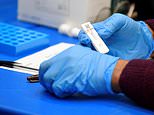
Fully vaccinated people who come into contact with a confirmed case of Covid-19 should take a daily lateral flow test for seven days, the government has said. Pictured, a file photo of a health worker handling a lateral flow test
People have been advised to order a box of seven lateral flow tests free of charge from NHS test and trace and to then log their results online
Health Secretary Sajid Javid said: ‘We are taking this proportionate and more practical measure to limit the impact on people’s day to day lives while helping to reduce the spread of Omicron.
‘Vaccines remain our best defence and I urge anyone yet to get a first and second jab to come forward and those eligible for a booster to get boosted as soon as possible.’
It comes as new modelling suggests that, under one scenario, almost twice the number of coronavirus patients could be admitted to hospital compared with last year due to the impact of Omicron.
Experts from the London School of Hygiene & Tropical Medicine calculated figures which show a large wave of infections could occur over the next few months if tougher measures are not brought in.
The DHSC said testing daily with lateral flow tests will also help with understanding how and where the virus is spreading.
The department said close contacts of people who test positive are at higher risk of getting Covid-19 and, with one in three people asymptomatic, daily testing will help ensure people are not unknowingly passing the virus on to others.
The DHSC said anyone identified as a contact with a negative lateral flow test is ‘strongly advised’ to limit close contact with other people outside their household, especially in crowded or enclosed spaces and with anyone who is more vulnerable.
Dr Jenny Harries, chief executive of the UK Health Security Agency, said: ‘If you are identified as a contact of someone with Covid-19, taking a rapid daily test – and only needing to isolate if it is positive – will help reduce the spread of the virus and minimise its impact on our everyday lives over the coming weeks and months.
‘Rapid tests are freely available in pharmacies and online. Our latest analysis shows that boosters provide the best protection against the Omicron variant, please go forward when you are called.
If you haven’t had any vaccine, a first and second dose still gives you protection against becoming seriously unwell.
‘Don’t worry about stepping forwards now – you will be warmly welcomed by our vaccination staff and I would strongly advise you to get vaccinated as soon as possible.’
Education Secretary Nadhim Zahawi today revealed there are now patients with Omicron being treated in UK hospitals, as he said the new coronavirus variant represents a ‘huge bump in the road’ for the nation’s recovery from the pandemic.
Omicron cases in Britain rose by 50 per cent yesterday. Some 663 new cases of the strain were detected across the UK, the UK Health Security Agency (UKHSA) said, up from the 448 recorded yesterday. It takes the country’s total to 1,898, although experts suggest the true number is much higher.
The UK’s overall daily cases were also up 26 percent week on week today to 54,073 while deaths inched upwards by 4% to 132.
Mr Zahawi painted a grim picture of the spread of the mutant strain as he said it now accounts for one third of all cases in London.
He also confirmed that cases of the variant are doubling every two to three days with more than 1,600 formally confirmed so far.
Omicron cases in Britain rose by 50 per cent today, data revealed as Government scientists warned the variant could cause nearly 2,500 daily hospitalisations this winter and tougher measures will be needed to deal with it
Some 663 new cases of the strain were detected across the UK, the UK Health Security Agency (UKHSA) said, up from the 448 recorded yesterday. It takes the country’s total to 1,898, although experts suggest the true number is much higher
The above map shows the ten areas that have the most confirmed and suspected Omicron cases in England, according to the UK Health Security Agency. West Northamptonshire is the country’s hotspot for the mutant strain, although eight in ten areas on the list are in London
Confidential UK Health Security Agency data showed that Omicron may now be behind 8.5 per cent of infections. The figures are based on the proportion of PCR tests failing to detect a specific gene, an early indicator of the variant. PCRs look for three genes to confirm a Covid infection, but with Omicron one is so mutated that they only pick up two of them. The analysis was done by Professor Alastair Grant, a Covid modeller at the University of East Anglia, who has access to the secret statistics
However, Mr Zahawi warned that the actual number of cases of Omicron will be ‘up to 10 times that’ as he said the vaccine booster programme is now in a ‘race against time’ against the variant.
Dr Susan Hopkins, chief medical adviser for the UK Health Security Agency, said that while there are now cases in UK hospitals there is yet to be a confirmed Omicron-linked death.
Scientists advising the Government have said tougher Covid restrictions may be needed to prevent Omicron causing anywhere between 25,000 to 75,000 deaths in England over the next five months.
A wave of infection is projected which could lead to a peak of more than 2,000 daily hospital admissions, with 175,000 hospital admissions and 24,700 deaths between December 1 this year and April 30 next year, even under the most optimistic scenario.
Even under the most optimistic of four scenarios modelled by experts – relating to how much Omicron might ‘escape’ vaccines and how effective booster jabs are – it’s predicted it could cause 25,000 deaths by the end of April without further social distancing restrictions.