

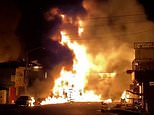
More than 60 killed as petrol tanker explodes in Haiti
More than 60 killed as petrol tanker explodes in Haiti: People use buckets to scoop up fuel among dozens of corpses
Explosion happened overnight in Haiti’s second-largest city Cap-HaitienPeople reportedly rushed to collect spilled fuel as bodies lay in the streetDeputy mayor who visited the site said burned bodies were unrecognisablePrime Minister Ariel Henry announced a three-day period of mourning
<!–
<!–
<!–<!–
<!–
(function (src, d, tag){
var s = d.createElement(tag), prev = d.getElementsByTagName(tag)[0];
s.src = src;
prev.parentNode.insertBefore(s, prev);
}(“https://www.dailymail.co.uk/static/gunther/1.17.0/async_bundle–.js”, document, “script”));
<!–
DM.loadCSS(“https://www.dailymail.co.uk/static/gunther/gunther-2159/video_bundle–.css”);
<!–
More than 60 people were killed when a fuel truck exploded in a street in Haiti’s second-largest city Cap-Haitien during the night, the city mayor said on Tuesday.
As dozens of bodies lay near the explosion site, people in the area used buckets to scoop up fuel from the truck and the street to take back to their homes, Dave Larose, a civil engineer who works in Cap-Haitien, told the Associated Press.
‘We have now counted 60 deaths,’ Deputy Mayor Patrick Almonor said, adding that authorities were still searching for additional victims amid the charred debris.
Almonor earlier described a horrific scene at the blast site, saying he had seen more than 50 people “burned alive” and that it was “impossible to identify them.”
According to Almonor, the truck is believed to have flipped over after the driver lost control while swerving to avoid a motorcycle taxi.
‘It’s horrible what happened,’ he said. ‘We lost so many lives.’
More than 50 people were killed when a fuel truck exploded in a street in Haiti’s second-largest city Cap-Haitien during the night, the city mayor said on Tuesday. Pictured: Video showing the aftermath of the explosion, which cause a huge blaze
Pictured: A burnt fuel truck lies overturned next to a destroyed house after the truck exploded in a neighbourhood during the night, in Cap Haitien, Haiti December 14, 2021
People stand at the site of an explosion in Cap-Haitien, Haiti December 14, 2021. At least 50 people have been killed in the blast
Almonor said around 20 houses in the area were also set ablaze by the explosion, but that no details were yet available on possible victim numbers inside the homes.
Fuel spilled onto the road and pedestrians apparently rushed to collect the tanker’s gas, which is in short supply as Haiti grapples with a severe fuel shortage caused by the tightening grip of criminal gangs on the capital Port-au-Prince.
The local hospital was stretched trying to treat the injured, Mayor Pierre Yvrose told Reuters. The true total number of injured was still not known.
‘We need human resources, and also material resources, namely, serum, gauze, and anything that can be used in case of serious burns,’ Yvrose said.
‘We don’t have the ability to treat the number of seriously burned people,’ a nurse told AFP. ‘I’m afraid we won’t be able to save them all,’ she said.
The truck carrying gasoline overturned around midnight in the area of Sanmarie on the eastern end of Cap-Haitien, according to local media.
As rescue workers cleaned up in the aftermath of the explosion, bodies covered in white sheets lay on the ground before they were loaded on to trucks to be taken away.
The blast also damaged the fronts of houses and shops in the street and charred motorbikes and cars, Reuters journalists said.
Residents stand at their homes damaged by a gasoline truck that overturned and exploded in Cap-Hatien, Haiti, Tuesday, December 14, 2021
Police and firefighters cover up the bodies of people who were killed after a fuel truck exploded in a neighbourhood during the night, in Cap Haitien, Haiti December 14, 2021
A firefighter stands next to the remains of a truck that was carrying gasoline and overturned in Cap-Hatien, Haiti, Tuesday, December 14, 2021. The truck exploded, engulfing cars and homes in flames, killing more than 60 people and injuring dozens of others
Deputy Mayor Patrick Almonor, who visited the site of the blast (pictured on Tuesday), said he had seen more than 50 badly burned bodies, while Prime Minister Ariel Henry had estimated the death toll at around 40 in an earlier tweet
‘I learned, with desolation and emotion, the sad news of the explosion, last night, in Cap-Haitien, of a tanker truck which transported gasoline,’ Prime Minister Ariel Henry wrote on Twitter.
The government declared three days of mourning for the dead. Henry promised field hospitals would be rapidly deployed to help care for the blast victims.
‘Three days of national mourning will be decreed throughout the land, in memory of the victims of this tragedy which has devastated the whole Haitian nation,’ he said.
The United Nations office in Haiti said it stood ready to help the national authorities in its response, and offered its condolences to the families of the victims.
The Caribbean nation has suffered from a wave of violence this year by gangs who for nearly a month prevented fuel trucks from loading at its main fuel ports, forcing many businesses to shut down. Fuel deliveries resumed last month.
Gangs have grown more powerful since the July assassination of President Jovenel Moise, which created a political vacuum and allowed criminal groups to expand their territory.
The Caribbean nation has never produced enough electricity to meet the needs of the whole population. Even in well-off parts of the capital, the state-run Haiti electric utility only provides, at most, a few hours of power a day.
Pictured: A street vendor pushes his wheelbarrow past burning barricades set up by protesters in reaction to rising fuel prices, in Port-au-Prince, Haiti, Friday, December 10, 2021
Those who can afford it rely on pricey generators, which are no help in the face of the severe fuel shortage caused by gangs blocking access to the country’s oil terminals in the capital and its outskirts.
In recent months more than a dozen vehicles transporting fuel have been attacked by gangs demanding ransoms for the drivers’ release.
Demonstrators took the streets as recently as Monday protesting the increase of the resulting rise in gasoline prices.
The lack of fuel is also damming up water access, in a country where many people rely on private companies to deliver water by truck to at-home systems.
And with no guarantee of steady power or water supply, health care providers have been forced to drastically cut back their services.
Haiti is also dealing with the aftermath of the assassination of President Jovenel Moise in July.
Cap-Haitien, located on the northern coast, is the country’s second-largest city.