

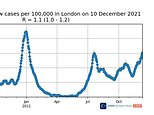
Omicron-hotspot London is seeing Covid cases rise faster now than since the very first wave
Omicron-hotspot London is seeing Covid cases rise quicker now than since very first wave and anyone with a cold probably has the virus, top expert claims as health boss warns variant is ‘biggest threat since start of pandemic’ and NHS is in ‘serious peril’
Professor Tim Spector claimed today that cases are rising faster in London than since the first waveHe added there was ‘no difference’ in symptoms between infections with the Omicron and Delta variantsSAGE Professor Graham Medley said he feared Omicron could trigger a large wave of hospitalisations
<!–
<!–
<!–<!–
<!–
(function (src, d, tag){
var s = d.createElement(tag), prev = d.getElementsByTagName(tag)[0];
s.src = src;
prev.parentNode.insertBefore(s, prev);
}(“https://www.dailymail.co.uk/static/gunther/1.17.0/async_bundle–.js”, document, “script”));
<!–
DM.loadCSS(“https://www.dailymail.co.uk/static/gunther/gunther-2159/video_bundle–.css”);
<!–
Omicron-stricken London‘s Covid cases are rising faster than at any point since the first wave and most people who have a cold are likely to be infected with the virus, a top epidemiologist claimed today.
Professor Tim Spector, who runs the UK’s largest study tracking viruses, said at least half of all respiratory infections in the capital were now Covid. For comparison, it is about one in four across the rest of the country.
He added there was ‘no difference’ in symptoms between Omicron and Delta infections, with warning signs similar to a cold and including a headache, sore throat, runny nose, fatigue and sneezing.
Health bosses warned today that Omicron was the ‘biggest threat’ since the start of the pandemic, and was leaving the NHS — a key barometer of whether more restrictions are needed — in ‘peril’.
SAGE scientist Professor Graham Medley said he feared the mutant strain could trigger a ‘very large’ wave of hospitalisations in the country because it is more transmissible than other strains.
Omicron is already behind more than 50 per cent of infections in London, which has seen its infection rate spiral to the highest levels since January at 575.4 cases per 100,000 people.
Hospitalisations in the capital have also risen 50 per cent in a fortnight, from 90 to 140 people being admitted to wards with Covid every day on average. But deaths remain flat at an average of 10 fatalities due to the virus a day.
These are lagging indicators, however, because of the time taken for someone who catches the virus to fall seriously ill and be admitted to hospital.
A spokesman for the mayor suggested yesterday that they would support more restrictions for the capital, saying it is better to ‘act now’. But Tories called on ministers to rely on the ‘vaccine shield’.
It comes amid signs the capital may already be locking itself down, with many West End performances shelved because actors have caught the virus and pubs and restaurants facing a sea of Christmas party cancellations.
Professor Tim Spector said infections in London were now rising at their fastest rate since the first wave. The above graph shows the app’s estimates for cases in the capital, and reveals they are ticking up faster than when Delta took hold
This graph shows the Covid infection rate per 100,000 people in England’s regions. It also shows there has been a rapid uptick in London (red) while cases remain largely flat in other regions
The above graph shows the seven-day average for hospital admissions in different regions of England. It reveals that in London (orange) there has been a steady increase
Professor Spector claimed that hospitalisations in London are now surging at their fastest rate since the end of the first wave of the pandemic.
He told BBC Radio 4’s Today programme: ‘If we look at our regional charts, we see London really accelerating more than we have really seen it anytime since the first wave.’
But figures from his own Covid Symptom Study, which has more than a million daily contributors, suggest Covid cases in the capital are not rising faster than last winter when the Alpha variant took hold.
During the first month of the Omicron wave cases in the capital have risen by more than a quarter, the study says, from 7,757 to 9,923 estimated daily infections.
But during the first month of the Alpha wave last winter Covid infections surged by 71 per cent from 7,694 to 13,228 daily infections. When Delta took hold this summer the app estimates cases remained level.
Separate data from the Department of Health’s Covid dashboard shows infections in the capital have doubled since the Omicron wave began, with the seven-day average for cases rising from 3,024 to 6,119.6 daily infections.
But when Alpha took hold it shows infections quadrupled over the same period from 1,985 to 10,725. And when the Delta wave began they rose three-fold from 243 to 954.
The beginning of each wave was set as the low-point in infections before they rose quickly.
For the ZOE Symptom Study app, this was November 13 for the Omicron wave, May 6 for the Delta wave and December 2 last year for the Alpha wave. And for the Department of Health figures this was November 4 for Omicron, May 14 for Delta and November 23 last year for Alpha.
Covid infections are rising from a higher base now than when Alpha took hold, which may explain why it had a faster rate of increase in cases.
Professor Spector said: ‘Omicron is the predominant variant already [in the capital] and will be at 100 per cent very soon, that’s happened in just a matter of days really and that’s why so many people are going down with infections.’
He added: ‘We’re also tracking non-Covid viruses and currently across the country it is about one in four.
‘[But] in London where Covid is increasing rapidly it is far more likely to be Covid than it is to be a cold.’
UK Health Security Agency chief Jenny Harries has warned the NHS could be in ‘serious peril’ because of the Omicron wave.
She said: ‘I think it is probably the most significant threat we have had since the start of the pandemic and I am sure for example that the numbers that we see on data over the next few days will be quite staggering compared to the rate of growth that we have seen in cases for previous variants.
‘The real potential risk here, and I would underline that because we are still learning a lot about the variant, is in relation to its severity, clinical severity, and therefore whether those cases turn into severe disease, hospitalisations and deaths.
‘We are still at too early a stage for that, in fact the world probably is still at too early a stage to be clear.
‘The difficulty is that the growth of this virus has a doubling time, doubling days, at the moment which is shortening, i.e. it is doubling faster, growing faster and in most regions in the UK it is now under two days.
‘When it started we were estimating about four or five. So if you think of that growth rate right across the UK and we are starting to see it and to feel it now in London particularly but yesterday particularly around Manchester and we are very sure there are levels growing across most communities in the UK now, although there is quite a lot of regional variation still.’
Doctors on the frontlines in South Africa had suggested Omicron was triggering more mild disease among patients.
Official figures from the country showed that although hospitalisations rose at a similar level to when Delta took hold, there were fewer people on ventilators and in the emergency units.
But it is yet to be clear whether the variant is more mild because more people now have immunity against the virus than when Delta took hold.
South Africa has a lower vaccination rate than the UK with 25 per cent of people double-jabbed, but most have already caught the virus there. Experts warn it is difficult to make comparisons between the two countries because in South Africa most people are young, whereas the UK has a much older population.
Professor Graham Medley, from the London School of Hygiene & Tropical Medicine and a member of the Scientific Advisory Group for Emergencies (Sage), told BBC Radio 4’s Today programme he is worried ‘we could see numbers of people being admitted to hospital getting very large’ if infections continue to rise and spill into older age groups.
It came as Dr Jenny Harries, chief executive of the UK Health Security Agency, told MPs the Omicron coronavirus variant is ‘probably the most significant threat we’ve had since the start of the pandemic’.
She said the ‘real potential risk’ is whether ‘cases turn into severe disease, hospitalisations and deaths’, but added that it is ‘too early’ to be clear on that.
Speaking in a personal capacity, Prof Medley said it is ‘very hard to predict in real time exactly what’s happening on any day, but it’s certainly true that the numbers of infections primarily with Omicron is increasing, and has been increasing quite dramatically’.
He added: ‘We’re probably now at the level that we have been at the past, sort of back in January, and it does look as though it’s going to continue beyond that and go over it.’
Prof Medley said there is not currently any good information on the severity of Omicron but added: ‘We are a population in a very different position to this time last year, in the sense that the majority of people have been vaccinated and there has been much infection since then, so there is much more immunity…
‘The fact that we are much more immune than we were generally means that the virus will appear to be much less severe.
‘So, individually, we have a much lower risk but the numbers of infections means that even though individually we’re at less risk, at a population level (the) number of people ending up in hospital could get very large.’
On Omicron’s symptoms, Professor Spector said: ‘The majority of symptoms are just like a common cold, so we’re talking about headaches, sore throat , runy nose, fatigue, and things like sneezing.
‘Things like fever and cough and loss of smell are actually now in the minority of symptoms that we’re seeing.’
He said there were ‘no real differences’ between Covid symptoms currently being reported in London now and those from a month ago before Omicron took hold.
Asked whether the virus was triggering more severe disease, he said: ‘We are not seeing any severe disease, we are not seeing any unusual symptoms that people have reported in South Africa.
‘It’s looking very similar, it’s looking very respiratory. It’s looking mild at the moment and it’ll be a while before we know exactly how mild because most of the cases are still in the young.
‘But we are getting breakthrough infections in people who are having two or three vaccinations, and that’s more than we saw before.
‘When we look at regions with high and low Omicron we are seeing more breakthrough infections in London where there is high Omicron.’
London could soon face more restrictions, reports suggest, as ministers mull over ‘Plan C’ measures introducing more curbs on people’s daily lives.
A spokesman for the mayor Sadiq Khan said yesterday: ‘Cases of Omicron are rising sharply in London and with so much at stake, it is better that we act now to safeguard the public and help reduce pressures on NHS services.
‘Londoners will see vaccine centres working around the clock, more local pop-up sites coming online near them, and [the Mayor] will use all of our resources at City Hall to ensure that all of London’s communities are encouraged to take up this lifesaving vaccine.
They added: ‘The last thing any of us want is to see a further lockdown or to see the virus running out of control.’
Emma Best, the Conservative’s London Assembly member for health, said: ‘A strong vaccine shield, not a local lockdown is the best protection for our capital.
‘Our vaccine shield is weaker than other parts of the country as only 61 per cent of people are fully vaccinated and sadly, some hospitals in London are already reporting that their coronavirus wards are starting to fill up.
‘That’s why it’s so important Londoners get vaccinated and go for their booster jab as soon as possible.’