

Covid-19 UK: Boris Johnson will hold 5pm Downing St press conference on Omicron today
Boris Johnson will hold 5pm Downing Street press conference TODAY amid growing Omicron threat and Government will hold Cobra meeting at same time as No10’s own experts pile pressure on PM to bring in ‘Plan C’ with NHS in ‘serious peril’
PM expected to give update on Omicron situation and booster rollout, but not introduce new restrictionsBut he faces growing pressure from his own advisers to hit the panic button on Plan C to curb new variantNicola Sturgeon has re-introduced social distancing in pubs, restaurants and limited groups of three houses
<!–
<!–
<!–<!–
<!–
(function (src, d, tag){
var s = d.createElement(tag), prev = d.getElementsByTagName(tag)[0];
s.src = src;
prev.parentNode.insertBefore(s, prev);
}(“https://www.dailymail.co.uk/static/gunther/1.17.0/async_bundle–.js”, document, “script”));
<!–
DM.loadCSS(“https://www.dailymail.co.uk/static/gunther/gunther-2159/video_bundle–.css”);
<!–
Boris Johnson will hold a Downing Street press conference later today as he faces growing pressure from his own advisers to hit the panic button on even tougher Covid restrictions in the face of Omicron with warnings that the NHS is in ‘serious peril’.
With the ultra-infectious variant already dominant in London and grim modelling predicting at least 200,000 people are catching the it every day, the Prime Minister will shed light on the current situation and booster roll-out when he addresses the country at 5pm alongside Professor Chris Whitty and top NHS doctor Nikki Kanani.
No fresh curbs are expected to be unveiled at the briefing, with No10 saying ‘there are no plans to go beyond what we have set out’. Transport Secretary Grant Shapps was also wheeled out on TV and radio today to bat off calls for an immediate Plan C.
Mr Shapps insisted this Christmas will be a ‘good deal happier than last’ and said England’s current restrictions — of work from home guidance, vaccine passports and compulsory face masks in some settings — were ‘sensible’ and ‘proportionate’.
But the Westminster Government has already deviated from its Scottish counterpart in how to handle the next stage of the pandemic, having refused to ask people to limit socialising over the festive period. Ministers have only urged people to get tested before meeting loved ones.
Nicola Sturgeon yesterday re-introduced social distancing in pubs, restaurants and shops, and advised Scots to cut down on indoor mixing to just three households.
Senior ministers from across England, Scotland, Wales and Northern Ireland will attend a Cobra meeting at the same time Mr Johnson addresses the nation, with the topic of discussion centered around the ‘UK-wide response’. The PM’s spokesman said today: ‘We’ve had success throughout in sharing information and approaches, and we’ll continue to do that.’
It comes as other scientists advising the Government today ramped up the pressure for ministers to impose even tighter Covid curbs.
Dr Jenny Harries, head of the UK Health Security Agency, warned Omicron posed the ‘biggest threat’ yet. She told MPs: ‘Trying to prevent ingress of any infections still remains a key point, particularly when we can foresee a very large wave of Omicron coming through and our health services potentially being in serious peril.’
SAGE modeller Professor Graham Medley admitted he feared the super-strain could trigger a ‘very large’ wave of hospitalisations because it is so transmissible, while jabs adviser Professor Adam Finn called for action to halt the ‘alarming’ spread of the virus.
But after suffering a 100-strong backbench revolt over introducing Covid passes last night, there are now serious questions about whether the Prime Minister has the political strength to impose a tougher lockdown if he needs to.
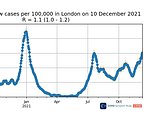
Omicron is already behind half of all new Covid cases in London, which has seen its infection rate spiral to the highest levels since January and prompted calls for regional action. One modelling study has found that cases in the capital are now rising faster than at any point since the first wave, prompting an expert to say that anyone battling a cold currently probably has Covid.
Parts of London’s West End have already effectively entered lockdown as theatre shows are suspended and pubs and restaurant suffer a wave of cancellations triggered by mounting fears over the variant sweeping the capital.
The Prime Minister, pictured speaking during PMQs in the House of Commons this afternoon, will address the nation at 5pm alongside Professor Chris Whitty and senior NHS official Dr Nikki Kanani
The Omicron Covid variant is now dominant in London, and is expected to make up the majority of cases in other regions over the coming days and weeks.
The above graph shows the proportion of cases suspected to be Omicron because they do not have an S-gene (purple). PCR tests look for three genes to confirm a Covid infection but with Omicron one is so mutated that they only pick up two of them
The above graph shows the proportion of cases suspected to be Omicron because they do not have an S-gene (purple). PCR tests look for three genes to confirm a Covid infection but with Omicron one is so mutated that they only pick up two of them
A spokesman for the mayor suggested yesterday that they would support more restrictions for the capital, saying it is better to ‘act now’. But Tories called on ministers to rely on the ‘vaccine shield’.
Hospitalisations in the capital have also started to tick upwards, rising 50 per cent in a fortnight. But the raw numbers still stand at around 150 a day, compared to nearly 1,000 during the darkest days of the capital’s second wave in January. Deaths remain flat at around 10 a day.
These are lagging indicators, however, because of the time taken for someone who catches the virus to fall seriously ill and be admitted to hospital, meaning the worst of the rapid spread — which has yet to show any signs of slowing down — won’t be felt until the New Year.
Professor Spector claimed that hospitalisations in London are now surging at their fastest rate since the end of the first wave of the pandemic.
He told BBC Radio 4’s Today programme: ‘If we look at our regional charts, we see London really accelerating more than we have really seen it anytime since the first wave.’
But figures from his own Covid Symptom Study, which has more than a million daily contributors, suggest Covid cases in the capital are not rising faster than last winter when the Alpha variant took hold.
During the first month of the Omicron wave cases in the capital have risen by almost a third, the study says, from 7,626 to 9,856 estimated daily infections.
But during the first month of the Alpha wave last winter Covid infections surged by 71 per cent from 7,694 to 13,228 daily infections. When Delta emerged the app estimates cases also rose by a third from 6,483 to 8,380.
Separate data from the Department of Health’s Covid dashboard also shows cases in the capital are not rising faster than when Delta or Alpha took hold.
It suggests cases in the capital have doubled since the Omicron wave began, with the seven-day average for cases rising from 3,024 to 6,119.6 daily infections.
But when Alpha took hold it shows infections quadrupled over the same period from 1,985 to 10,725. And when the Delta wave began they rose three-fold from 243 to 954.
The beginning of the waves was set as the low-point in infections before they spiralled.
For the ZOE Symptom Study app, this was November 11 for the Omicron wave, June 13 for Delta and December 2 last year for Alpha. And for the Department of Health figures this was November 4 for Omicron, May 14 for Delta and November 23 last year for Alpha.
Covid infections are rising from a higher base now than when Alpha took hold, which may explain why the new variant is not causing cases to spiral as quickly.
More Britons also have immunity against the virus now than when Delta and Alpha emerged through either vaccination or past infection, which may also be helping to slow the spread of the virus.
UK Health Security Agency chief Jenny Harries has warned the NHS could be in ‘serious peril’ because of the Omicron wave.
She said: ‘I think it is probably the most significant threat we have had since the start of the pandemic and I am sure for example that the numbers that we see on data over the next few days will be quite staggering compared to the rate of growth that we have seen in cases for previous variants.
‘The real potential risk here, and I would underline that because we are still learning a lot about the variant, is in relation to its severity, clinical severity, and therefore whether those cases turn into severe disease, hospitalisations and deaths.
‘We are still at too early a stage for that, in fact the world probably is still at too early a stage to be clear.
‘The difficulty is that the growth of this virus has a doubling time, doubling days, at the moment which is shortening, i.e. it is doubling faster, growing faster and in most regions in the UK it is now under two days.
‘When it started we were estimating about four or five. So if you think of that growth rate right across the UK and we are starting to see it and to feel it now in London particularly but yesterday particularly around Manchester and we are very sure there are levels growing across most communities in the UK now, although there is quite a lot of regional variation still.’
Doctors on the frontlines in South Africa had suggested Omicron was triggering more mild disease among patients.
Official figures from the country showed that although hospitalisations rose at a similar level to when Delta took hold, there were fewer people on ventilators and in the emergency units.
But it is yet to be clear whether the variant is more mild because more people now have immunity against the virus than when Delta took hold.
South Africa has a lower vaccination rate than the UK with 25 per cent of people double-jabbed, but most have already caught the virus there. Experts warn it is difficult to make comparisons between the two countries because in South Africa most people are young, whereas the UK has a much older population.
Professor Tim Spector said infections in London were now rising at their fastest rate since the first wave. The above graph shows the app’s estimates for cases in the city, and reveals they are ticking up at about the same rate as when Delta emerged
This graph shows the Covid infection rate per 100,000 people in England’s regions. It also shows there has been a rapid uptick in London (red) while cases remain largely flat in other regions
The above graph shows the seven-day average for hospital admissions in different regions of England. It reveals that in London (orange) there has been a steady increase
Covid cases in London are surging upwards amid the spread of the Omicron variant which now makes up more than 50 per cent of daily infections in the city. Case numbers are the highest they have been since January
Patient hospital admissions with Covid in London are also beginning to rise, but this is a lagging indicator because of the time taken for someone who has caught the virus to fall seriously ill
Covid deaths in the capital are still flat. But these are also lagging indicators
Professor Graham Medley, from the London School of Hygiene & Tropical Medicine and a member of the Scientific Advisory Group for Emergencies (SAGE), told BBC Radio 4’s Today programme he is worried ‘we could see numbers of people being admitted to hospital getting very large’ if infections continue to rise and spill into older age groups.
Speaking in a personal capacity, Professor Medley said it is ‘very hard to predict in real time exactly what’s happening on any day, but it’s certainly true that the numbers of infections primarily with Omicron is increasing, and has been increasing quite dramatically’.
He added: ‘We’re probably now at the level that we have been at the past, sort of back in January, and it does look as though it’s going to continue beyond that and go over it.’
Professor Medley said there is not currently any good information on the severity of Omicron but added: ‘We are a population in a very different position to this time last year, in the sense that the majority of people have been vaccinated and there has been much infection since then, so there is much more immunity…
‘The fact that we are much more immune than we were generally means that the virus will appear to be much less severe.
‘So, individually, we have a much lower risk but the numbers of infections means that even though individually we’re at less risk, at a population level (the) number of people ending up in hospital could get very large.’
Professor Adam Finn, from the University of Bristol and a member of the Joint Committee on Vaccination and Immunisation (JCVI), told BBC Breakfast the wave of Omicron is just taking off across the country.
He said: ‘The wave is coming very fast and in fact alarmingly fast – if anything faster than ever. So it really is a race at the moment.
‘The more immunity that we’ve all got the less of a problem this is going to be, but I’m afraid it is going to be a serious problem either way.’
Professor Finn said it is not up to him to say what regulations should be put on the population, but added: ‘I think I can certainly encourage people to do everything they can to minimise spread of the virus during this critical period and, of course, a lot of that can be done voluntarily without anyone imposing rules on people.
‘We all know now what the things are that we can do. We can avoid social contact, we can minimise contact at work, we can wear masks and really importantly, do lateral flow tests and check that you aren’t showing signs of infection on a test before you go into a crowded place where you might infect other people.’
Professor Finn said he is ‘very concerned’ about the current number of daily infections, adding that we are ‘going to see the numbers of people becoming ill and needing hospital care beginning to rise steadily now over the next week and maybe over Christmas as well’.
But he said boosters take effect in the body quickly, adding: ‘It does come through very fast because you’ve got immunological memory, you’ve seen the antigen before from your previous doses, so the level of protection goes up pretty quick.’
Professor Spector said: ‘Omicron is the predominant variant already [in the capital] and will be at 100 per cent very soon, that’s happened in just a matter of days really and that’s why so many people are going down with infections.’
He added: ‘We’re also tracking non-Covid viruses and currently across the country it is about one in four.
‘[But] in London where Covid is increasing rapidly it is far more likely to be Covid than it is to be a cold.’
On Omicron’s symptoms, Professor Spector said: ‘The majority of symptoms are just like a common cold, so we’re talking about headaches, sore throat , runy nose, fatigue, and things like sneezing.
‘Things like fever and cough and loss of smell are actually now in the minority of symptoms that we’re seeing.’
He said there were ‘no real differences’ between Covid symptoms currently being reported in London now and those from a month ago before Omicron took hold.
Asked whether the virus was triggering more severe disease, he said: ‘We are not seeing any severe disease, we are not seeing any unusual symptoms that people have reported in South Africa.
‘It’s looking very similar, it’s looking very respiratory. It’s looking mild at the moment and it’ll be a while before we know exactly how mild because most of the cases are still in the young.
‘But we are getting breakthrough infections in people who are having two or three vaccinations, and that’s more than we saw before.
‘When we look at regions with high and low Omicron we are seeing more breakthrough infections in London where there is high Omicron.’
London could soon face more restrictions, reports suggest, as ministers mull over ‘Plan C’ measures introducing more curbs on people’s daily lives.
A spokesman for the mayor Sadiq Khan said yesterday: ‘Cases of Omicron are rising sharply in London and with so much at stake, it is better that we act now to safeguard the public and help reduce pressures on NHS services.
‘Londoners will see vaccine centres working around the clock, more local pop-up sites coming online near them, and [the Mayor] will use all of our resources at City Hall to ensure that all of London’s communities are encouraged to take up this lifesaving vaccine.