

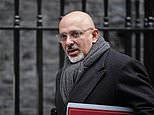
Education Secretary Nadhim Zahawi calls on ex-teachers to help out as Covid causes staff shortages
Education Secretary Nadhim Zahawi calls on ex-teachers to help out as over 13,000 staff stay off work due to Covid – while Ofsted reveals 236,000 pupils skipped school due to virus last week
Nadhim Zahawi has called on former teachers to return to the profession Minister said the Department for Education (DfE) will work with sector leadersThe DfE has also announced it will be extending its workforce fund for schools
<!–
<!–
<!–<!–
<!–
(function (src, d, tag){
var s = d.createElement(tag), prev = d.getElementsByTagName(tag)[0];
s.src = src;
prev.parentNode.insertBefore(s, prev);
}(“https://www.dailymail.co.uk/static/gunther/1.17.0/async_bundle–.js”, document, “script”));
<!–
DM.loadCSS(“https://www.dailymail.co.uk/static/gunther/gunther-2159/video_bundle–.css”);
<!–
Education Secretary Nadhim Zahawi has called on former teachers to return to the profession in an effort to help schools facing staff absences and ‘boost supply capacity’.
The minister has said the Department for Education (DfE) will work with sector leaders and supply agencies over the coming days to offer advice to ex-teachers who want to provide support to schools and colleges.
The latest DfE figures show that 2.4 per cent of teachers and school leaders – which equates to around 13,000 staff – were absent from schools in England due to Covid-19 related reasons on December 9.
The figure is up from the 2.0 per cent that was recorded on November 25.
It comes as Government figures suggest that 2.9 per cent of all pupils – nearly 236,000 children – were not in class for reasons connected to coronavirus on December 9.
Education Secretary Nadhim Zahawi has called on former teachers to return to the profession in an effort to help schools facing staff absences
In an email to school and college leaders ahead of the Christmas holidays, Mr Zahawi said: ‘We know that in areas with high absence a particular issue can be the availability of supply staff. We want to make sure that as many supply staff as possible are available to schools and colleges.’
The Education Secretary added: ‘We will work with sector leaders and supply agencies over the coming days to offer advice to ex-teachers who want to provide support to schools and colleges.
‘We will help them to register with supply agencies as the best way to boost the temporary workforce available to the sector.’
In the plea to heads on Thursday, Mr Zahawi said: ‘From now, you can support this effort by using your own professional and personal networks to encourage others to sign up to offer temporary help.’
The DfE has also announced it will be extending its workforce fund for schools and colleges facing the greatest staffing and funding challenges amid Covid.
The fund, which helps schools to cover the cost of staff absences, is now being extended until the February half-term rather than December 31.
Some pupils are also being asked to take laptops home before Christmas as part of contingency measures in case lessons have to move online in January.
Geoff Barton, general secretary of the Association of School and College Leaders (ASCL), said: ‘Everybody hopes that education will resume as near to normal as possible in January after the Christmas holidays.’
But he added: ‘The difficulty will be if there are very high levels of staff absence as a result of the impact of the Omicron variant of Covid-19.
‘It is likely that this would result in schools having to send home classes or year groups, or closing for on-site teaching, for short periods of time and providing remote education for those at home.
‘It may also be the case that local public health teams advise attendance restrictions for short periods of time if there are high case numbers in order to break chains of transmission of the virus.’
Paul Whiteman, general secretary of school leaders’ union NAHT, said: ‘There is a very real concern about the impact on schools of exponentially rising case numbers.
‘The reality is that if school staff become ill with Covid there are going to be challenges in maintaining provision, be that in-person or remote.
‘Every single school leader will be determined to minimise any disruption to learning, but it does seem as though choppy waters lie ahead and that some form of disruption at the start of next term is looking sadly inevitable.’
Year eight pupils wear face masks as they queue in a corridor before attending an English lesson at Moor End Academy in Huddersfield
In Wales, schools will have two days at the start of term in January to assess staffing capacity and to make plans for moving to remote lessons if needed.
In England, secondary schools will receive a ‘small amount of flexibility’ on when they return so they can test pupils for Covid-19 after the Christmas break, education minister Alex Burghart said.
But he told MPs on Wednesday: ‘The Government is committed to ensuring schools open in January as normal.’
Health minister Gillian Keegan has suggested that children aged 12-15 getting their coronavirus vaccines should be enough to keep schools open in January.
The call for more teachers comes after Government figures showed that 2.9 per cent of all pupils – nearly 236,000 children – were not in class for reasons connected to coronavirus on December 9.
A series of reports from Ofsted suggest that pupils have been absent from class for a variety of reasons – including Covid-related anxiety among families and mental health.
Children have also missed school due to parents rescheduling or rearranging term-time holidays, as well as testing positive for Covid-19, inspectors found.
Some schools reported that they have seen more coronavirus-related absences among specific year groups – such as Year 11 and sixth form, who are due to take exams, and Year 8 – as well as disadvantaged pupils and those with special educational needs and disabilities (Send).
The Ofsted reports into the impact of the pandemic on children and learners are based on 214 routine inspections of nurseries, childminders, schools and further education and skills providers in England this term.
Many childcare providers said that young children – especially those born during the pandemic, or those who have spent most of their lives in it – are behind with their language, communication and social skills.
Ofsted chief inspector Amanda Spielman said: ‘Children have missed out so much already. And some pupils remain persistently absent from school for a variety of reasons.
‘So, as we face further turbulence, we must do all we can to make sure children are able to continue learning in their classrooms.’
School leaders said lockdowns have particularly affected the newest cohorts in schools who are arriving with lower starting points than previous years.
Inspectors were told that Year 7 pupils struggle with their behaviour and have taken ‘longer to settle in’ with school routines.
Some schools said the Year 7 cohort (11 and 12-year-olds) feel a lot younger than they normally do and have displayed ‘more immature’ behaviour.
Some secondary schools have extended the school day to help pupils catch up, while other heads said they are offering sessions after school, before school, or on Saturdays for those who need extra support.
Ms Spielman added: ‘The pandemic is still with us, and children’s education is still being disrupted.
‘But it’s clear that many school leaders and staff have responded to these challenges with tenacity, and demonstrated creativity in how they have supported children and learners’ education and personal development.’