

Business leaders in Northern Ireland condemn new Covid restrictions
‘Unacceptable and unforgivable’: Business leaders in Northern Ireland condemn new Covid restrictions as Stormont ministers announce nightclubs will shut from Boxing Day
The decision was made after NI’s highest daily increase in cases was recordedMinisters said measures were ‘proportionate based on where we are today’But business chiefs criticised the lack of an additional financial support package
<!–
<!–
<!–<!–
<!–
(function (src, d, tag){
var s = d.createElement(tag), prev = d.getElementsByTagName(tag)[0];
s.src = src;
prev.parentNode.insertBefore(s, prev);
}(“https://www.dailymail.co.uk/static/gunther/1.17.0/async_bundle–.js”, document, “script”));
<!–
DM.loadCSS(“https://www.dailymail.co.uk/static/gunther/gunther-2159/video_bundle–.css”);
<!–
Business leaders in Northern Ireland have slammed the country’s new Covid restrictions as ‘unacceptable and unforgivable’.
Stormont ministers announced today that nightclubs will close from Boxing Day after its highest daily increase in coronavirus cases was recorded.
Some 3,231 new cases of the virus were confirmed in the region on Wednesday, a jump from 2,096 cases recorded on Tuesday.
The move to close nightclubs was agreed at a virtual meeting of the powersharing Executive on Wednesday, in which it was determined that dancing will also be prohibited in hospitality venues. It will not apply to weddings, however.
First Minister Paul Givan described the measures as ‘proportionate based on where we are today’ but added they will be kept under review.
However, Belfast Chamber of Commerce heavily criticised the fact that no additional financial support package was agreed to accompany the measures.
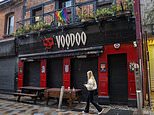
Closed Voodoo nightclub in Belfast after ministers announced today venues would have to shut after Boxing Day
Chief Executive Simon Hamilton, a former DUP minister in the Stormont Executive, said businesses had already suffered significant losses due to heighted consumers fears about the prospect of a lockdown.
‘For weeks now, businesses who have experienced a difficult 2021, have been subjected to a drip feed of speculation and scaremongering about possible lockdowns and further restrictions,’ he said.
‘As the rhetoric ramped up, the impact on businesses was very real as millions of pounds of trade disappeared, causing owners and their teams huge distress.
‘Today, the Executive has added insult to injury. As well as having to deal with the impact of additional measures, businesses haven’t been offered a single penny in financial support. That is simply unacceptable and unforgivable.
‘What sort of a message does that send to the thousands of people who rely on jobs in the affected sectors and their supply chains to heat their homes and feed their families?
‘It is shameful that they now face into an uncertain future after all they’ve endured already. It feels like businesses, their owners and their staff have been cast aside without a care.’
Retail NI chief executive Glyn Roberts said his members were ‘extremely disappointed’ at the lack of financial package.
‘To leave so many businesses in financial limbo like this is unfair and needs to be addressed immediately,’ he said.
‘We welcome the decision not to significantly change the regulations around retail. Our members have been and will continue to work hard to keep staff and shoppers as safe as possible throughout the pandemic’.
In a statement, the CBI in Northern Ireland said: ‘While Stormont is right to prioritise reducing transmission, the latest restrictions on hospitality, leisure and events businesses will leave them reeling after working tirelessly to claw back two years of lost takings.
‘Once again the economy’s hardest-hit sectors are being asked to carry the can for protecting public health, yet are not being adequately compensated for restrictions that will clearly put operations and livelihoods at risk.’
First Minister Paul Givan described the measures as ‘proportionate based on where we are today’ but added they will be kept under review
Northern Ireland Hotels Federation (NIHF) chief executive Janice Gault said the new measures had not come as a surprise.
‘The hotel industry has in effect not been able to trade under normal conditions since March 2020,’ she said.
‘Many thought that we were moving beyond the Covid-19 crisis but once again we are moving into a period of increased restrictions. The hotel sector has shown its resilience and ability to adapt over the last nineteen months. These are attributes that the sector will need to draw upon for the foreseeable future.
‘As always, the health of guests and staff remain the primary concern of hoteliers. The industry will continue to try to work within this new framework and hope that the future will bring better times for the sector and society as a whole.’
Deputy First Minister Michelle O’Neill said ministers ‘spent considerable time agreeing a proportionate package of measures based on the best evidence that we have available to us at this time’.
She said they will continue to analyse the data over the Christmas period.
‘In the meantime, we are getting on with planning for all eventualities,’ she said.
‘Central to our ability to respond to the pandemic has been around the availability of money to support individuals and businesses through this very difficult time.
‘We will continue to press the Treasury for financial support because that gives us more flexibility in terms of managing the situation as we see fit here, not depending on what happens in England.’
Health Minister Robin Swann said Omicron is now the dominant variant in Northern Ireland.
He said the precautionary approach would have been to impose more restrictions, but said options were ‘extremely limited’ due to the absence of furlough and additional supports.
‘I have made clear to ministerial colleagues that we may have to move quickly again in the event of the Covid situation deteriorating again further and additional funding becoming available,’ he said.
‘That may have to happen in the very near future but I will say again, it is not inevitable.
‘So I would encourage everyone still to come forward and get their vaccinations and follow public health guidance.’
The Executive will meet again on December 30.
(left to right) Deputy First Minister Michelle O’Neill, First Minister Paul Givan and Northern Ireland Health Minister Robin Swann in the Great Hall of Parliament Buildings at Stormont
Ministers also agreed that sporting events can continue with no limits on capacity, while the work from home message will be bolstered and legislation introduced to require social distancing in offices and similar typed workplaces.
Employers will be encouraged to introduce lateral flow testing procedures for people who are still coming into work.
People attending large events will be urged to wear face masks, take lateral flow tests and not car share to or from the venues.
While nightclubs must close, other restrictions are coming into effect on the rest of the hospitality sector. People must remain seated for table service while table numbers will be limited to six.
Dancing will also be prohibited from December 26. Weddings are exempted from the latest measures.
The jump in infection numbers is the highest increase reported in Northern Ireland for a 24-hour period since Covid reporting began in April 2020.
The figures come amid stark warnings of soaring infection rates when the Omicron variant takes hold in the region.
The death of three patients who had previously tested positive for Covid-19 were also notified by the Department of Health on Wednesday.
On Wednesday morning, there were 261 Covid-positive patients in hospital, of whom 34 were in intensive care.
Meanwhile, pregnant women of all ages, including those aged under 18, are being urged to come forward for vaccination if they have not already done so.
This follows the latest review of evidence by the Joint Committee on Vaccination and Immunisation (JCVI), who now advise that pregnant women of any age should be considered as a clinical risk group and should be prioritised for vaccination.
Pregnant women of any age can receive their vaccination at a Health and Social Care Trust vaccination hub. Information on vaccination clinics is available on Trust websites.
Pregnant women over the age of 18 can also get their vaccination from participating local pharmacies. Information on pharmacy locations