

Hopes are high for happy New Year! With Parliament away, time is running out for MPs to impose curbs
Hopes are high for a happy New Year! With Parliament away, time is running out for MPs to impose fresh legally-binding curbs on party season
Multiple sources say time is running out to impose new restrictions ahead of NYENo 10 is awaiting more data before making final decision on further restrictionsIt is thought they could instead issue guidance as done for Christmas festivities
<!–
<!–
<!–<!–
<!–
(function (src, d, tag){
var s = d.createElement(tag), prev = d.getElementsByTagName(tag)[0];
s.src = src;
prev.parentNode.insertBefore(s, prev);
}(“https://www.dailymail.co.uk/static/gunther/1.17.0/async_bundle–.js”, document, “script”));
<!–
DM.loadCSS(“https://www.dailymail.co.uk/static/gunther/gunther-2159/video_bundle–.css”);
<!–
New Year’s Eve celebrations are likely to be free from legally-binding coronavirus curbs, sources revealed last night.
Time was running out to recall Parliament to impose fresh restrictions before the end of the year, multiple sources said.
The Government has vowed to give MPs a vote if more stringent measures are needed over the Christmas recess – but preliminary data has not yet been sufficient to justify further curbs.
Ministers remain anxious that hospital admissions are rising and the transmissibility of Omicron could lead to the NHS being overwhelmed. But they have been buoyed by studies suggesting the variant is less severe than previous coronavirus strains.
Last night a Cabinet source said that ‘with every day that goes by, it becomes less likely’ that Parliament will be recalled before New Year’s Eve. They said that with the post-Christmas bank holidays and 48-hour delay to recalling Parliament, it was ‘possible’ but unlikely that MPs would be ordered back.
‘Especially considering the amount of time needed for internal decisions to be made in Government before a recall is made,’ they added. Another said: ‘Colleagues would not vote in our favour if we cut short their Christmas break.’
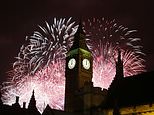
New Year’s Eve celebrations are likely to be free from legally-binding coronavirus curbs, sources revealed last night. Pictured: crowds celebrate New Years Eve in London (stock image)
Pictured: Fireworks explode over Elizabeth Tower housing Big Ben clock to celebrate New Year
Downing Street is awaiting more data before making a final decision on whether to impose further restrictions, but could instead issue guidance – as it has done for Christmas.
A Government source said last night: ‘It is more complicated to put things in law, but it is still possible – though you would obviously need quite strong data to justify doing that.’
In a video message, Boris Johnson will today say: ‘After two years of this pandemic, I can’t say that we are through it. How can I? When Omicron is surging… we must together try to stop the spread of this new variant.
‘We must test ourselves and take extra care when meeting elderly or vulnerable relatives. We know that things remain difficult.
‘But for millions of families up and down the country, I hope and believe that this Christmas is, and will be, significantly better than the last, in this vital respect.’
He praised those who are ‘selflessly self-isolating’ over the festive period to keep others safe and added: ‘Though the time for buying presents is theoretically running out, there is still a wonderful thing you can give your family and the whole country… and that is to get that jab, whether it is your first or second, or your booster.’
Former Sage scientist Sir Jeremy Farrar said yesterday it was ‘very reasonable to pause, assess updated data after Christmas before deciding what if any measures are needed to ensure NHS, schools, work places, infrastructure can function through January’.
There had been speculation that ministers could impose a ‘circuit breaker’ after Christmas, but Tory MPs last night urged him to resist such a move.
Former Cabinet minister Theresa Villiers said: ‘Whilst people need to exercise caution and common sense over New Year, it is not clear further restrictions are needed.’
There had been speculation that ministers could impose a ‘circuit breaker’ bank of measures after Christmas, but Tory MPs last night urged the Prime Minister (pictured) to resist the move
Ministers reportedly remain anxious that hospital admissions are increasing and the transmissibility of Omicron variant could lead to the NHS being overwhelmed in the new year
Another contrasted Mr Johnson’s position to that of Welsh first minister Mark Drakeford, who has introduced fresh restrictions from Boxing Day. ‘At the moment it looks relatively encouraging. If he holds his nerve, we could be okay.
‘That, of course, is very much unlike what is happening here in Wales, where Drakeford is in a complete flap,’ the MP said.
Northern Ireland, Wales and Scotland have all announced extra restrictions to tackle Omicron.
The Scottish government has closed nightclubs for at least three weeks from December 27. They have been told they can open with social distancing and table service, meaning they would be operating more like bars.
The change will infuriate the hospitality sector north of the border. The rules will affect about 150 clubs.
At football matches in Scotland fans chanted abuse at first minister Nicola Sturgeon over rules that will effectively ban them from games. A crowd at a game between Hibernian and Aberdeen chanted, ‘Sturgeon, get tae f***’.
Others held a banner saying ‘open your homes for COP26, closed doors for fans, f*** SNP’ – a reference to the climate change conference, which some blame for fuelling Covid cases.
Liz Cameron, chief executive of the Scottish Chambers of Commerce, said Miss Sturgeon’s restrictions ‘will be another hammer blow for employers and Scotland’s economy’.
The row over restrictions came as a key Government report revealed that Omicron is up to 70 per cent less likely to cause hospital admission than Delta.
Health Secretary Sajid Javid hailed the evidence from the UK Health Security Agency (UKHSA) – the fourth study to show the strain causes less severe illness.
The agency’s findings are consistent with studies by Imperial College London and the University of Edinburgh, offering a more optimistic figure for reduced severity, but experts warned the strain does cause a steeper drop-off in immunity ten days after a booster vaccine.
Mr Javid said the emerging findings on severity were ‘encouraging’ after Downing Street confirmed that there will be no more announcements on toughening rules until next week.
But he stressed that the rapid spread of the variant will still pose a serious threat and huge numbers of cases would mean ‘significant hospitalisations’.
Despite the morale-boosting evidence, however, daily Covid cases spiked again on Thursday, with hospitalisations rising by a fifth in a week, amid scientists’ warnings that the UK is still in the ‘danger zone’.
Cases hit a high for the second day running, with 119,789 reported in 24 hours — up 35 per cent on last Thursday and putting a dampener on hopes that the variant could be less devastating than initially feared.
Latest hospitalisations ticked up to 1,004, marking the first time they had reached four figures since early November.
Another 147 Covid deaths were recorded which was barely a change from last week, but these are lagging indicators because of the time taken for someone who catches the virus to fall severely ill. There were 16,817 further cases of Omicron confirmed, bringing the total to 90,906.
Meanwhile, there were warnings from SAGE that Omicron might need to be 90 per cent milder than Delta to avoid the NHS coming under unsustainable pressure.
In minutes published on Thursday, No10’s top scientists said if Omicron doubles every two days – like modelling estimates – there could still be thousands of hospitalisations this winter even if the strain is slightly weaker.
This could only be avoided, they said, with more curbs, ‘significant behaviour change’, or if the variant cut the risk of severe disease by 90 per cent.
The meeting took place on December 20, and it was possible that the scientists had not seen an Imperial College London study released yesterday showing Omicron was 45 per cent less likely to cause severe disease.
The minutes read: ‘In the absence of further interventions or significant behaviour change, intrinsic severity would need to be greatly reduced (by around 90 per cent) for hospitalisations to not reach the levels of previous peaks unless the wave peaks early for other reasons.’
Gloomy SAGE estimates have repeatedly come under fire in recent days, after the committee suggested deaths could peak at 6,000 this winter. Last year they reached 1,300 at the peak.
It comes after three major studies in England, Scotland and South Africa confirmed Omicron is milder than Delta and far less likely to put someone in hospital.
One paper by ‘Professor Lockdown’ Neil Ferguson found the mutant strain was up to 45 per cent less likely to lead to hospitalisation than Delta, based on 300,000 people in England.