

Covid UK: PM set to make decision on new restrictions as London’s daily hospital admissions surge
New Year’s eve on a knife edge: Boris Johnson set to make decision on new restrictions on Monday as London’s daily Covid hospital admissions surge 92% to 386 – within touching distance of No10’s ‘threshold for action’
The PM is set to review the latest Covid figures on Monday as further restriction could be imposed before NYECovid hospital admissions in London are within touching distance of the threshold of 400 for a lockdown Ministers are said to be watching admission rates in London before pulling the trigger on more national curbs
<!–
<!–
<!–<!–
<!–
(function (src, d, tag){
var s = d.createElement(tag), prev = d.getElementsByTagName(tag)[0];
s.src = src;
prev.parentNode.insertBefore(s, prev);
}(“https://www.dailymail.co.uk/static/gunther/1.17.0/async_bundle–.js”, document, “script”));
<!–
DM.loadCSS(“https://www.dailymail.co.uk/static/gunther/gunther-2159/video_bundle–.css”);
<!–
Further Covid restrictions could be imposed just in time for New Year’s Eve as Boris Johnson is set to review the latest figures on Monday.
Covid hospital admissions in London — Britain’s Omicron ground zero — are within touching distance of the Government’s threshold of 400 for introducing lockdown restrictions across the country.
Latest NHS data shows there were 386 new admissions for the virus in the capital on December 22, marking a 92 per cent rise on the figure last week.
Covid hospitalisations are now doubling roughly every 10 days – though they are still a far cry from the 850 at the peak last January.
Johnson may have to make a call on more restrictions by Tuesday at the latest so they can be implemented in time for New Year’s Eve, The Times reports.
Paramedics unload a patient from an ambulance outside the Royal London Hospital in London on Friday as the UK records 114,625 new coronavirus cases
Reports have claimed ministers are watching hospitalisation numbers in the capital, with a two-week ‘circuit breaker’ lockdown set to be imposed if daily numbers surpass 400
Covid hospital admissions in London — Britain’s Omicron ground zero — are within touching distance of the Government’s threshold of 400 for introducing lockdown restrictions across the country
Covid hospitalisations are now doubling roughly every 10 days – though they are still a far cry from the 850 at the peak last January
An age breakdown of the number of covid patients admitted to hospital since the start of the pandemic (left) and as the rate per 100,000 people since the start of the pandemic (right)
Ministers are said to be watching admission rates in the capital before pulling the trigger on more national curbs because London is a few weeks ahead in its Omicron outbreak.
A national two-week ‘circuit breaker’ lockdown has been mooted after Christmas if London’s daily admissions breach 400 this week — which would signal ‘unsustainable’ pressure on the NHS.
London became the epicentre of the UK’s Omicron outbreak two weeks before the super mutant variant became dominant across the country and experts are treating trends in the city as a sign of what could come for England.
But NHS data recording lags mean it will be after Christmas before it is known whether admissions surpassed 400 in the last two days.
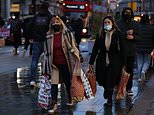
Shoppers on Oxford Street on Christmas Eve. Further Covid restrictions could be imposed just in time for New Year’s Eve as Boris Johnson is set to review the latest figures on Monday
People shopping on Oxford Street earlier this Friday. A national two-week ‘circuit breaker’ lockdown has been mooted after Christmas if London’s daily admissions breach 400 this week
MPs and experts have now demanded the Government distinguishes between people who are being hospitalised ‘with’ or ‘for’ Covid before deciding on social restrictions.
Former Conservative leader Iain Duncan Smith told MailOnline the distinction was ‘really important’ for working out how much pressure the NHS faces.
He said: ‘The government has dragged its feet over showing those figures, I suspect because they know what will happen — it will reduce the numbers that they have going into hospital with Covid — in other words who are ill and have to go to hospital because of Covid.’
MailOnline’s analysis of London Covid admissions show that a third (127) of the 386 new patients only tested positive after arriving at hospital for a different illness.
The proportion of so-called ‘incidental admissions’ was around 12 per cent in the last two weeks of the Delta variant at the end of November, for comparison.
Tory MP Craig Mackinlay also called for urgent clarity, telling MailOnline: ‘This is the question we have been asking right the way back from day one in March (last year) – what are these numbers?
‘Are these people going in with coronavirus and that’s the reason for their admission, or have they gone in with a broken leg, had a test and ”Oh God, you’ve got a positive test”.
‘Those are very different numbers aren’t they. Entirely different numbers.’
Official figures today also showed that a record 1.7million people had Covid last week and the ten worst-hit by Covid areas in England are all within a three square mile radius in south London.
UK cases rose to another new high of 122,000 and London is being battered hardest by the Omicron variant after quickly becoming a hotbed for the strain earlier this month, with one in 20 infected in the capital according to Office for National Statistics (ONS) data.
The ten postcodes — all in Wandsworth and Lambeth — have an average infection rate of 3,819 cases per 100,000 people, more than quadruple the 838 per 100,000 in the rest of the country.
In a drive to get the country boosted, millions will also be receiving texts encouraging them to get a third jab on Boxing Day, as more than 32 million booster and third doses have already been administered.
Health Secretary Sajid Javid said: ‘We are texting this Boxing Day for all eligible adults to get boosted now.
‘It has never been as important to get protected with the booster, so whether it is in between turkey sandwiches or before the Boxing Day fixtures, whatever your traditions make the booster a part of them this year.
‘Millions of vaccine slots are available through the festive calendar so if you’re not boosted and you get this text, take up the offer and get vaccinated.’
Omicron’s surge has also cancelled Christmas getaways for thousands of Britons following coronavirus restrictions imposed by destinations.
Winter sports operator Crystal Ski has axed its trips to Austria departing on December 27 after the country introduced tougher entry requirements due to the new variant.
Austria announced on Wednesday that arrivals from the UK will be required to quarantine for 10 days from Saturday unless they are fully vaccinated including a booster dose, and have evidence of a recent negative PCR test.
The Netherlands has been put into lockdown until at least mid-January, while Germany has joined France in prohibiting UK tourists.
Meanwhile, Ryanair has reduced its planned January capacity by a third.
Omicron’s spread also saw Christmas Eve shopping plunge by 21% compared to 2019 as Britons preferred to shop online.
Footfall levels in central London dropped by nearly a third (30.3%) compared with last Friday and city centres outside the capital saw a 10% fall in visits, data from Springboard showed.
The day proved to be 21% worse for retailers across the country than in 2019, but it was more than 30% better than a year ago when there were more pandemic restrictions in place.
But retail parks across the UK fared better than the high streets as they pushed footfall across the country up by nearly 14%.
Springboard data also showed that footfall rose by 19.6% at shopping centres, while coastal towns saw a 26.3% rise and market towns a 14.3% increase.
London became the epicentre of the UK’s Omicron outbreak two weeks before the super mutant variant became dominant across the country and experts are treating trends in the city as a sign of what could come for England. Pictured, shoppers walking along Regent Street on December 24
People walking around in the capital earlier this Friday. MailOnline’s analysis of London Covid admissions show that a third (127) of the 386 new patients only tested positive after arriving at hospital for a different illness